
A food can sound wholesome on its label and still need a closer look at its nutritional adequacy and fit for our dog. A nutritional adequacy statement is the label declaration that identifies a food’s intended species and life stage and states how its complete-and-balanced nutrition is substantiated. We need a practical way to judge health needs, not just attractive package claims.
The finished diet matters more than any single ingredient viewed alone. A named meat, grain or vegetable does not tell us whether the whole formula supplies what our dog needs. Age, activity, body condition and health can all shape a good fit.
We can check the label, understand ingredient terms, and consider how processing and life stage affect a choice. A veterinarian can help us weigh health concerns that a package cannot address. We can make a more informed choice by checking the finished food and our dog’s individual needs together.
Key Takeaways
- Start with the nutritional adequacy statement and intended life stage.
- Use the guaranteed analysis and calorie content to compare products.
- Ingredient names explain categories, not the quality of the whole diet.
- Processing method alone does not predict nutrition or safety.
- Match food to the dog’s health, body condition and household routine.
What Does Dog Food Ingredient Quality Mean?
A nutritionally sound dog food supplies required nutrients in the right amounts and ratios, not just ingredients that sound appealing. Whole-diet nutrition matters more than a single name on the package, because each dog needs a suitable mix of nutrients.
Complete means the food contains all required nutrients; balanced means those nutrients appear in the correct ratios. These terms describe the finished food, not how appetizing its ingredient list looks.
Judge a food by its nutrient profile and fit for the dog, not by one ingredient’s reputation.
Nutritional completeness comes first
Dogs need protein, fat, water, vitamins and minerals. Protein supplies amino acids for tissue growth and repair, while fat provides energy and helps the body use some vitamins.
Water supports normal body functions and must remain available alongside meals. Vitamins and minerals help many processes, including bone health and nerve function. A complete food brings these nutrients together in amounts suited to its intended use.
Carbohydrates can supply energy and fiber, but healthy adult dogs do not require carbohydrates as essential dietary nutrients. That does not make carbohydrate sources harmful. Their value depends on the whole formula and the dog eating it.
Ingredients have different jobs
Ingredients provide nutrients, help create texture, or support flavor and shelf stability. Chicken may contribute protein and other nutrients, while grains or vegetables can supply energy and fiber. The same ingredient can serve more than one role.
Dog Food Ingredient Quality cannot be judged from a food name or a few familiar ingredients. Ingredient lists do not show how well a dog digests a formula, how much of each nutrient reaches the body, or whether the final nutrient balance suits that dog.
Ingredient wording may sound impressive without proving that the finished pet food meets a dog’s needs. A less familiar ingredient may still have a clear role in a balanced recipe. The list helps us see what goes into the food, but it cannot rank the full diet by itself.
Quality also depends on whether the food’s nutrient profile fits the dog’s age, activity and health. A formula that works for one dog may not suit another with a different life stage or medical concern. Treat the ingredient list as one part of the decision, not as a stand-alone score for the whole diet.
How Do We Read a Dog Food Label?
Before comparing ingredient names, find the nutritional adequacy statement and confirm that the product is meant for your dog’s life stage. Start there, then use calories and feeding directions to judge how the food may fit daily needs.
A complete-and-balanced claim can rely on nutrient profiles or feeding tests for a stated life stage. The label gives useful facts, but no single panel tells the whole story.
Start with adequacy, calories and feeding directions
The nutritional adequacy statement names the intended species and life stage, then explains how the maker substantiates complete-and-balanced nutrition. AAFCO recognizes gestation and lactation, growth, maintenance and all life stages. Foods marked for all life stages are formulated for growth and reproduction.
Manufacturers may meet AAFCO Dog Food Nutrient Profiles or use AAFCO-procedure feeding tests for a life stage. AAFCO’s two substantiation routes describe different ways to support a claim. AAFCO Model Pet Food Regulations are not official regulations themselves, though most U.S. states have adopted a version into law or regulation.
Most complete-and-balanced foods need feeding directions, and U.S. labels must show calories. Calorie statements use kilocalories per kilogram and a familiar unit, such as a cup or can. Feeding directions offer a starting amount, not a fixed rule for every dog.
Actual portions depend on activity, body condition, health and weight goals. A dog that gains weight may need less food, while a very active dog may need more. Snacks, treats and supplements do not need a nutritional adequacy statement.
- Check the life-stage adequacy statement.
- Review the guaranteed analysis.
- Compare calories per kilogram and per familiar serving.
- Read feeding directions as a starting point.
Interpret the analysis and ingredient list
The guaranteed analysis commonly lists minimum crude protein and fat, plus maximum crude fiber and moisture. These numbers help compare products, but they do not show every nutrient or the amounts a dog absorbs.
Ingredients appear in descending order of predominance by weight. The first item is the heaviest ingredient before processing, not always the main nutrient source in the finished food. Water-heavy ingredients can rank high because their moisture adds weight.
A search for a dog food ingredients list or a free dog food ingredient checker can start with the package itself. A tool cannot confirm whether the product fits a dog’s life stage or health; we still need the adequacy statement, calories and feeding guidance.
Check the exact product, since a brand can sell recipes for different ages and purposes. Keep the product’s lot number and best-by date available so a package can be identified if a safety notice appears.
What Do Dog Food Ingredient Names Mean?
An ingredient name describes a defined material, but the name alone does not tell us how nutritious the finished food is. Definitions matter because similar-sounding words can identify different animal parts or processing steps.
“By-product” names a defined ingredient category, not a synonym for waste. The term tells us what type of material a recipe uses, while the full formula tells us how that material fits the diet.
Meat, poultry and by-products
AAFCO defines meat as primarily mammalian muscle tissue and excludes bone. Generic “meat” can refer only to cattle, pigs, sheep or goats. Other mammals must be named by species, and poultry or fish cannot be labeled “meat.”
| Ingredient term | What it means | Notable exclusions | What the name identifies |
|---|---|---|---|
| Meat | Primarily mammalian muscle tissue | Bone; poultry and fish | Species, or limited generic group |
| Meat by-products | Clean, non-rendered mammal parts other than meat | Hair, horns, teeth and hooves | Mammal parts, which may include organs and bone |
| Poultry | Clean bird flesh and skin, with or without bone | Feathers, heads, feet and entrails | Bird tissue |
| Poultry by-products | Clean, non-rendered poultry parts | Feathers | Bird parts such as heads, feet and viscera |
Meat by-products can include organs and bone. Their defined category does not by itself show whether a food is well made or suitable for a dog.
Meals and rendered ingredients
Meat meal is rendered mammal tissue, while meat and bone meal includes bone. Rendering separates fat and water from animal tissue through cooking. A named meal identifies an animal source, while a generic “animal” term does not name one.
Animal by-product meal means rendered mammal tissue. Its definition is not meant to label a mixture of animal tissue products. These terms tell us about the material and, when named, its source; they do not rate nutrient quality.
AAFCO notes that the first four raw animal-derived ingredients it describes are cooked during manufacturing to destroy harmful bacteria. This fact does not make an ingredient name a safety guarantee for every product or handling step.
Labels use defined words, but ingredient quality depends on the food’s full recipe and how it meets nutritional needs. Read each term by its definition and the rest of the formula rather than treating “meal” or “by-product” as an automatic quality verdict.
Which Dog Food Ingredients Should We Avoid?
The clearest reasons to avoid a food are a known toxic ingredient, a confirmed trigger for that dog or a credible contamination alert. There is no universal blacklist that applies to every dog and every recipe.
Xylitol, grapes or raisins, and chocolate are toxic to dogs; garlic and onions are also concerns. A veterinarian can help us tell a diagnosed food intolerance from a general claim about an ingredient.
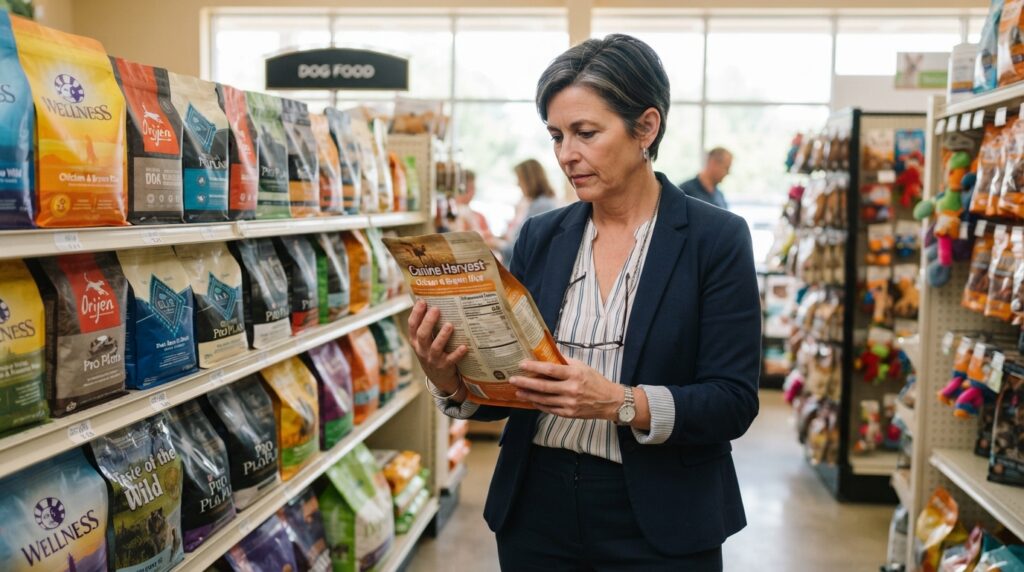
Recognize genuine hazards and individual triggers
Some ingredients are unsafe for dogs, while others cause trouble only for a particular dog. We should avoid a food containing a veterinarian-identified trigger, but not assume grains, by-products or approved additives are harmful to all pets.
Raw animal products carry a higher risk of harmful bacteria, including Salmonella and Listeria monocytogenes. Dogs may also spread germs around the home. Households with young children, older adults or people with weak immune systems need extra care around raw food.
Three checks help separate real concerns from broad claims:
- Look for known toxic ingredients, including xylitol, grapes, raisins or chocolate.
- Consider confirmed individual intolerance identified with veterinary help.
- Check current recall status for the exact product and package.
Separate ingredient concerns from recall risks
Recalls address a product safety issue, not an ingredient’s general value. On September 8, 2026, Fi recalled Fi Calming supplement for Dogs 180 g, lot 26118, and Fi 8-in-1 Formula supplement for Dogs 180 g, lot 26159, for possible Salmonella contamination from an ingredient.
On May 22, 2026, Raaw Energy expanded a dog food recall for possible Listeria monocytogenes contamination. It covered products made from July 17, 2025, through December 23, 2025, and a Beef and Turkey Medley batch dated March 31, 2026.
Some finished Raaw samples tested positive for Listeria and some tested negative. The recall’s mixed test results do not mean every food or batch was tested, so a negative result cannot clear all affected product.
A 2026 systematic review screened 4,888 studies and included 121. Its analyses of additives and preservatives covered 60 and 39 studies; pooled risk differences were 0.0006 and 0.0003. The review did not substantiate harm from approved additives and preservatives used within AAFCO guidelines.
For safer raw-food handling, follow a clear raw feeding safety guide and keep food away from surfaces used for human meals. Check the exact product name and lot against a recall notice before feeding a package that may be affected.
How Do Processing Methods Affect Dog Food Quality?
Processing can make a food safer and more consistent, but the method’s name or temperature is not a stand-alone nutrition score. Method and ingredients work together, so we should not use heat level alone to judge a finished diet.
Processing can limit microbial growth and help foods meet safety standards. Its effects on nutrients and digestibility depend on both the ingredients and the method.
Dry foods use several heat-processing routes
Extrusion mixes ingredients, forms pieces under heat and pressure, then dries them with heated air. It is common for kibble. Baking and pressing make dry products in other ways, and each route creates a different texture and moisture level.
| Method | Temperature and time | Typical finished moisture | Food format |
|---|---|---|---|
| Extrusion | 125-150 °C for 10-270 seconds; drying air 90-180 °C | Less than 12% | Kibble |
| Baking | 175-230 °C for 10-25 minutes | 10% or less | Baked dry pieces |
| Pressing | Steam up to 80 °C in a pellet mill | Around 10% | Pressed pellets |
| Retort | 116-129 °C for 20-100 minutes | Not stated as a typical figure | Wet food in a sealed pack |
Extruded kibble typically has less than 12% moisture. Baked pieces usually finish at 10% moisture or less, while pressed food finishes around 10%. These are typical figures, not a measure of nutrient quality.
Wet foods and processing trade-offs
Retort processing heats sealed wet food to help control microbes and support shelf stability. Typical setpoints range from 116-129 °C for 20-100 minutes. The package and process work together to keep the food safe until opening.
Research comparisons have examined processing effects on both ingredient digestibility and nutrient content. One set included 102 comparisons for digestibility and another 137 for nutrient content. Results varied widely, and outcomes depended on ingredients and processing method rather than intensity alone.
These findings do not mean every process affects every nutrient in the same way. Heating can change ingredients, while the recipe and controls affect the food’s final value and safety. A high temperature alone cannot show whether nutrients remain suitable for a dog.
Raw or minimally processed food is not automatically safer. Processing methods help reduce pathogen risks, but safe handling and sound manufacturing still matter across formats. Compare the complete diet and its safety controls rather than treating “processed” as a synonym for poor quality.
Is Fresh or Human-Grade Dog Food Better?
Fresh, kibble and canned foods can all be suitable choices when the specific product is complete and balanced for the dog. Fresh is a format, not a nutrition grade, and human-grade wording does not prove better health outcomes.
Choose by the individual product’s adequacy and fit, not its appearance or label style. The right format also needs to suit our storage and serving routine.
Compare formats by handling and nutritional adequacy
Fresh foods are often cooked and sold refrigerated or frozen. Traditional formats include dry kibble and canned or pouched food. Wet food has more moisture, while kibble is dry and can be stored at room temperature before opening.
Fresh foods may need cold storage, thawing or careful portioning. Cans and pouches are easy to serve, but unused portions need proper storage. We can choose a format based on the dog’s routine and what our household can handle safely.
“Fresh” has no AAFCO definition. That leaves the word open to broad use, so it cannot replace the nutritional adequacy statement. Fresh food is not automatically more nutritious than dry or canned food.
Wet dog food ingredient quality still depends on its formula and the dog eating it. Water-heavy ingredients may rank high by weight because ingredient order reflects weight before processing. A high-ranking item is not always the main nutrient source in the finished food.
What human-grade evidence can establish
Human-grade claims concern ingredient and facility standards. They do not, on their own, show that a food has better nutrient balance or improves health more than another complete food.
Six studies compared human-grade ingredients with feed-grade ingredients. Method limits and high risk of bias kept the findings from supporting firm conclusions about nutrition or health benefits.
A manufacturer may use ingredients fit for human food, yet the finished dog food still needs the right nutrient profile for its intended use. Good handling and clear storage directions matter, too. A label term cannot tell us whether a particular dog thrives on the recipe.
We should compare the actual food, rather than assuming a higher price or fresher look means better nutrition. Choose the format our household can store and serve safely, then judge its nutrition by the individual product’s adequacy statement.
How Should Life Stage and Health Shape the Choice?
The right food is one that matches the dog’s life stage and health, not simply the category that is currently popular. Age and health change the fit because nutrient needs and feeding goals can shift over time.
Growth, maintenance and reproduction call for food suited to that life stage. “Senior” is not a separate AAFCO nutrient profile, so the label’s intended use still matters.
Match the food to the dog’s life stage
Puppies need food for growth, while adult dogs usually need a maintenance formula. Reproduction includes gestation and lactation. Foods labeled for all life stages are formulated for growth and reproduction, which may not match every adult dog’s needs.
Short-term, intermittent or complementary foods should make up 10% or less of the diet, unless a therapeutic diet is fed under veterinary supervision. That limit helps keep extras from displacing too much of a dog’s complete food.
Life stage is only one part of the choice. Body size, activity, weight goals and health can affect portions and the best feeding plan. A label does not replace an individual assessment.
Consider health, body condition and diet concerns
Body condition score assesses body fat stores; muscle condition score assesses muscle mass. A dog can have a healthy-looking body shape yet lose muscle, especially with aging or disease. Both scores help us track changes that a scale alone may miss.
Diet-associated dilated cardiomyopathy, or DCM, has appeared associated with diets high in pulses, including peas, lentils, chickpeas and beans. Grain-free and grain-inclusive foods can both be high in pulses.
As of June 2026, the specific cause of heart injury had not been identified. The disease did not appear to result from the absence of grain or a taurine or other nutrient deficiency. More than 30 scientific studies on diet-associated DCM had been published.
This concern does not show that every pulse-rich diet causes disease, and it does not support choosing food by one ingredient alone. We should discuss a food change with a veterinarian if a dog has a health condition or a suspected reaction.
Keep a record of new signs, changes in food and timing when a reaction seems possible. That detail can help a veterinarian assess whether food may be involved. Ask our veterinarian before changing a therapeutic diet or responding to a suspected food-related health problem.
How Can We Compare Foods for an Individual Dog?
Compare the exact recipes side by side, because products from one brand can differ in formulation and intended life stage. The specific product matters more than a brand’s general image or a single ingredient’s place on the list.
A strong choice fits the dog, has a suitable adequacy statement and comes from a maker that can explain its checks. Veterinary input helps when health needs affect the choice.
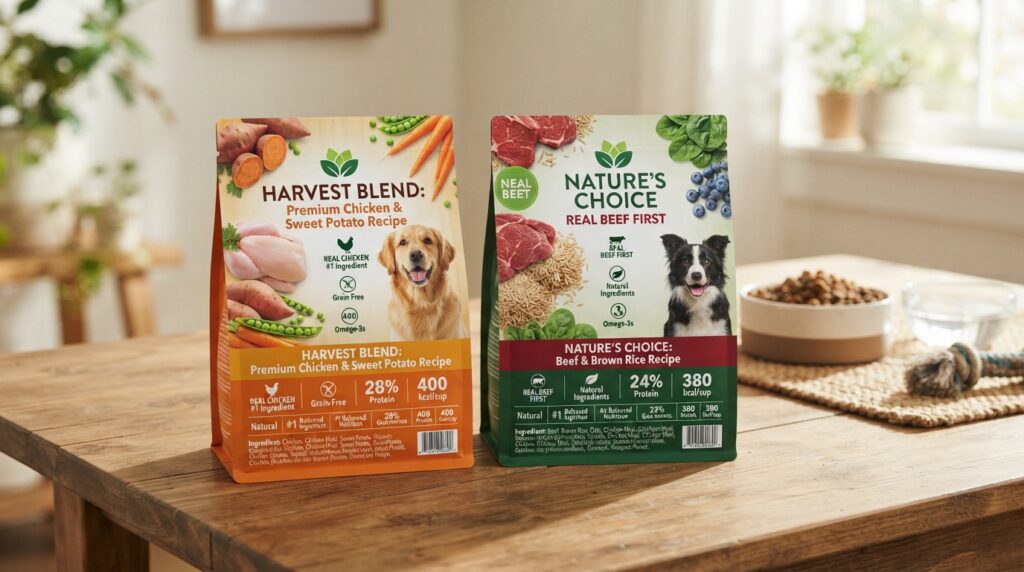
For a typical household, look for complete-and-balanced nutrition for the dog’s life stage, clear ingredient terms and sound safety steps. No brand name alone proves a recipe is best or worst. A brand may sell foods with different uses and nutrient profiles.
A careful dog food ingredients checker can be a manual review of the package and the manufacturer’s answers. It need not be a special app or a free online tool. We can use the same questions for each product and compare the answers.
- Check life-stage adequacy for this dog.
- Compare calories with feeding needs and weight goals.
- Review ingredient purpose and the dog’s known tolerance.
- Ask about nutrition expertise and safety controls.
The manufacturer’s nutrition staff should have suitable training. WSAVA names a PhD in animal nutrition or board certification by the American College of Veterinary Nutrition or the European College of Veterinary and Comparative Nutrition as appropriate qualifications to look for.
We can ask how the maker validates ingredients and analyzes nutrients in finished diets. We can also ask about toxicology, bacteriology, packaging and shelf-life screenings before, during and after manufacturing.
When a company cannot explain who formulates its food and how it checks finished diets, a brand name cannot fill that gap.
Pay attention to plain, specific answers about the recipe and its checks. A company should be able to describe who formulates the food and how it tests finished diets, not just repeat marketing claims.
Compare the exact product’s life-stage statement, calorie content and feeding directions with the dog’s needs. If a company cannot clearly explain who formulates its food and how it checks finished diets, ask our veterinarian to help assess another option.
Conclusion
A sound choice begins with a complete-and-balanced food that fits our dog’s life stage and health. Ingredient-list rankings and marketing language can draw our eye, but they cannot show whether the whole recipe meets that dog’s needs.
We can make the next choice more useful by bringing the current package and our questions to a veterinarian. Bring the package label to our next veterinary appointment and ask whether its life-stage statement, calories and feeding amount fit our dog.