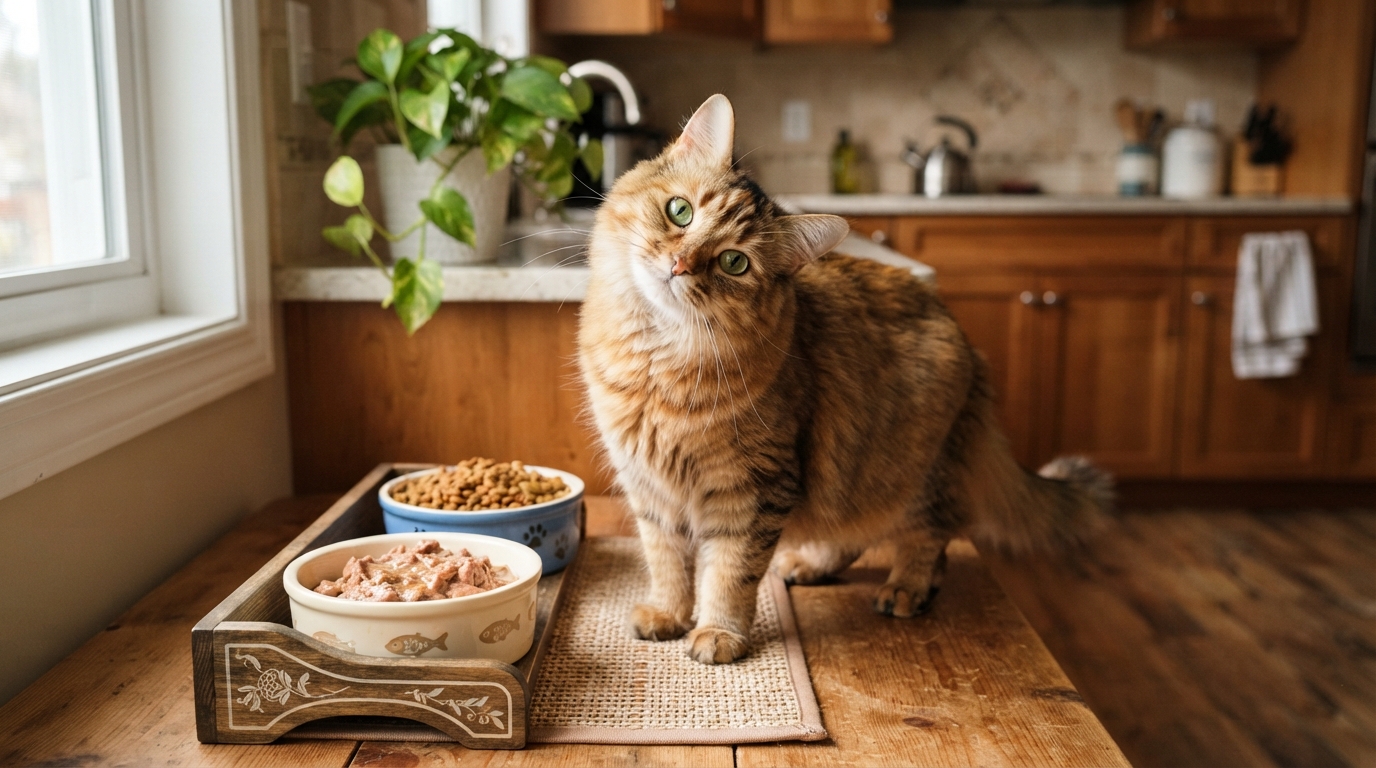
A healthy cat can thrive on complete-and-balanced wet food, dry food, or a measured combination, with the best fit shaped by health, appetite, and household routine. A kilocalorie (kcal) is the unit used to measure energy in food and a cat’s daily calorie needs. We can make a sound choice by weighing our cat’s preferences, our household routine, and any advice from a veterinarian. The right food also needs to support a healthy body condition over time.
Wet food can be a strong fit when added moisture matters, while dry food often suits households seeking convenience and lower cost. A mixed plan can work, too, when we measure each portion as part of the daily amount. Our cat’s needs come first, but a workable routine matters because it helps us feed consistently. We’ll focus on choosing a food that meets the cat’s needs and fits daily life. The useful choice is the one our cat will eat consistently while maintaining a healthy body condition.
Key Takeaways
- Either format can work when complete and balanced for the cat’s life stage.
- Wet food adds more water to meals; dry food is more energy-dense.
- Recipe quality matters more than whether food is wet or dry.
- Health needs may call for a veterinarian’s advice about food choice.
- Measure portions, including treats, to support a healthy body condition.
- A mixed plan can suit cats and households when portions fit the daily target.
Wet Food Versus Dry Food for Cats: How Do They Compare?
A serving of wet food brings substantially more water, while a similar weight of dry food packs more calories. The main difference is moisture content: wet cat food typically contains 70-80% water, while dry cat food usually contains 9-12%.
Wet food also has fewer calories per kilogram than kibble. Typical energy density is 750-1,200 kcal/kg for wet food and 3,500-4,500 kcal/kg for dry food. The exact amount still depends on the recipe.
| Format | Typical moisture content | Typical energy density |
|---|---|---|
| Wet food | 70-80% | 750-1,200 kcal/kg |
| Dry food | 9-12% | 3,500-4,500 kcal/kg |
| Common form | Cans or pouches | Kibble |
Moisture and energy density
A cat that eats wet food takes in more water through meals. Dry food supplies more energy in a smaller weight of food, so a measured serving matters. A cat’s needs can make either feature useful.
Nutrients depend on the recipe
Neither format is automatically more nutritious. Protein and carbohydrates vary by recipe, and a food’s moisture can change the numbers shown on its label.
As-fed percentages describe nutrients in the food as packaged. Water dilutes those percentages, so they can mislead when we compare foods with different moisture levels. A complete food label and feeding plan help put those numbers in context.
Compare complete nutrient profiles and calories per serving, not the front-label percentages alone.
Our veterinarian can help compare recipes when nutrition needs are not straightforward. That matters more than choosing a format based on one nutrient number. Typical calorie ranges can help us read a label, but the package’s serving information still matters. Compare complete nutrient profiles and calories per serving, not the front-label percentages alone.
Which Food Fits Your Cat’s Health Needs?
A cat that needs more water for a health condition may do better with a wet-food plan, while a cat that prefers crunchy meals may do well on measured dry food. Health comes first, so we should match food to the cat, not just the bowl. Kidney disease, diabetes, and lower urinary tract disease can require diet changes guided by a veterinarian.
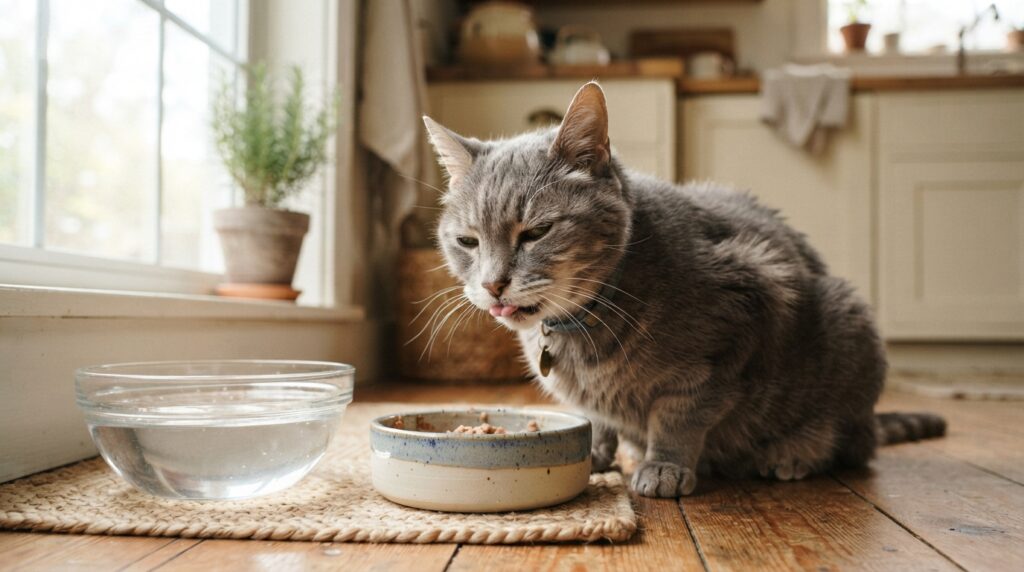
- Cats needing more water because of a health condition may benefit from wet food.
- Cats managing weight may need carefully measured portions that fit a feeding plan.
- Cats with dental discomfort, and some senior cats, may find soft food easier to eat.
- Cats who prefer kibble may enjoy puzzle feeding that makes meals more engaging.
We can feed wet food every day if it is complete and balanced for the cat’s life stage, and the portion fits the feeding plan. Wet food is not inherently bad for cats’ teeth. Ordinary kibble does not replace dental care, while dental-specific dry diets are a distinct option designed to help reduce plaque and tartar.
A dry cat food label does not tell us whether a diet suits a medical condition. A food made for one diagnosis may not fit another cat’s needs. Ask a veterinarian to review any disease-specific diet before changing the bowl. Food labels and nutrition needs can help us prepare for that discussion. Have a veterinarian match any disease-specific diet to the diagnosis instead of choosing by format alone.
Does Wet Food Help Cats With Constipation?
Wet food can add water to a cat’s diet, but it should not be treated as a quick cure for constipation. Extra dietary water can increase water in the stool, yet constipation may have causes that food alone cannot fix. Keep fresh water freely available, whether a cat eats wet or dry food.
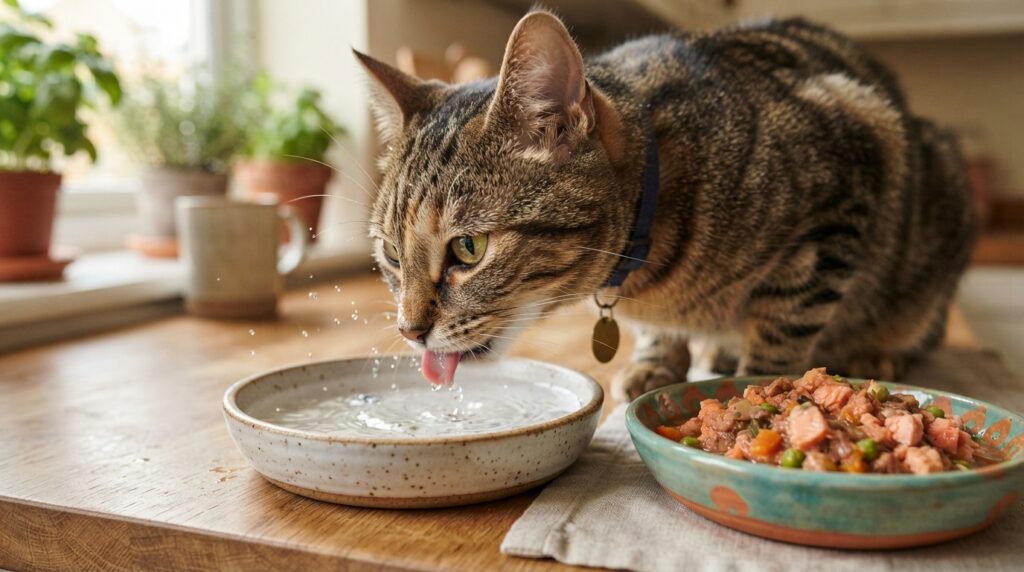
Water can support hydration, not replace treatment
For cats that refuse canned food, adding water to kibble can raise dietary water and fecal water content. One study found no difference in diet form between cats seen for constipation and cats seen for other diseases. It did not control for other diet or hydration factors, so it cannot show that dry food causes constipation.
About 60-70% of cats with constipation receive a diagnosis of idiopathic constipation after vets rule out predisposing causes. Recurrent cases may need lifelong therapy. Some cats that do not respond to treatment need periodic hospital care or surgery. Fresh water and added water in food can support hydration, but a veterinarian should guide ongoing care.
Signs that need veterinary attention
Hard, dry feces, fewer bowel movements, or no bowel movement can signal constipation. A cat may strain, seem tired, lose interest in food, or vomit. Call a veterinarian if constipation has not cleared within 48 hours; seek care sooner if the cat is clearly uncomfortable.
Straining does not always mean a cat is trying to pass stool. Difficulty producing urine is an emergency, so we should not wait to see if it improves. Kittens younger than 3 or 4 weeks need help to urinate and defecate. Older kittens should pass stool at least once every 24 hours.
A kitten without a bowel movement for more than 24 hours should see a veterinarian. Severe constipation may need fluids, an enema, or manual feces removal. Those treatments may require sedation or anesthesia, so they belong in veterinary care, not at home. A vet can also check for the cause when signs return. Difficulty producing urine is an emergency, even when the straining looks like a bowel movement problem.
How Should You Mix Wet and Dry Cat Food?
A mixed plan works best when we replace part of the usual ration rather than adding wet food on top of a full dry-food portion. Count both foods toward one daily calorie target. Split that target between the two foods, then use each package’s calorie information to work out its portion.
Set a daily split and calculate portions
A wet-to-dry proportion can range from all wet to all dry. A 50% wet and 50% dry mix is one possible starting point, not a rule for every cat. We can adjust the split for health, preferences, household routine, and budget.
For a simple calculator, first assign part of the cat’s daily calorie target to wet food and the rest to dry food. Then divide each calorie amount by that food’s calories per serving or per can. The package gives the values needed to calculate portions. If the cat has a medical condition, ask the veterinarian to set or confirm the target.
Same bowl or separate meals?
Wet and dry food can go in the same bowl or in separate meals. Either way, both portions count toward the day’s total. Feeding wet food at breakfast and kibble at dinner can make a wet dry routine easier to manage.
When we mix foods in one bowl, the cat may eat the kibble and leave the wet portion, or the reverse. That can make it harder to know how much the cat actually ate. Wet food also needs food-safety care when left out, so we should avoid leaving a mixed serving sitting for hours. Separate meals can make intake easier to track while still giving the cat both options. Recheck the split if the cat’s weight or body condition changes.
What Are the Cost and Convenience Trade-Offs?
Dry food is usually easier to store and less expensive, while wet food asks for more attention once a can or pouch is opened. Daily routine matters: the best setup is one we can manage and measure. Wet food left out for more than a few hours risks contamination.
| Format | Serving and storage | Routine trade-off |
|---|---|---|
| Wet food | Refrigerate opened food and use within 24 hours | More preparation and typically higher cost |
| Dry food | Store sealed and discard uneaten food at day’s end | Easier to store and typically less expensive |
| Mixed schedule | Refrigerate leftover wet food and measure dry food | Combines meal-time feeding with feeder convenience |
Wet food can be served at one meal and dry food at another on the same day. That schedule can fit households that want meal-time feeding and the option to leave measured kibble for later. A sealed container helps keep dry food protected between servings.
Opened wet food should go in the refrigerator and be used within 24 hours. At the other end of the routine, discard uneaten dry food at the end of the day. These small steps help keep feeding tidy without adding a set price to the comparison. Choose a schedule that makes it easy for us to measure what the cat actually eats.
How Much Should You Feed, and How Do You Choose?
Start with a complete-and-balanced food for the cat’s life stage, then set portions using a calorie estimate that fits the cat’s age and condition. For a healthy adult at ideal weight, one estimate uses resting energy requirement: body weight in kilograms raised to 0.75 and multiplied by 70. That estimate applies only when the cat fits its stated limits.
- Select food labeled complete and balanced for the cat’s life stage.
- Estimate a healthy adult’s daily calories only when the calculator’s limits fit.
- Measure each portion and count treats as part of daily intake.
- Monitor weight and body condition, then adjust with veterinary guidance.
The estimate uses an activity factor of 1 for inactive cats, 1.2 for average activity, or 1.4 for high activity. It is not intended for growing, pregnant, or lactating cats, or cats needing significant weight loss or gain. Calculator results are estimates, so regular checks of weight and body condition help us adjust the plan.
AAFCO is making a major update to its model pet food and specialty pet food label rules, the first major update in more than 40 years. On October 13, 2026, AAFCO announced a final position on enforcement discretion tied to updates in feline calcium and phosphorus profiles. AAFCO’s October 2026 position relates to label enforcement, not a reason to skip checking a product’s current recall status.
A terminated recall means reasonable efforts have removed or corrected the violative product, and the product was properly disposed of according to the hazard.
Before relying on a product, check FDA recall information for its current status. Keep the package label nearby, since it names the food and helps us track the exact product. Bring the food label and a recent weight or body-condition record to the veterinarian when the feeding plan needs adjustment.
Conclusion
We do not have to choose a single format for every cat or every household. Wet food can be a useful daily source of moisture, while measured dry food can offer a convenient complete diet. Both can fit when the food suits the cat’s life stage and the portions support a healthy body condition.
A mixed plan is also an option when both portions fit the daily target. We can start with the food our cat accepts and keep track of how much goes into the bowl. Before changing the bowl, ask our veterinarian to confirm that the chosen food and portion suit our cat’s health and life stage.