
A healthy daily diet gives dogs and cats the nutrients and energy their bodies need, in amounts suited to the individual animal. Each needs six nutrient classes, but the right amounts depend on species, life stage, and health. Metabolizable energy (ME) is the portion of food energy available to the body after digestion and metabolism.
Choosing a balanced food can feel difficult when packages make broad claims and pets have different needs. We can use the package’s nutritional adequacy statement, feeding directions, and our pet’s changing body condition to guide daily choices. We can also learn how water, homemade diets, and veterinary advice fit into a safe feeding plan.
Good feeding decisions start with the pet, not the food’s front label. We can make better feeding decisions by checking the food’s nutritional adequacy statement and monitoring the animal’s weight and condition.
Key Takeaways
- Choose food made for the pet’s species and life stage.
- Check the nutritional adequacy statement, not just front-label claims.
- Measure portions, then watch weight and body condition over time.
- Keep fresh, clean water available every day.
- Ask a veterinarian before making major diet changes.
What Do Pet Nutrition Requirements Include?
A sound pet diet supplies six nutrient classes, but they do not all serve the same role. Water, protein, fat, carbohydrates, vitamins, and minerals must appear in suitable amounts and proportions. Protein, fat, and carbohydrates provide energy; vitamins, minerals, and water do not.
A complete diet needs all six nutrient classes in appropriate amounts and proportions. Fresh, clean water remains essential, even when food is carefully balanced.
A food’s ingredient list may name many items, but the list alone cannot show whether the diet meets an animal’s needs. The amount of each nutrient and its relationship to other nutrients matter.
Water, the nutrient animals cannot do without
Water helps regulate body temperature, move nutrients, and support digestion and other body functions. Animals lose water through urine, stool, breathing, and evaporation, so they need to replace it each day.
Food can contribute water, especially when it is wet, but drinking water still matters. A pet’s needs can shift with heat, activity, diet, and health.
Protein, fat, carbohydrates, vitamins, and minerals
Protein supplies amino acids, which animals use to build and maintain tissues. Some amino acids must come from food because the body cannot make enough of them.
Fat provides concentrated energy and essential fatty acids. Those fats support cell membranes and other body functions. Carbohydrates can supply energy, while fiber, a type of carbohydrate, can support normal bowel function.
Vitamins and minerals help regulate body processes, form tissues, and support normal function. A sound diet includes the right forms and levels, not simply a long list of ingredients. More is not always better, since excess amounts can also cause harm.
Fresh, clean water remains essential even when the rest of the diet is carefully balanced.
How Do Dogs’ and Cats’ Nutrient Needs Differ?
Cats and dogs share the same six nutrient classes, but a dog food is not a substitute for food formulated for a cat. Cats need dietary taurine and several other nutrients in amounts that differ from dogs’ needs. Species-specific food matters for daily feeding.
Dogs need 10 essential amino acids in their diet. Cats also require dietary taurine, vitamin A, and arachidonic acid. Cats have higher requirements than dogs for arginine, niacin, and vitamin B6.
For cat owners asking about pet nutrition requirements for cats, taurine is one key difference, alongside other distinct nutrient needs. Dog nutritional requirements also change by life stage, so dog protein minimums are not one fixed percentage.
AAFCO lists protein minimums on a dry-matter basis, or DM. This removes water from the comparison, so foods with different moisture levels can be compared more fairly.
| Species and life stage | Crude protein minimum (% DM) | Important species-specific note |
|---|---|---|
| Dog growth and reproduction | 22.5% | Minimum differs from adult maintenance |
| Dog adult maintenance | 18% | Lower minimum than growth and reproduction |
| Cat growth and reproduction | 30% | Cat diets need dietary taurine |
| Cat adult maintenance | 26% | Cat nutrient needs differ from dogs’ |
These figures describe minimum crude protein levels, not the full quality of a food. A cat eating dog-formulated food as its regular diet may miss nutrients its body needs.
Compare protein figures on a dry-matter basis, since moisture changes the percentage shown in food as served.
Which Life Stage Should a Pet’s Food Support?
The right food should match the pet’s current stage, such as growth, adult maintenance, or reproduction. For 2026 label guidance, AAFCO recognizes gestation/lactation, growth, maintenance, and all life stages. Current needs guide the choice.
Dogs and cats need nutrient concentrations suited to their life stage. A growing puppy or kitten has different needs from an adult, while pregnancy and nursing also change nutrient demands.
AAFCO publishes dog and cat nutrient profiles for Adult Maintenance and Growth and Reproduction. The National Research Council’s 2006 nutrient stages include growth after weaning, adult maintenance, late gestation, and peak lactation.
The MSD Veterinary Manual’s feeding guidance notes that puppies need a complete growth diet until skeletal maturity. Large- and giant-breed puppies need food formulated for their size.
| Label category | Animals it is intended to cover | Feeding direction to check |
|---|---|---|
| Gestation/lactation | Pregnant or nursing dogs and cats | Separate directions for reproduction |
| Growth | Growing puppies and kittens | Directions for the growing animal’s weight |
| Maintenance | Adult dogs and cats not reproducing | Directions for adult maintenance |
| All life stages | Growth, reproduction, and adult maintenance | Different amounts for each stage |
An all-life-stages claim does not mean one feeding amount works for every animal. The label should give different directions for gestation/lactation, growth, and maintenance.
A healthy senior is not a separate AAFCO life-stage category, though age-related changes can still affect an individual pet’s needs. For a pet still growing or nursing, check that the package’s adequacy statement covers that specific stage.
How Can We Tell Whether a Food Is Complete and Balanced?
The fastest package check is the nutritional adequacy statement, not a marketing phrase on the front. That statement identifies whether a food is complete and balanced for a species and life stage. It helps us match the food to the animal.
For 2026 label guidance, a complete food contains all required nutrients, while a balanced food provides them in the right ratios. The nutritional adequacy statement is the key package detail for checking that claim.
What “complete and balanced” means
A food labeled complete and balanced is intended to provide the nutrients needed for its stated species and life stage. Treats and foods labeled for supplemental feeding do not serve the same purpose.
Feeding directions answer how much to offer for a pet’s weight and life stage. The adequacy statement answers whether the food is intended as a complete diet. One does not replace the other.
How nutritional adequacy is substantiated
The Association of American Feed Control Officials (AAFCO) develops model regulations and nutrient profiles. AAFCO does not approve or certify individual foods. Most states have adopted a version of its Model Pet Food Regulations, but the models themselves are not official regulations.
A company can substantiate nutritional adequacy in several ways. The package statement may identify a method, giving us context for the claim.
| Method | What it establishes | Key label implication |
|---|---|---|
| Formulation to nutrient profiles | Formula meets the AAFCO nutrient profile | Statement identifies the profile basis |
| Feeding tests using AAFCO procedures | Animals ate the food in a feeding test | Statement identifies feeding-test substantiation |
| Comparison with a product substantiated by feeding tests | Food is compared with a tested product | Statement identifies the comparison method |
AAFCO’s assumed caloric density for dog profiles is 4,000 kcal ME/kg DM. This standard helps support profile formulation, while a particular food can have a different energy density.
Choose a statement that names the right species and life stage and supports use as a complete diet.
What Else Should We Check on a Pet Food Label?
A label gives useful information only when we know what each required part can and cannot tell us. Check the guaranteed analysis, ingredient statement, nutritional adequacy statement, and guarantor information. These details answer different questions about a pet food.
For 2026 label guidance, required information includes those four items. The label must also identify the species; a dog or cat picture alone does not count as species identification.
| Label item | What it tells us | What to verify |
|---|---|---|
| Guaranteed analysis | Listed nutrient levels | Values and units are clear |
| Ingredient statement | Ingredients in the food | Order and named ingredients |
| Species identification | Animal the food is made for | Dog or cat is named, not shown only in a picture |
| Manufacturer or distributor information | Company serving as guarantor | Name and address appear |
Ingredients must appear in descending order of predominance by weight before processing. The first item is not proof of overall nutritional quality, since ingredients differ in water and nutrient content.
Common AAFCO model naming conventions generally require an unqualified named ingredient in a food name to make up at least 95% of the product by weight, excluding water. Other naming descriptors follow different rules.
Feeding directions for a complete and balanced food must give at least the amount for the animal’s weight and life stage per unit of time. Use the whole label, since no single line gives the full picture.
Treat the ingredient list as one label detail, not a stand-alone measure of nutritional adequacy.
How Do We Estimate a Pet’s Calorie Needs?
We can estimate resting energy needs from body weight, but the result is a starting point rather than a serving instruction. Resting energy requirement (RER) estimates the calories an animal needs at rest. It does not automatically show a pet’s daily maintenance need.
The Merck Veterinary Manual gives a formula for dogs and cats: RER = 70 × body weight in kilograms raised to the 0.75 power. For animals weighing more than 2 kg and less than 45 kg, a linear option is RER = 30 × body weight in kilograms + 70.
The resting energy formula
For example, the formula uses kilograms, not pounds. We first convert the pet’s body weight to kilograms, then apply one suitable equation.
Food packages list energy in calories, often as kcal per cup, can, or kilogram. Metabolizable energy (ME) is the energy in food available to the body after digestion and metabolism. That value helps connect calorie needs with a food’s energy content.
Why the estimate is only a starting point
RER describes rest, not every activity a pet does through the day. A pet’s full energy need can differ with age, activity, body condition, and other factors.
Two animals with the same body weight may need different daily amounts. A growing, pregnant, nursing, ill, or unusually active animal needs an individualized interpretation.
We should not treat a formula result as an exact feeding plan. The estimate does not account for every health issue or lifestyle.
A veterinarian can help interpret the estimate for a growing, pregnant, nursing, ill, or unusually active animal. That context matters when turning a number into a daily amount.
Use the formula as a discussion tool with a veterinarian, not as a replacement for the food label or an individual feeding plan.
How Should We Adjust Portions to Maintain Body Condition?
Two pets at the same weight can need noticeably different daily calories. An animal may need as much as 30% more or less calories than another animal of equal weight. We should measure food and adjust portions to the pet’s body condition.
Package directions provide a starting point, not a rule for every dog or cat. Activity and condition can change how much food an animal needs.
Use a measuring cup or kitchen scale to portion the daily amount. Measuring makes small changes easier to track than filling a bowl by eye.
Weight gain or loss can signal that intake needs adjustment. Check the pet over time rather than reacting to one day’s change.
- Can we feel the ribs without pressing hard?
- Can we see a waist from above?
- Is there an abdominal tuck when viewed from the side?
- Is the pet’s weight trending up or down?
- Does muscle condition appear to be changing?
Reassess after a change in activity, appetite, or health. Body condition can shift even when the amount in the bowl stays the same.
If weight trends away from the veterinarian’s target, change the portion with veterinary guidance rather than relying on the package amount alone.
How Much Water Do Dogs and Cats Need?
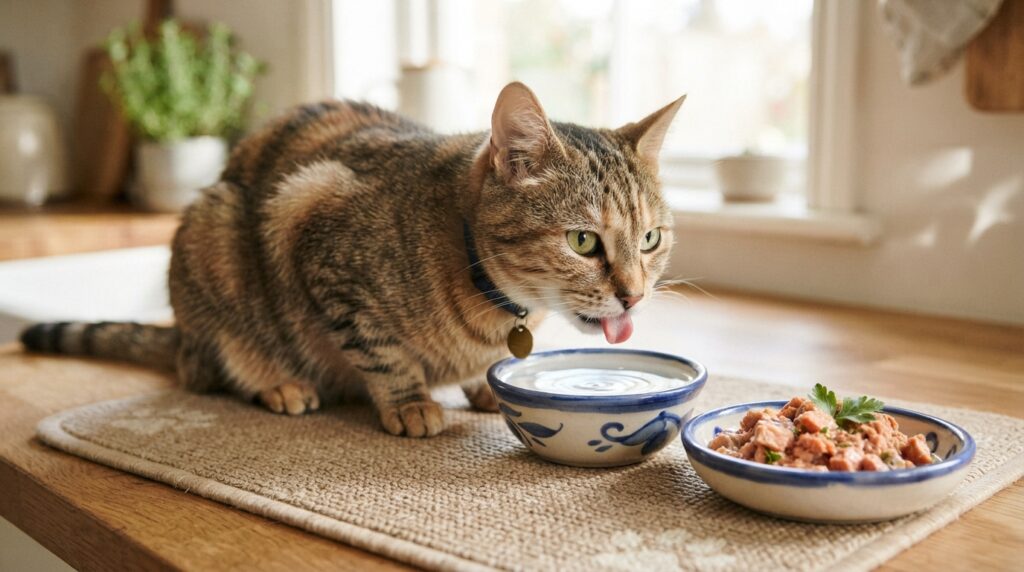
A typical starting point is about 50 mL of water per kilogram daily for a cat, with food moisture contributing to total fluid. Most mammals in a thermoneutral environment need about 44-66 mL/kg daily. Drinking water is only part of total fluid.
A typical 4-5 kg cat needs about 200-250 mL of water daily. That figure includes fluid from food, not just water drunk from a bowl.
Daily water needs
Water intake changes with diet, environment, activity, and health. Warm conditions or increased activity can raise needs, while wet food can supply a large share of fluid.
Keep fresh water available and consider offering more than one water source. Some cats drink more when bowls sit away from food or in several quiet spots.
How food moisture changes drinking needs
Canned food contains about 60% to more than 87% moisture. Dry food contains about 3%-11%, while semimoist food contains about 25%-35%.
Food with 70% moisture can provide about 70% of a cat’s fluid requirement when the cat eats 200-250 g daily. Wet food with 80% water can fully cover fluid needs when fed at an average amount of 250-300 g.
Commercial dry diets contain a maximum of 10% moisture, so cats eating them need additional water. Typical feline water guidance is about 50 mL/kg daily, though food moisture counts toward total fluid.
A sudden change in drinking can point to a health concern. Contact a veterinarian if a pet begins drinking far more or less than usual.
Cats eating dry food still need accessible fresh water because dry diets provide little moisture.
How Often Should We Feed Dogs and Cats?
Most adult dogs do well with one or two measured meals daily, while puppies usually need smaller meals more often. Puppies often need three or four meals a day. Measured meals make daily intake easier to track.
The right schedule depends on age, size, health, and the veterinary plan. Young animals may need smaller, more frequent meals to meet energy needs without eating one large serving.
Adult dogs commonly eat once or twice daily. For puppies, meal timing can change as they grow, so we should follow veterinary advice for the individual animal.
Measured meals help us notice appetite changes and manage total food intake. A pet that suddenly leaves food or eats much more may need attention.
Free-feeding, or leaving food out all day, does not suit every pet. It can make portions hard to track and may not work well in homes with several animals.
For cats, a predictable routine can help us notice changes in appetite. The daily amount still matters, even when a pet prefers several small meals.
Keep meal timing and portions consistent enough to spot a change in appetite.
Can We Make a Healthy Homemade Diet for a Dog?
A healthy homemade diet for a dog is possible, but a plausible ingredient list does not make a recipe balanced. Homemade food can meet a dog’s needs when a qualified veterinary nutritionist formulates it for that individual. Meat and vegetables alone are not a complete formulation.
Unbalanced homemade diets are a common cause of nutrition problems in dogs and cats. Limited-ingredient recipes may fail to supply nutrients a dog needs, even when the ingredients seem wholesome.
Why a recipe needs precise formulation
Recipe details matter. Ingredient substitutions, omitted supplements, and changes to cooking methods can alter nutrient levels.
Homemade food that meets a dog’s nutritional requirements needs a complete formulation, not just meat and vegetables. A tailored recipe accounts for the dog’s needs and the amounts of each ingredient.
When to involve a veterinary nutritionist
A board-certified veterinary nutritionist can formulate a diet for a dog’s needs. The recipe may include specific ingredients and supplements, with directions for cooking and serving.
We can protect the plan by following practical safeguards:
- Obtain a recipe tailored to the individual dog.
- Measure each ingredient accurately.
- Follow the preparation and cooking instructions.
- Avoid substitutions that the nutritionist has not approved.
- Arrange follow-up if the dog’s health or condition changes.
Even a small change can affect the nutrient balance. A recipe should not be treated as a flexible template unless its formulator says which changes are safe.
Do not start or substantially alter a homemade diet without a veterinarian or board-certified veterinary nutritionist involved.
Which Feeding Mistakes Can Cause Deficiencies or Excesses?
A short ingredient list can create a serious imbalance when it replaces a complete diet. Deficiencies and toxicities can result from missing nutrients or excessive amounts. Simple does not mean balanced.
Some common feeding choices carry specific risks:
- Meat-heavy or hamburger-and-rice-only diets can cause calcium deficiency and secondary nutritional hyperparathyroidism.
- Feeding only liver can cause vitamin A toxicity in dogs and cats.
- An unbalanced diet made from only a few ingredients may leave out required nutrients.
- Raw ingredients can contain factors that harm nutrient use.
Cooking can change nutrient availability. Raw egg avidin can destroy biotin, raw fish thiaminases can destroy thiamine, and raw soybean trypsin inhibitors can interfere with protein digestion.
These examples are not a home treatment guide. A pet with weakness, poor growth, or other signs of illness needs veterinary care, not a trial-and-error diet change.
A suspected imbalance may involve too little or too much of a nutrient. Supplements can add to the problem when they are given without knowing what the diet already supplies.
Do not try to correct a suspected deficiency or toxicity by adding a supplement without veterinary advice.
Does the Ingredient List Reveal Protein Quality?
The words “crude protein” describe how protein is measured, not how well an animal can use it. A crude protein number does not show digestibility or amino acid balance. Quality depends on more than the number on a label.
Protein quality depends on amino acid composition and digestibility. Foods may combine animal and plant sources to supply protein.

Dogs need 10 essential amino acids, and cats need dietary taurine. A food must supply useful amino acids in suitable proportions for the animal.
Protein digestibility below 80% is low. Levels from 80%-85% are average, 86%-93% are high, and above 93% are very high.
The label’s crude protein value comes from a testing method. It does not tell us how much protein an animal can digest or whether the amino acids meet its needs.
A named meat ingredient does not by itself prove a food is better. The full formula and the animal’s response matter more than one ingredient name.
Use the adequacy statement as the baseline and ask a veterinarian about protein concerns tied to a health condition.
When Should We Ask a Veterinary Nutritionist About a Diet?
A pet with a medical condition or a nonstandard diet may need an individualized nutrition plan rather than a general feeding rule. A board-certified veterinary nutritionist is a veterinarian with advanced specialty training and certification in veterinary nutrition. The credential matters.
Veterinary guidance is especially useful for diagnosed disease, unusual growth or reproductive needs, poor appetite, unexplained weight change, or a diet that is hard to balance.
Medical conditions and therapeutic diets
Therapeutic diets can help manage certain medical conditions. The veterinary team should select them because the right food depends on the pet’s diagnosis and overall care plan.
Ask for help in situations such as these:
- We want to start or change a homemade diet.
- We need to choose a therapeutic food for a diagnosed condition.
- A restricted diet must still meet the pet’s nutrient needs.
- We suspect a diet may be linked to illness.
A sudden health crisis needs prompt care, not a routine nutrition visit. Trouble breathing, collapse, prolonged seizures, or unproductive retching call for urgent emergency veterinary care.
What a board-certified veterinary nutritionist does
A veterinary nutritionist can assess a pet’s diet and help plan for complex needs. The specialist may work with the pet’s primary veterinarian to support a medical treatment plan.
The words “pet nutritionist” alone do not name a standardized veterinary specialty credential. Board certification means the person is a veterinarian with advanced specialty training and certification in veterinary nutrition.
For complex needs, ask the veterinarian whether referral to a board-certified veterinary nutritionist is appropriate.
What Place Should Treats and Supplements Have in a Pet’s Diet?
Treats and supplements usually add to a complete diet rather than replace it. A complete and balanced food already supplies required nutrients for its intended life stage. Extra nutrients are not always helpful.
For 2026 label guidance, treats and supplements are generally intended for use in addition to a complete diet. They generally do not carry a nutritional adequacy statement.
Adding a supplement can create excessive amounts or interfere with a prescribed plan. A pet eating therapeutic food may need its diet kept consistent.
Before using a product, check:
- Does the label say it is for supplemental use?
- Does it carry a nutritional adequacy statement?
- Did a veterinarian recommend it for a diagnosed need?
- Will it change the pet’s total daily intake?
Treats can also add calories and displace balanced food. Include them when considering how much the pet eats each day.
Before adding a supplement, check with the veterinarian, especially when the pet already eats a therapeutic diet.
Do Older Pets Need a Different Diet?
Older pets do not all need the same food, and age by itself does not determine the right formula. AAFCO and the National Research Council do not recognize a separate nutrient-requirement life stage for healthy older adult dogs and cats. Individual changes still count.
Aging can change metabolism, activity, body composition, and medical needs. Some older pets move less, while others maintain their activity and body condition.
“Senior” is not a separate AAFCO nutrient profile category. Choose food based on the individual pet’s condition and health.
Older-adult nutrition may be considered across young adult, mature adult, and geriatric or super-senior stages. These descriptions do not mean that every pet in an age group needs the same nutrient profile.
We should not assume every older animal needs fewer calories or a special formula. Body condition, activity, and health give better clues than age alone.
Ask the veterinarian to reassess diet when an older pet’s weight, appetite, activity, or health changes.
Conclusion
A healthy feeding plan starts with the right complete food and stays on track through observation. Choose a complete, balanced food for the right species and life stage, then adjust portions to the individual pet’s condition.
Start by checking the current package’s nutritional adequacy statement and comparing it with your pet’s needs. If the fit is unclear, a veterinarian can help interpret the label and the animal’s health needs.
Check the food label today and ask your veterinarian about any diet change your pet’s age or health may require.