
A dog owner trying to stop leash pulling needs a different kind of help from someone preparing for a dog-training career. We compare options for both household pets and people who want to train dogs for work. Our review weighs format, trainer access, methods, and cost, so owners can focus on what fits their needs.
Positive reinforcement means teaching a behavior by rewarding the dog when it performs that behavior. That simple idea can guide daily practice, from a puppy’s first cue to better leash manners. The right training program also depends on how much support an owner wants while learning.
Some dog training programs teach owners to work through lessons on their own. Others offer live coaching, in-person classes, or a path toward a professional certification. We look at what each format can do, and where its limits matter.
Choose a program by the skill you need to build and the support you want while practicing.
Key Takeaways
- Match the format to your goal and the feedback you want.
- Use a focused course for one clear household behavior.
- Check a program’s methods before you pay or enroll.
- Professional courses and credentials serve different purposes.
- Seek expert care for serious aggression or extreme anxiety.
How do you choose the right training format?
Start with the kind of help you need: a replayable lesson, a trainer to answer questions, or direct coaching while your dog practices. Online dog training can help owners practice new cues in a quiet setting and repeat lessons at their own pace.
Choose live or in-person help when you need feedback on what happens during practice. In-person instruction lets a trainer observe the dog and owner in real time. Online lessons let you replay details, though a self-directed course cannot watch your timing.
Pick a replayable lesson for flexible practice, or choose direct coaching when you need feedback as you work.
| Format | Trainer feedback | Where practice happens | Best fit |
|---|---|---|---|
| App | Limited to in-app features | At home or nearby | Daily cues and reminders |
| Self-directed course | Usually none | At home or outdoors | Owners who learn alone |
| Live virtual coaching | Direct video feedback | At home on camera | Questions and personal help |
| In-person class | Live observation | Class site or home | Hands-on practice |
Online dog training classes can also offer a working spot, where an owner sends video for instructor feedback. The American Kennel Club’s online class format overview describes options such as auditing, forums, and video review.
Use this short checklist before choosing a training program:
- How old is your dog, and does the course fit that age?
- What one behavior or skill do you want to work on?
- How much time can you set aside for regular practice?
- Do you need a trainer to answer questions or watch practice?
- What budget can you keep up with over time?
A puppy may benefit from short daily lessons, while an adult dog may need a more flexible plan. Your budget should include any extra coaching or class fees, not just the listed program price.
Before paying, decide whether you need a library of lessons or someone who can adjust the plan as you go.
Best Dog Training Programs for App-Based Training
For a broad, all-life-stage app with live expert chat, PawChamp is the strongest fit; for a puppy-only path, Zigzag is more focused. Apps suit owners who want step-by-step prompts and a phone-based training system.
PawChamp covers more life stages, while Zigzag centers its lessons on puppy development. In 2026, PawChamp offered personalized programs, progress tracking, age-based paths, behavior support, and live chat with dog experts.
| App | Best fit | Useful features | Listed subscription examples |
|---|---|---|---|
| PawChamp | Dogs at any life stage | Personal plans, tracking, expert chat | About $9.99 weekly or $99.99 yearly |
| Woofz | Puppies and newer owners | Daily tasks, reminders, house-training | About $12.99 weekly, $29.99 for 3 months, or $69.99 yearly |
| Zigzag | Puppy development | Research-backed 12-week program | Typically $11.99 monthly or $79.99 yearly |
| Pupford | Self-guided video learning | Trainer-led course and video library | Academy about $19 monthly or $147 yearly |
PawChamp’s listed plans start at about $9.99 per week or $99.99 per year. Its live chat with dog experts adds access to help inside the app.
Woofz gives owners daily tasks and reminders, with step-by-step obedience and house-training programs. Its listed prices start at about $12.99 per week, $29.99 for three months, or $69.99 per year.
Woofz is described as positive-leaning, but its trainer credentials are unclear. Independent reviews often cite billing concerns, so check renewal terms and cancellation steps before subscribing.
Zigzag follows a 12-week puppy development program and uses positive reinforcement. It has a free tier, but its puppy-specific structure may not suit adult dogs, rescue dogs, or behavior work outside that plan.
Pupford also has a free tier and uses positive reinforcement. Pupford Academy offers a self-directed video library, with limited personalization compared with a tailored app plan.
Free dog training courses online may provide a starting point, but an app’s free tier does not automatically include personalized support or a professional certification. The four apps also differ in method: PawChamp, Zigzag, and Pupford use positive reinforcement, while Woofz is positive-leaning.
Check renewal terms and the exact features in a free tier before entering payment details.
Which self-paced online dog courses suit each goal?
A single, well-defined problem usually calls for a focused course rather than a large bundle. A narrow lesson can keep owners from paying for topics they do not need.
Choose a course by its methods and the exact skills it covers. SpiritDog offers individual courses for leash walking, reactivity, and potty training, along with a much larger course bundle.
| Program | Course structure | Strongest fit | Price or price model |
|---|---|---|---|
| SpiritDog | Issue-specific courses and bundles | One defined behavior | $9-$199; $499 Ultimate Masterclass Bundle |
| DIYK9 | Separate foundation courses and system | Several training stages | $119-$397; Complete Training System $1,997 |
| Brain Training for Dogs | 21 games across 7 modules | Boredom-focused brain games | $67 |
| Dunbar Academy | Courses across several behavior topics | Owners comparing topic options | Course pricing varies |
SpiritDog lists individual courses from $9 to $199. Its $499 Ultimate Masterclass Bundle includes 20 full courses and 16 bonus mini-courses.
DIYK9 lists Puppy Essentials and Perfect Walk at $297 each, Obedience 101 at $397, and a Complete Training System at $1,997. The individual course range starts at $119.
Read the DIYK9 bundle list carefully: two courses use leash pressure and e-collar methods. Those two courses mean the bundle is not a force-free option from start to finish.
Brain Training for Dogs costs $67 and uses 21 brain games across seven modules. The lessons may suit owners focused on boredom-driven behavior rather than a specific obedience skill.
Dunbar Academy covers potty training, puppy training, impulse control, and reactivity. It does not offer live one-to-one sessions, so owners who need direct feedback should factor that limit into their choice.
Brandon McMillan’s MasterClass offers training-session videos as a general learning option. It is not customized to each dog, so owners will need to judge how each lesson fits their own practice.
Read the methods and included course list for a bundle before comparing its headline price with individual lessons.
When is live coaching or a local class worth it?
Choose live coaching when you need someone to see what happens during practice or answer questions between lessons. Direct feedback can help when an owner is unsure about timing, setup, or how the dog responds.
Customization and trainer access matter more than a program’s popularity. A well-known course may not fit a dog’s needs if it offers no way to get help.
Live virtual coaching for questions and feedback
Homeschool by LAY LO offers one-to-one live video calls, text support between sessions, and a resource library with more than 20 expert-led videos. Owners can ask questions as they work through practice at home.
GoodPup provides one-to-one video sessions through its app, along with practice guides and trainer chat. The video session offers live help, while the guides give owners a way to review the work later.
The right live option depends on how you like to learn. Some owners want scheduled calls, while others value a place to ask questions between lessons.
In-person practice with a trainer
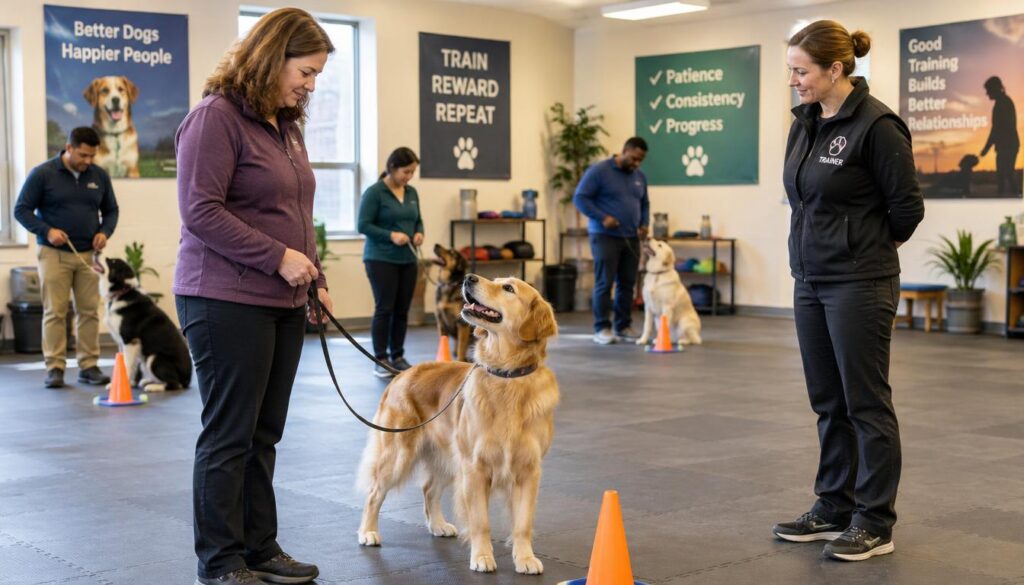
In-person classes let a trainer watch timing, leash handling, and the dog’s response in real time. A trainer can see whether a cue comes too late or the dog is distracted by the setting.
That direct view can matter during leash practice, when distance, movement, and the dog’s focus all change from moment to moment. A local trainer may also observe how the dog responds around other people and dogs.
Some online classes let owners submit videos for feedback, while others provide lessons alone. The American Kennel Club explains that online formats can include auditing, discussion forums, or a working spot with video review.
Ask whether your fee includes individual feedback, group instruction, or access to lessons alone.
How do professional dog trainer credentials differ?
A professional credential proves a different kind of preparation from a certificate of course completion. Credentials test defined standards, while career courses teach skills through lessons and practice.
CPDT-KA tests knowledge, and CPDT-KSA assesses practical skills. Neither route guarantees a job or a set salary.
CPDT-KA knowledge certification
Applicants for the CPDT-KA must be at least 18 and hold a high school diploma, GED, or equivalent. They need 300 hours of dog-training experience from the previous three years.
They also submit an approved professional’s signed attestation and confirm they follow CCPDT standards and its code of ethics. The CCPDT certification requirements describe this experience threshold.
The CPDT-KA exam has 200 multiple-choice questions. Candidates can test at computer-based sites in the United States and internationally, or use remote proctoring.
CPDT-KSA skills assessment
Applicants must hold a current CPDT-KA credential and submit an online application plus a video of assigned training exercises. They must also confirm they follow CCPDT standards and its ethics code.
The CPDT-KSA tests four hands-on exercises recorded at a location chosen by the candidate. Candidates record them during a three-week testing period.
Both CPDT-KA and CPDT-KSA holders must renew every three years. They can earn the required continuing-education units or retake the certification exam.
Career courses from KPA and CATCH
Karen Pryor Academy’s Dog Trainer Professional program has 21 lessons, 100 coordinated learning goals, 250 instructional videos, 40 hands-on exercises, and interactive workshops.
Its curriculum covers training science and practice, teaching clients, solving canine behavior problems, and running a dog-training business. Graduates who meet all program requirements earn the Certified Training Partner credential.
KPA offers in-person and virtual workshop formats. Graduates across formats receive the same KPA certification. Free demo walks show the program, but they are demonstrations, not professional certifications.
CATCH Canine Trainers Academy offers a 10-phase curriculum with self-paced distance learning, mentor guidance, and hands-on workshop options. Its courses are approved for CCPDT continuing-education units.
Free dog training courses with certificates do not replace the experience and exam requirements for recognized certification. Dog trainer salary also depends on location, work model, experience, and specialty, not certification alone.
Check the credential’s eligibility rules and renewal schedule before paying for a career course.
What do dog training programs cost?
Professional training can cost thousands of dollars, while a practice test is a separate, much smaller expense. Career-course tuition pays for a broader learning path than exam preparation alone.
Karen Pryor Academy lists tuition at $5,600 for its in-person format and $6,600 for its virtual format. Both U.S. formats offer a five-part interest-free installment plan.
The Regional/National Dog Trainer Professional format lists at $5,600. The Virtual Dog Trainer Professional format lists at $6,600. Those amounts apply to the listed U.S. programs.
CCPDT’s CPDT-KA practice test costs $105. Each test has 50 questions and a two-hour time limit, making it a smaller exam-preparation expense rather than a career course.
The difference matters when you compare training programs. A practice test helps candidates get familiar with exam questions, while professional tuition covers a larger curriculum and learning activities.
Before enrolling, check what tuition includes. Workshops, coaching, hands-on exercises, and exam preparation can affect the value of a course.
Payment plans also change when and how much you pay, but they do not reduce the total tuition. Check current payment terms directly with the provider before enrolling.
Compare total tuition and included hands-on support, not just the number of installments.

Which training method is most effective for dogs?
Reward-based training is the best-supported starting point here, especially when the goal is to teach without adding avoidable stress. Positive reinforcement rewards a dog for the behavior we want to see again.
Research supports reward-based practice as a sound default, but results can differ among dogs and situations. The studies do not prove every dog will respond in the same way.
Reward-based training and what the evidence supports
A 2020 study of 92 companion dogs found more stress behaviors during training among dogs exposed to aversive stimuli. Those dogs also had higher cortisol rises after training.
Dogs trained only with aversive methods showed more pessimistic responses in a cognitive-bias task than dogs trained with reward or mixed methods. The study points to a welfare concern, not a promise about each dog.
A 2019 study found that secure attachment tended to be more consistent among dogs trained with reward methods. Researchers based that finding on behavior in a Strange Situation Procedure.
The studies help explain why many owners choose reward-based methods. They do not show that one approach will produce identical results for every behavior or setting.
Turning a cue into a repeatable skill
Choose one clear cue, such as “sit,” and reward the desired response promptly. Short, steady practice can help a dog connect the cue with the action.
Build the skill in manageable steps, then practice in places with more distractions. A dog that responds in a quiet room may need more practice before responding outside.
Consistency matters: use the same cue and reward the behavior you want. If the dog struggles, make the next step easier and watch how the dog responds.
Favor a program that explains what to reward and how to adjust practice when the dog struggles.
How should you match a course to your dog’s goal?
If you can name one behavior you want to change, start with a program built around that specific skill. One clear goal makes it easier to choose lessons and track practice.
A focused course is usually the best fit for one defined behavior. A broader course or app can suit owners working on several skills or seeking ongoing support.
One defined behavior or skill
For leash pulling, reactivity, or potty training, a focused course can keep lessons centered on the issue. SpiritDog offers single-topic courses for leash walking and other specific behavior goals.
A narrow course can also help owners avoid unrelated lessons. Before choosing, name the exact behavior and consider whether you need live feedback while practicing.
Several foundations or ongoing support
DIYK9’s multi-stage approach covers separate foundations such as puppy skills, walking, and obedience. It may suit an owner who wants a broader path instead of one short course.
An app with progress tracking can help owners keep up with regular practice. An on-demand brain-game program such as Brain Training for Dogs is a closer fit when boredom drives the main concern.
A rescue or adult dog may need a more flexible path than a puppy-only curriculum. Choose lessons that fit the dog’s age and history, rather than trying to force every skill into a puppy schedule.
Write down one behavior goal and the kind of support you want. That gives you a practical way to compare a focused course, a broader program, and a trainer-supported option.
Choose the narrowest program that covers the goal and support your household will consistently use.
When should an app give way to professional help?
A bite history, severe aggression, or extreme anxiety is a reason to seek a certified veterinary behaviorist instead of relying on an app. Safety comes first when behavior could harm a person or dog.
Serious behavior concerns need an assessment suited to the individual dog. A general obedience course cannot replace care for a severe case.
Do not rely on an app for a dog with a bite history, severe aggression, or extreme anxiety. Arrange an expert assessment first.
Routine skills, such as basic cues, may suit a regular training program. Serious aggression or extreme fear calls for an individual plan that accounts for the dog’s history and needs.
Local services may offer in-home sessions, facility training, or group classes. Dog Training Elite’s Green Bay and Appleton listing describes all three formats.
When people search for the best dog training programs near me, distance alone is not enough. Compare local credentials, methods, and the type of support the provider offers.
Ask a nearby provider these questions before you book:
- What experience do you have with this behavior?
- Which methods do you use during training?
- Will you assess my dog before recommending a plan?
- How will you coach me and follow up after sessions?
- Should a certified veterinary behaviorist be involved?
A local group class may suit routine practice, while in-home coaching can show how a dog behaves in its usual setting. A serious case needs a careful assessment, not a generic lesson plan.
For a serious behavior concern, arrange an assessment with an appropriately qualified professional before starting a general course.
Conclusion
The strongest choice is the program that matches the problem you want to solve and the help you can use consistently. A household skill and a professional career call for different kinds of learning.
Start by writing down one priority behavior. Then check the program’s methods, trainer support, and terms before you enroll.
Write down your main training goal and compare two suitable options before signing up.