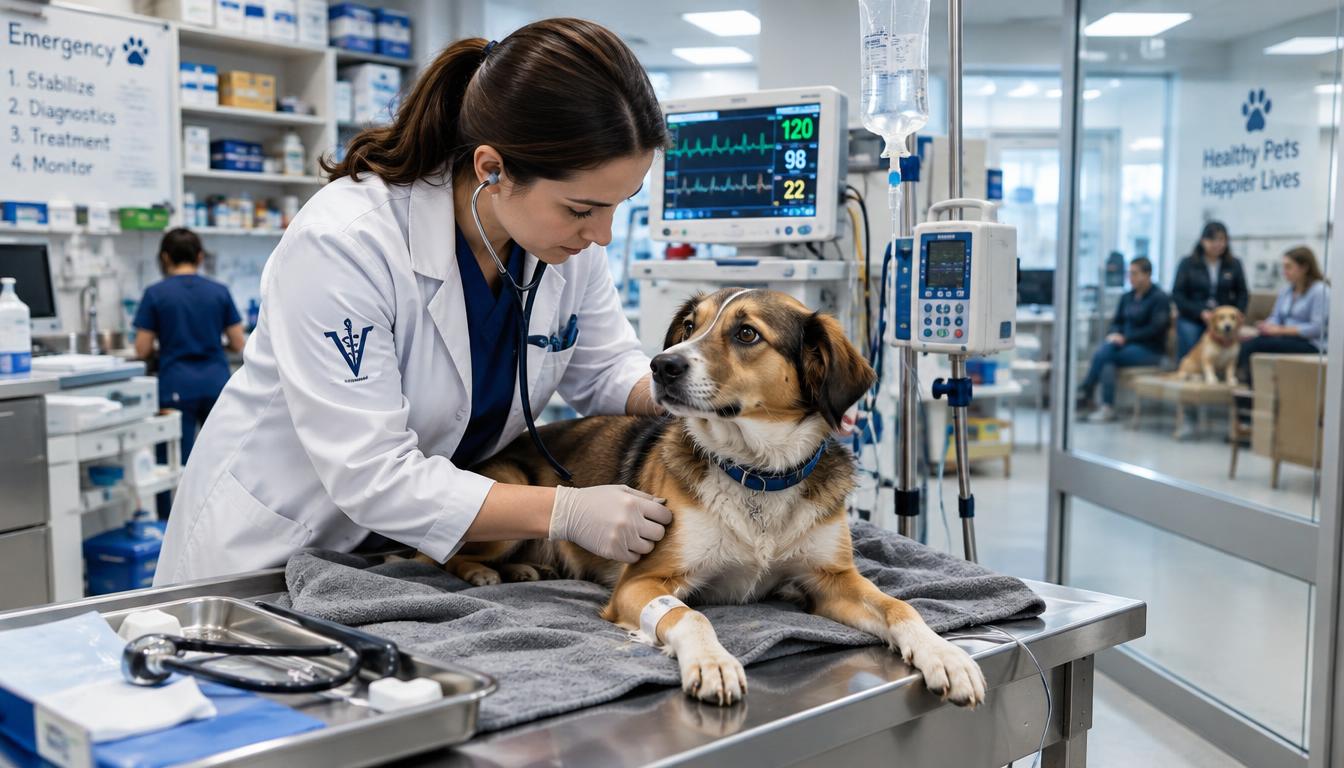
An emergency visit may involve an exam alone or expand into testing, treatment and overnight monitoring. In 2026, a dog’s average emergency exam fee is $135, before any added services. The final bill depends on the problem, the tests needed, treatment and how long a pet needs care. Triage is the rapid assessment that ranks patients by how urgently they need care. Severe symptoms take priority over comparing costs. When we know what an estimate includes, we can ask clearer questions and weigh the choices with the veterinary team. The goal is to help us plan without letting price checks delay care when time matters.
Key Takeaways
- Emergency costs can include much more than an exam.
- Diagnostics, treatment and hospital care add to the bill.
- Serious symptoms need prompt attention.
- Ask for a written treatment estimate.
- Payment rules differ among veterinary hospitals.
- Save an emergency hospital’s number before you need it.
If a pet is in immediate distress, call an emergency hospital while preparing to leave.
What Do Emergency Veterinary Care Costs Include?
The national emergency exam averages in 2026 are $135 for dogs and $143 for cats, before tests or treatment. Those fees are only a starting point, not the full cost of an emergency vet visit. The exam fee is separate from diagnostics, treatment and hospitalization.
An emergency exam fee covers the initial assessment, not every service that may follow.
Emergency exam fees by location
The average emergency exam fee ranges from $107 to $246 for dogs and $113 to $260 for cats. The 2025 CareCredit study lists Hawaii averages of $241 for dogs and $257 for cats, the highest state averages. Mississippi averages are lowest, at $108 for dogs and $115 for cats.
| Location | Average dog exam | Average cat exam |
|---|---|---|
| U.S. average | $135 | $143 |
| Hawaii | $241 | $257 |
| Mississippi | $108 | $115 |
| Florida | $133 | $141 |
| New York | $159 | $170 |
Virginia averages are $131 for dogs and $137 for cats. An emergency vet visit cost near me depends on local fees and the services a pet needs. Without insurance, a clinic may require payment during the visit; eligible insurance reimbursement usually comes later.
Diagnostic tests and overnight care
In 2026, emergency X-rays with two to three views average $334 for dogs and $310 for cats. A complete blood count, or CBC, averages $104 for dogs and $79 for cats. A chemistry panel averages $164 for dogs and $144 for cats.
An ultrasound averages $483 for dogs and $323 for cats. An IV catheter and one bag of fluids average $130 for dogs and $121 for cats. One general veterinary clinic hospitalization night averages $619 for dogs and $582 for cats; emergency-room and ICU nights cost more.
For a cat or a dog without insurance, those added services can make the bill much higher than the exam alone. Ask for an itemized breakdown of common emergency fees that separates the exam, diagnostics, treatment and any planned hospital stay.
Why Can an Emergency Vet Bill Climb So Quickly?
A critical case can cost thousands because stabilization, rapid diagnostics, surgery and overnight monitoring may all be needed. Speed and severity shape the bill, along with the pet’s size and the care required. The exam is only the starting charge; diagnostics, hospitalization or surgery can take a case into the thousands.
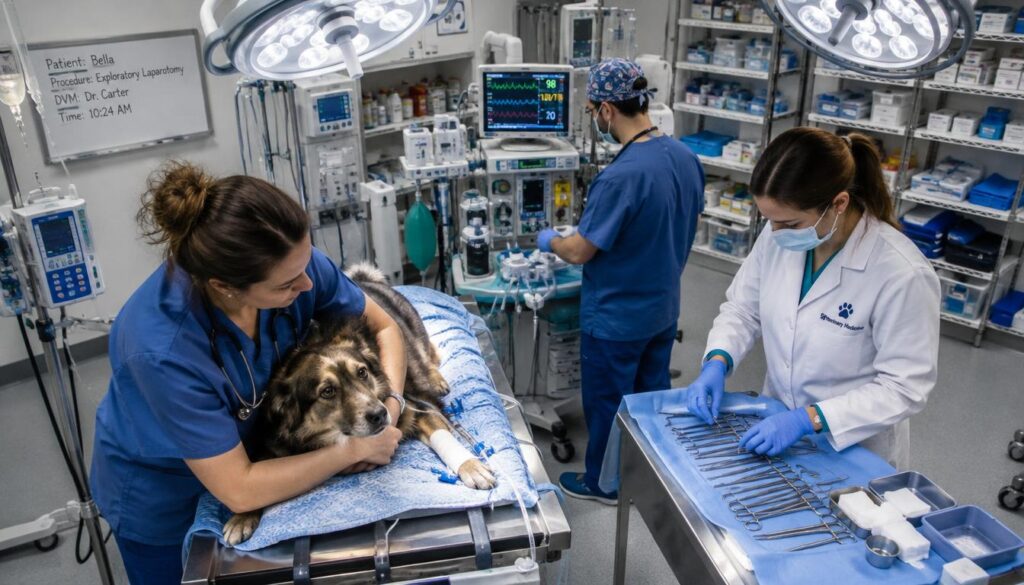
An emergency hospital needs staff ready outside regular hours, plus equipment for urgent tests and treatment. Access to specialists, intensive monitoring and surgery can add to the cost. A larger dog may need more medication or fluids, while a more severe illness may require longer care.
| Emergency scenario | Broad estimate | What can raise the bill |
|---|---|---|
| GI upset | $500-$3,000+ | Tests, fluids, hospitalization |
| Toxin ingestion | $300-$5,000+ | Toxin, severity, monitoring |
| Trauma or fracture | $1,000-$6,000+ | Imaging, repair, hospitalization |
| Seizures | $1,500-$8,000+ | Cause, tests, repeat seizures |
| GDV | $2,500-$8,000+ | Stabilization, surgery, ICU care |
These are broad case estimates, not a quote for an individual pet. Basic bloodwork often costs $80-$200, basic imaging $150-$600, and three to five hospital days $2,000-$3,500. Emergency surgery commonly costs $2,000-$5,000.
Procedure choices can change the total. The University of Illinois teaching hospital estimates care for a stable blocked male cat at $1,500-$2,500. For a swallowed object, it estimates $2,000-$3,000 for endoscopy, $3,500-$5,500 for surgery, or $5,000-$7,000 for bowel resection.
GDV surgery is estimated at $5,000-$7,000. North Carolina State Veterinary Hospital lists initial emergency stabilization at $600-$900 in 2026. The University of Illinois estimates $2,000-$4,000 for one to two ICU days, including emergency tests.
Ask which recommended services are needed immediately and which can wait until your pet is stable.
Which Symptoms Mean a Pet Needs Emergency Care Now?
Trouble breathing, collapse, prolonged seizures or unproductive retching calls for immediate veterinary care. Do not wait when a pet cannot breathe normally or stay responsive. A male cat straining to urinate with little or no urine needs same-day emergency care because a blockage can be fatal.

Signs of immediate medical distress
These signs call for prompt emergency care, not a routine appointment:
- Trouble breathing.
- Collapse, inability to stand or unresponsiveness.
- A seizure lasting longer than five minutes, or several seizures in a row.
- Retching without bringing anything up.
- Visible bleeding or injury.
The American Animal Hospital Association’s pet emergency guidance also flags breathing difficulty, seizures, bleeding and unresponsiveness as urgent signs.
How pain can look different in dogs and cats
Pain may show as changes in behavior, appetite, breathing or movement. A pet may limp, whine, pant, tremble, resist movement or become restless. Some pets eat less or breathe shallowly, but they may not cry.
Cats in pain may hide more, become less social or stop grooming. Dogs may withdraw or seem picky about food. A hunched posture or the prayer position, with the front end lowered and hindquarters raised, can signal discomfort in a dog, but it cannot diagnose the cause.
There is no single “silent killer” in dogs. GDV is one rapidly dangerous emergency, especially when a dog retches without bringing anything up. Call an emergency hospital promptly when a pet cannot urinate, breathe normally, stand or stay responsive.
What Should We Expect During an Emergency Vet Visit?
At arrival, the team first checks whether your pet needs immediate stabilization before a full workup. Urgent cases are triaged first, based on how quickly they need care. The team may then examine your pet and discuss a treatment estimate before diagnostics or treatment begin.
The usual steps are triage when needed, an exam, an estimate, diagnostics, treatment or monitoring, then discharge or transfer for follow-up. Tests may include bloodwork, X-rays or an ultrasound. The team may give medication or fluids and provide ongoing hospitalization.
An urgent care clinic may suit a minor wound, ear problem or non-emergency vomiting. A pet needing 24-hour critical care belongs at an emergency hospital. Some emergency hospitals stay open 24/7; in some areas, a regular vet takes after-hours calls instead.
To find an emergency vet near me, save the nearest hospital’s address and phone number. Call ahead to confirm it can handle the problem, and ask about deposits and accepted payments. Many clinics require a deposit up front and full payment before discharge, but policies differ.
Call ahead when possible, but do not delay transport for breathing trouble, collapse or another immediate danger.
How Can We Pay for Urgent Veterinary Care?
Start by telling the clinic what you can pay now and asking for a written estimate and available payment choices. Payment rules differ among clinics, and a grant may not arrive in time for treatment. Do not count on aid until a program confirms that your case qualifies.
Insurance, savings and payment plans
Pet insurance may cover eligible emergency expenses under its policy terms, with exclusions for pre-existing conditions. Owners often pay first, then seek reimbursement. Check your policy limits and rules before relying on coverage.
Scratch Pay offers 12- to 24-month veterinary payment plans, with approved loan amounts of $200-$10,000 and APRs of 0%-36%. It requires a $15 down payment, and late fees may apply. Eligibility checks do not affect credit scores, but repayment activity may be reported to credit bureaus if a loan is accepted. More than 17,000 veterinary practices used Scratch Pay as of September 2025.
Grants and clinic conversations
Frankie’s Friends grants are capped at $2,000 per pet per household and are not guaranteed. An application needs an estimate from a veterinarian who examined the pet, a clear diagnosis, a specific treatment plan and a good prognosis.
The program pays the treating veterinarian directly, not owners, and it does not repay money already paid. It excludes the initial exam and diagnostic tests used to determine prognosis and treatment. It cannot help at hospitals with their own funds or assistance programs, including Banfield, BluePearl and VCA.
Frankie’s Friends grant rules explain its limits and required treatment plan. Other options include RedRover emergency veterinary funding, The Pet Fund for non-basic, non-urgent care, Paws 4 A Cure for dog and cat illnesses or injuries, and Brown Dog Foundation for emergency costs and chronic conditions.
Best Friends lists CareCredit and Scratch as financing options. Some aid groups are less likely to pay for care already provided, so contact more than one program. Ask clinics about lower prices or financing, and compare clinics or seek a second opinion when time allows.
A clinic may discuss payment options and a treatment plan if we cannot pay the full estimate. It cannot promise that it will provide care without payment. A low-cost urgent care clinic may help with a stable, non-life-threatening problem, but it cannot replace an emergency hospital in a critical case.
- Request a written treatment estimate.
- Ask which services are time-critical.
- Ask the clinic about reduced pricing or financing.
- Contact several aid programs before treatment is completed.
Check grant rules before relying on assistance, especially when the care or initial diagnostics have already been provided.
How Can We Prepare Before a Pet Emergency?
Save your nearest emergency hospital’s number and address before you need them. A few details kept ready can save time during a stressful trip. Keep your pet’s medical and vaccination records on your phone, and prepare a carrier or secure way to transport them.
Know how to reach the ASPCA Animal Poison Control Center, which is available 24/7. Call the hospital while en route when possible, so the team can prepare. If another person is available, ask them to drive while we monitor the pet.
Keep records and a secure carrier ready so a stressful departure does not slow transport.
Keep records and a secure carrier ready so a stressful departure does not slow transport.
Conclusion
The clearest plan is to act promptly when a pet is in distress and ask the veterinary team to explain the estimate. Timely assessment comes first in a true emergency. An itemized estimate can help us understand the proposed treatment and choices.
Save the number and address of your nearest emergency hospital now.