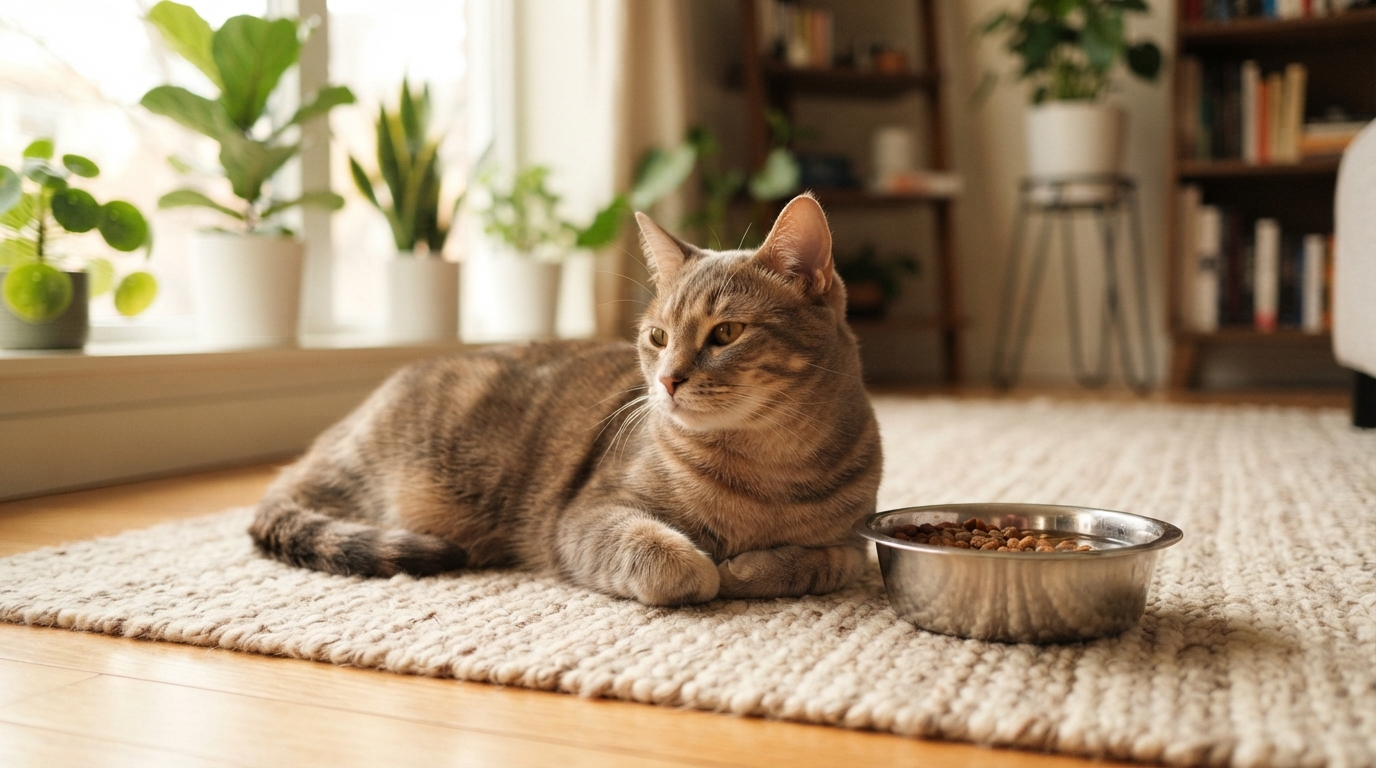
Indoor life can make it easier for extra calories to outpace daily movement, but a cat’s appearance alone cannot tell us whether weight loss is appropriate. A round belly or one weigh-in cannot show whether a cat needs to lose weight. A steady routine can support a healthy weight and help us avoid habits that lead to weight gain.
Weight Management for Indoor Cats starts with care for the individual cat, not a quick fix. Our aim is to make choices we can keep up over time while protecting our cat’s health. The aim is a practical routine that supports our cat’s health, not a fast change on the scale.
Key Takeaways
- Use a veterinary assessment to decide whether weight loss is right for our cat.
- Set a target weight and calorie plan with the veterinary team.
- Measure meals and count treats and shared snacks.
- Choose complete food matched to the cat’s life stage.
- Build indoor activity around the cat’s comfort and interest.
- Track changes and seek help if appetite drops.
How Do We Start Weight Management for Indoor Cats?
A home check can flag a concern, but a veterinary team should confirm any score other than 5/9 or any score we are unsure about. A body condition score (BCS) is a visual and hands-on estimate of a cat’s body fat based on body shape and how easily its ribs can be felt. For most adult cats, the usual target is a BCS of 5/9.
At 5/9, we can feel the ribs beneath a thin layer of fat, see a waist, and notice little abdominal fat. A primordial pouch may hang below the abdomen, so belly shape alone can mislead us. We need to assess ribs, waist, and belly profile together because weight alone cannot show how much body fat a cat carries.
Read the ribs, waist, and belly together
Muscle condition matters too. A cat can lose muscle at any BCS, including while carrying excess body fat. A veterinary team can check muscle along the spine, shoulders, and hips, not just the number on a scale.
A cat weight-loss calculator can estimate calorie needs, but it cannot set an individual plan on its own. The Pet Nutrition Alliance calorie calculator is designed for veterinary professionals. It directs pets with obesity at BCS 7/9 or higher to direct veterinary-team guidance.
Do not make substantial feeding or calorie changes from a chart alone; the cat’s full health picture must guide the plan.
Set a veterinary baseline before changing calories
The veterinarian considers age, frame, current BCS, muscle condition, appetite, activity, and health when setting a target weight. Pain, mobility limits, medications, arthritis, and diabetes can also affect the plan. The same weight can mean different things for cats with different frames and health needs.
A calorie target should fit the cat’s daily needs, not a generic chart. We can bring food labels and a record of current meals and extras to the veterinary assessment.
Bring the food labels and a record of current meals and extras to the veterinary assessment.
How Should We Control Food Portions and Treats?
A bowl topped up between meals can add calories that are easy for us to overlook. Measured meals make daily intake easier to track, especially when several people feed the cat. AAHA recommends measured portions, no free-feeding during a weight-loss plan, and smaller, controlled portions through the day.
Weighing food in grams is more accurate than estimating by eye. A few extra pieces of kibble can matter for a small cat. Count every extra as part of the cat’s daily intake, including food offered by guests or family members.
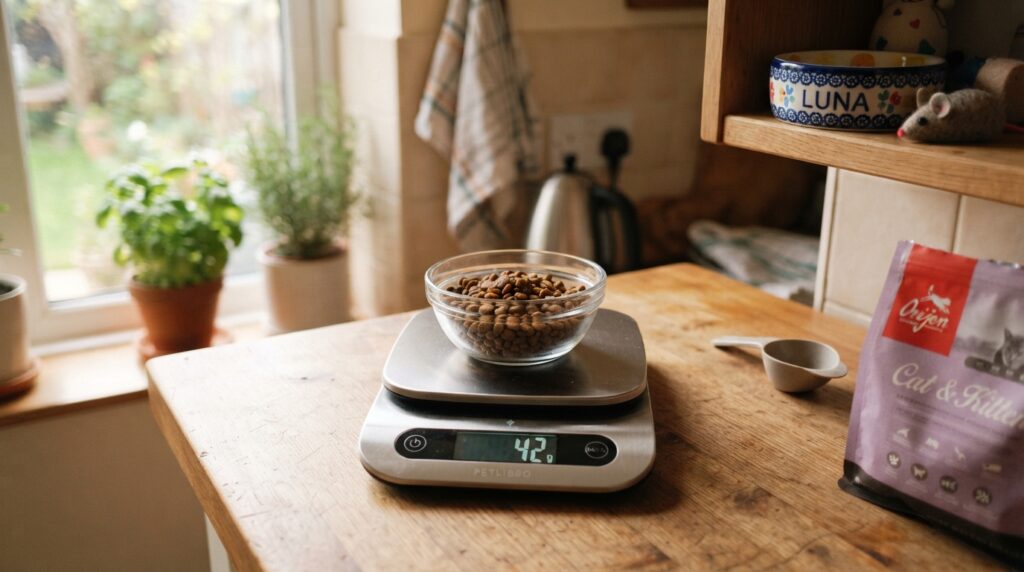
Measure meals and count every extra
A kitchen scale gives us a repeatable portion, while a measuring cup can vary with how food settles. We can use scheduled meals or divide the measured daily amount into smaller servings. A measured pet portion plan can help our household use the same serving method.
Set aside the day’s full portion before feeding begins. That makes it easier to see what remains and prevents an extra scoop from becoming the norm.
Keep treats and shared snacks within limits
Cornell gives treats a general ceiling of 10% to 15% of a cat’s daily calories. The general treat allowance is not the same as the stricter ASPCA limit for snacks shared with pets: no more than 5% of daily calories. Shared food counts toward daily intake, so household members should follow one limit.
Small portions of lean cooked chicken, turkey, beef, or pork can be shared if they have no bones or seasoning. Avoid using table scraps as a meal replacement. Treats and snacks should fit within the plan set for the cat.
Separate safe foods from dangerous ones
Some foods can harm cats or cause serious illness. Onion, garlic, and chives can upset the gastrointestinal tract and damage red blood cells; cats are more susceptible than dogs. Keep these foods away from curious paws and plates.
- Onion, garlic, and chives: gastrointestinal irritation and red blood cell damage.
- Chocolate, coffee, and caffeine: serious illness or toxicity.
- Alcohol and raw yeast dough: serious illness or toxicity.
- Raw meat and raw eggs: serious illness or toxicity.
- Milk and dairy: illness or digestive upset.
- Excessive salt or xylitol: serious illness or toxicity.
We can post the safe-food rules where everyone prepares meals. Keep one household log of meals, treats, scraps, and food offered by every family member.
Which Food Supports Weight Loss Safely?
A weight-loss food should be complete and balanced for the cat’s life stage, with its portion set by calories and veterinary guidance. No format is automatically best for weight loss; the measured serving and nutrition standard matter more. The best weight management for indoor cats uses a food that fits the cat, not a label making broad weight claims.
Check calories per measured serving when choosing weight-loss cat food. Look for the Association of American Feed Control Officials (AAFCO) nutritional guarantee that the food is complete and balanced for the cat’s life stage. Match the guarantee to the cat’s life stage, then follow the veterinary calorie target.
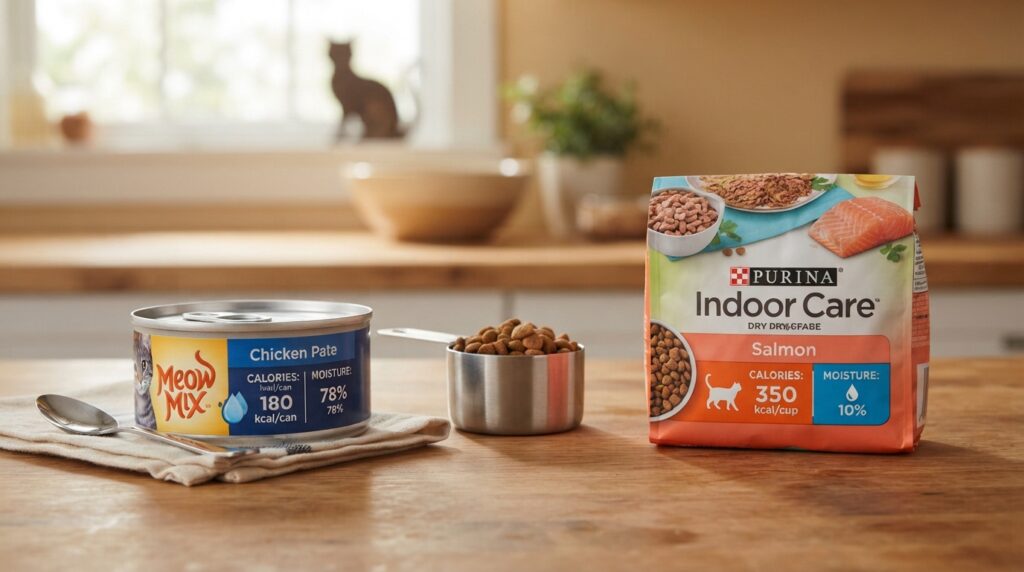
Compare canned and dry food by moisture and calories
Canned food contains at least 75% moisture and can provide dietary water. Dry cat food contains 6% to 10% water, so we should check the calories in the portion we measure. The table compares moisture and nutrition checks, not which food will make every cat lose weight.
| Type | Moisture or nutrition standard | Practical check |
|---|---|---|
| Canned food | At least 75% moisture | Counts as a dietary water source |
| Dry cat food | 6% to 10% water | Check calories in the measured portion |
| Complete-and-balanced commercial food | AAFCO nutritional guarantee | Confirm the guarantee matches the cat’s life stage |
Complete-and-balanced food is different from food labeled for intermittent or complementary feeding. A food label should state whether the product meets the cat’s full nutrition needs for its life stage.
Choose a complete diet for the cat’s life stage
A 2026 Cats.com review lists Nulo Prowess Healthy Weight Chicken & Whitefish Shreds in Broth Wet Cat Food as a weight-management product. The listing notes controlled calories, added fiber, and moisture, but that does not make it a universal pick.
We can compare any food by its calories, nutrition guarantee, and suitability for the individual cat. Cornell does not recommend raw diets because they may contain bacteria, viruses, and parasites that can infect cats and owners, without a clear health benefit. Keep clean, fresh water available regardless of which food format we feed.
How Can We Add More Indoor Activity?
Two daily interactive-play sessions of 10 to 15 minutes give us a clear starting routine for indoor activity. AAHA recommends at least two such sessions each day to encourage movement. Routine play can support natural weight management for indoor cats without relying on supplements.
We can make a play space inviting, then let the cat choose how to engage. Adapt play to age, health, pain, mobility, and interest, since an older cat may need a different pace than a young one.
- Wand-toy chase across a clear floor or hallway.
- Rolling toys that move at a speed the cat can follow.
- Food puzzles that encourage gentle movement and problem-solving.
- Climbing routes or elevated perches with safe access.
We can rotate toys to keep familiar games interesting. A short game may work best when the cat is alert, while a relaxed cat may prefer a quiet puzzle or perch.
Watch how the cat moves during play. If jumping seems painful or the cat tires quickly, we can ask the veterinary team to adjust the activity plan.
End each play session at a pace the cat can manage comfortably.
What Is a Safe Pace for Cat Weight Loss?
Safe feline weight loss should not exceed 1% to 2% of body weight per week. This is an upper limit, not a weekly goal to beat. Gradual loss matters because rapid weight loss can cause hepatic lipidosis, a potentially life-threatening fatty liver disease.
We can use the same scale and conditions for each check, then share the record with the veterinary team. Contact the veterinary team if the cat loses weight faster than 1% to 2% per week, so the plan can be reviewed.
| Measure | Benchmark | Response |
|---|---|---|
| Weekly loss rate | No more than 1% to 2% of body weight | Contact the veterinary team if loss is faster |
| Weigh-in | Every two weeks | Record weight and body condition |
| Appetite | Little or no food for 24 hours | Seek same-day veterinary assessment |
AAHA recommends weighing a cat every two weeks during a weight-loss plan and recording changes in weight and body condition. A trend over several checks can give the veterinary team more context than one reading.
Appetite changes need quick attention, even when the scale seems to be moving as planned. A cat that eats little or nothing for 24 hours needs same-day veterinary assessment.
The 1% to 2% weekly limit helps us spot a pace that may be unsafe. Pause the plan and contact the veterinary team promptly if appetite drops or the cat eats much less than usual.
How Do We Maintain a Healthy Weight Over Time?
Once a cat reaches its target, we need to maintain a steady routine rather than automatically restore earlier portions. Keep tracking weight and body condition, then ask the veterinary team to adjust food or activity based on progress. Maintenance takes follow-through, even after the main weight change is complete.
The Pet Nutrition Alliance calculator advises regular monitoring and changes to food or activity as progress is assessed. It is designed for veterinary professionals, and cats with obesity at BCS 7/9 or higher need direct veterinary-team guidance.
A target weight is a checkpoint, not a reason to restore the cat’s previous portions automatically.
Life changes can shift a cat’s needs. A move, new medication, illness, or change in activity may affect intake or weight, so we should note changes for the veterinary team.
We can keep a simple record of weight, body condition, and activity alongside the feeding routine. Bring that record to checkups so the team can judge whether the plan still fits.
Keep the maintenance routine consistent and ask the veterinary team to reassess it when weight or body condition changes.
Conclusion
A healthy weight plan works best when it fits the cat in front of us and the routine we can maintain. Gradual, monitored changes are more useful than a fast diet overhaul, and the veterinary team can tailor the plan to the cat’s health and needs.
Our next step can be a veterinary weight-management check. Schedule one and bring the current food labels and a record of everything the household feeds.