A small amount of extra food served every day can quietly shift a pet’s weight over time. Even a few uncounted bites can make a difference when they become part of the daily routine. Body condition score (BCS) is a 1-9 estimate of body fat made by looking at and feeling the body.
Measured feeding helps us understand what our pets eat and support a healthy weight. The right daily amount is individual, since pets differ in age, activity, and health. We can set a starting target, measure meals, count extras, and watch for changes in dogs and cats.
Home habits can make food intake more consistent, but veterinary decisions still need a veterinary healthcare team. A repeatable routine gives us a clearer picture of what our pet actually eats.
Key Takeaways
- Use package feeding guidelines as a starting point, not a personal prescription.
- Ask the veterinary team to set a dog’s weight-loss target.
- Count treats and other extras as part of daily intake.
- Weigh portions in grams when possible for more repeatable meals.
- Track weight and body condition during a weight-management plan.
- Keep each pet’s food separate when animals share a home.
How Do Pet Portion Control Strategies Set a Daily Target?
A package feeding guide gives us a starting estimate, while a veterinarian can set a more suitable target for an individual dog. The chart alone is not a personal prescription, since two pets of similar size may need different amounts. For weight loss, a veterinarian should calculate the dog’s calorie target and monitor progress.
A weight plan needs room for adjustment. The first estimate may need to change as the dog’s weight and health change. A veterinary healthcare team can review progress and revise the target safely.
Do not put a dog on a diet without help from a veterinary healthcare team.
Start with the feeding guide, then personalize it
Start with the food package’s feeding guidelines, then consider the pet’s needs. A guide may use weight ranges, but it cannot account for every dog’s daily routine. We can also compare food labels using this dog food label guide, which covers nutrition details and feeding directions.
These five factors can change the amount a pet needs:
- Ideal weight
- Age
- Activity level
- Spay or neuter status
- Health needs
Use ideal weight and veterinary advice
For a dog that needs weight loss, the veterinary team should set the calorie target using the dog’s ideal weight and health needs. A package chart may use current weight, which can lead to an unsuitable amount for a dog carrying extra weight.
The team can review the dog’s progress and decide whether food or activity needs to change. Bring the package and feeding directions to the visit, so the target can be matched to that specific food. Before reducing a dog’s food, ask the veterinary team to set the target and explain how progress will be reviewed.
What Does Body Condition Tell Us About a Healthy Weight?
A dog’s ribs should be easy to feel beneath a thin fat layer, with a visible waist and abdominal tuck. These signs help us judge body condition beyond the number on a scale. For an ideal dog, ribs feel easy to find, the waist is visible, and the belly rises behind the ribs.
We assess body condition by looking at the pet from above and from the side, then gently feeling the ribs. This visual-and-touch check helps us estimate body fat. It does not replace a veterinary exam when a pet’s condition changes.
Check the body by sight and touch
Look for a waist behind the ribs from above, and an abdominal tuck from the side. Then feel the ribs beneath the coat. A thick fat layer can make ribs harder to feel, while a very thin layer lets us find them easily.
A body condition score (BCS) estimates body fat on a 1-9 scale. It uses visual examination and touch, while a scale gives weight alone. We can learn more about pet nutrition needs and how body condition fits into feeding choices.
Record muscle condition separately
Muscle condition score (MCS) is a separate assessment from BCS. A pet can have extra body fat and still lose muscle, so the two scores answer different questions about the body.
During weight management, record a dog’s ideal body weight alongside its BCS. That record helps us and the veterinary team see changes over time rather than relying on memory. A new shift in weight can matter even when the pet still appears comfortable.
Unexpected weight change, weakness, or muscle loss warrants veterinary assessment. If a pet’s body changes unexpectedly or loses muscle, arrange a veterinary assessment rather than guessing at the cause.
How Do We Calculate Calories From a Pet Food Label?
To find the calories in a measured portion, first convert the label’s kcal/kg figure into calories per gram. Pet food labels show energy as kilocalories per kilogram, written as kcal/kg. Divide kcal/kg by 1,000, then multiply by the portion’s weight in grams.
Some labels also give calories per can, cup, biscuit, or other serving. Those units can help when we use that exact serving size, but food weight allows us to calculate a different portion.
Find the calorie unit on the label
Look for the calorie statement on the package. A food listed at 3,688 kcal/kg contains 3.688 calories in each gram. This figure is the food’s calorie density, or energy in a given weight of food.
A cup’s volume does not tell us its calorie amount unless the label gives calories per cup or we know its weight. Different foods can pack different amounts into the same cup. So the label’s calorie density matters when we change serving size.
Convert food weight into calories
For a 120-gram cup of food labeled 3,688 kcal/kg, multiply 3.688 by 120. The result is 442.6 calories. A 10-gram treat made from that same food contains 36.9 calories.
| Example | Food weight | Calories |
|---|---|---|
| 1 gram of 3,688-kcal/kg food | 1 g | 3.688 kcal |
| Cup example | 120 g | 442.6 kcal |
| Treat example | 10 g | 36.9 kcal |
Use the same method for any portion measured by weight. Keep the food’s actual calorie density in the calculation whenever a portion is measured by weight.
What Is the Most Accurate Way to Measure a Meal?
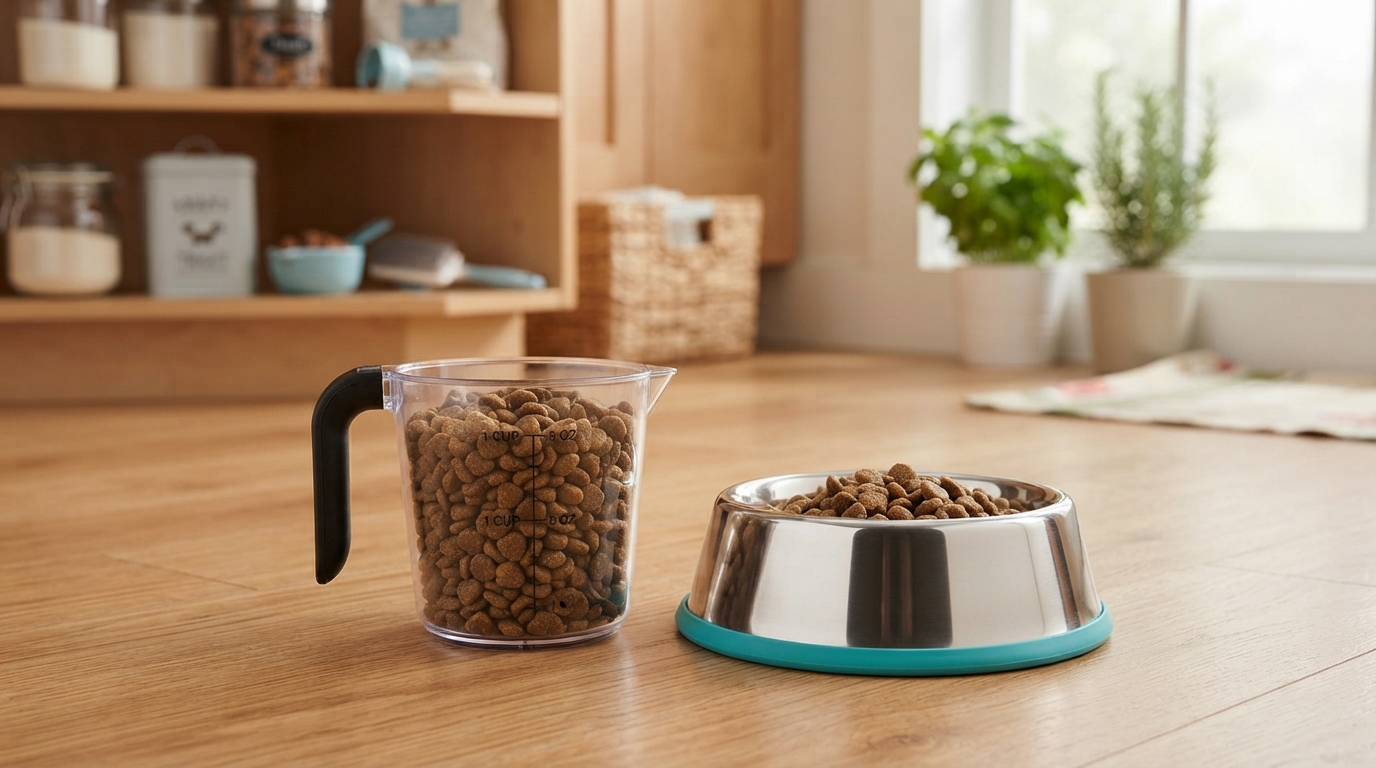
We can make a dog’s weight-loss portion more repeatable by weighing the daily food amount in grams. A kitchen gram scale is more accurate than measuring cups for weight-loss portions. Scoping kibble can miss the intended cup amount by about 25% above or below.
A gram scale helps us serve similar portions from day to day. It also makes it easier to split a daily amount into meals. Cup measures can be quick, but kibble shape and how we scoop affect how much fits.
Use a gram scale for repeatable portions
When possible, weigh a dog’s daily amount in grams, then divide it among planned meals. The number on the scale gives us a repeatable food weight, unlike a loosely filled scoop. A scale does not set the daily target; it helps us serve the amount already chosen.
Check the display as food is added, and use the same bowl when practical. Small changes in how we fill a cup can add up across a full day. A scale can help us avoid that variation without changing the food itself.
Check capacity and measurement limits
Choose a scale with enough capacity for the bowl and food together. Taring the scale resets its reading, but it does not reduce the load the scale must hold. The bowl still counts toward capacity.
| Method | Useful for | Measurement detail |
|---|---|---|
| 1-gram scale | Normal portions | Sufficient resolution for most |
| 0.1-gram scale | Small portions, treats, toppers | Finer display resolution |
| Scooped cup | Quick serving | May be about 25% above or below a cup |
Resolution means the smallest change shown on the display; it does not prove accuracy. A 1-gram resolution is enough for most normal portions, while 0.1-gram resolution may help with tiny servings. Set the bowl on the scale before taring, and make sure the scale’s capacity covers the bowl plus the food.
How Much of a Pet’s Daily Calories Can Come From Treats?
We should count every treat and chew as part of the day’s calories, not as a separate free extra. Treats should make up no more than 10% of daily calories, and 5% is a safer goal. Keep treats near 5% when practical and never let them exceed 10%.
Extras can add up without seeming like a full serving. Training bites given one at a time, a chew after a walk, or a topper in the bowl all contribute to daily intake.
Easy-to-miss extras include:
- Training treats
- Chews
- Table scraps
- Food toppers
Count these along with meals when we plan a pet’s daily calories. Small training rewards may feel too minor to track, yet repeated rewards still add energy. We can set aside part of the day’s measured food for training when that fits the pet’s plan.
Treats are not complete and balanced foods. They should not replace food that provides the full nutrition a pet needs. Too many treats can contribute to stomach upset and unhealthy weight gain.
For weight management, note extras in the same daily record as meals. This gives us a more useful picture of what the pet actually eats, especially when several people offer rewards during the day. Keep treats near 5% of daily calories when we can, and never let them exceed 10%.
How Often Should We Feed Pets Each Day?
A predictable schedule helps us see whether the day’s measured food has actually been served. Two meals a day is a common routine for a healthy adult dog, while cats can have 2-3 measured meals daily. Age, health, and veterinary advice can call for a different schedule.
Scheduled meals make daily intake easier to track than leaving food out all day. With food always available, it can be hard to tell how much a pet ate or whether another animal shared it.
For a healthy adult dog, two meals give us clear points in the day to serve and record food. Cats may do well with 2-3 measured meals, depending on their needs and the veterinary plan. These are practical starting routines, not rules for every pet.
Some pets need a schedule that differs from the usual adult routine. A health condition or medication may affect meal timing, and a veterinary team can give instructions for that pet. We should follow those directions rather than changing the schedule on our own.
Keep the plan simple enough for everyone in the home to follow. A written schedule can show what was served and when, especially if several people feed the pet. Consistent timing also helps us notice when a meal was missed.
Keep the meal times consistent enough that we can notice a missed serving instead of accidentally replacing it.
When Should We Adjust Food for Age or Activity?
A change in life stage or activity is a good reason to review the feeding plan, not to keep using an old amount automatically. A growing puppy, a less active older pet, and a pet with a new activity pattern may need different amounts over time. Recheck the plan when the pet’s usual needs change.
Age, activity level, spay or neuter status, and health needs can all affect feeding. A veterinary review can help us decide whether the amount or meal schedule needs to change.
Reassess as life stage and activity change
Puppies commonly need 3-4 meals a day as they grow. Their needs do not stay fixed through every stage of life. Older pets may be less active, though health and routine differ from one animal to another.
A pet that starts taking longer walks or becomes less active may also need a review. The same is true after a change in health or daily routine. These shifts can affect both the amount of food and the best timing for meals.
Adjust the amount, not the nutrition plan alone
When a pet’s needs change, review the whole feeding plan rather than only changing the scoop size. The food must still fit the pet’s life stage and health needs. A smaller amount of food that does not meet nutrition needs is not a complete plan.
We can bring the food label and notes about activity to a veterinary visit. That gives the team useful details about what the pet eats and how daily life has changed. Older pets need an individualized meal schedule based on health and activity, not age alone.
Recheck the plan when a pet’s usual activity or health changes, rather than waiting for a large weight shift.
How Do We Track Weight Loss Safely?
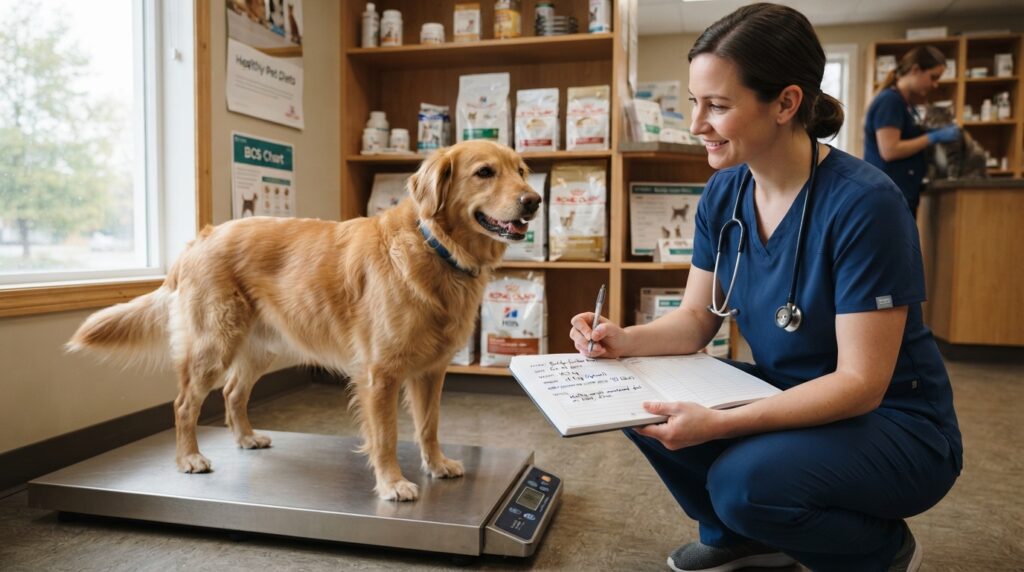
A safe weight-loss plan tracks progress over time, with different weekly targets for dogs and cats. Dogs may lose 1-2% of body weight per week, while cats may lose 0.5-1% per week. Regular veterinary monitoring helps keep the plan on track.
The veterinary team may adjust food or activity as weight changes. Rechecks every 2-4 weeks give the team a chance to review progress and revise the plan.
Record weight and body condition
Keep a short log so we can compare each check with the last one. Record these four details:
- Date
- Weight
- BCS
- Food or activity changes
Regular records help us see the trend, not just one reading. The Pet Nutrition Alliance calculator gives the weekly loss ranges above, along with regular monitoring and possible plan changes. A dog weight-loss guide from APOP also discusses individualized targets and monitoring.
Treat each recheck as a chance to revise the plan
A three-month weight-loss step is a projection, not an automatic feeding instruction for the next three months. The veterinary team should recalculate and review the plan at each recheck. A pet’s needs can change as weight and activity change.
Keep rechecks every 2-4 weeks during the plan, as directed by the veterinary team. Share the log, including any changes to meals or activity, so the team can assess the full picture. Keep each recheck on the calendar so the veterinary team can revise the plan before the next step.
When Does a Pet Need Veterinary Weight Guidance?
A pet with a BCS of 7/9 or higher needs a weight-loss program guided directly by the veterinary team. Do not make a substantial calorie cut without veterinary guidance. A safe plan can account for the pet’s health as well as body weight.
Excess weight in dogs is associated with several health conditions. This association does not mean every overweight dog will develop them, but it makes veterinary support important.
Health issues associated with excess weight in dogs include type 2 diabetes, heart disease, osteoarthritis, high blood pressure, and some cancers. The risk and needs of an individual dog require an individual assessment.
A veterinarian can review the dog’s health and help set a safe plan. Drastic food restriction may leave a pet without enough nutrition, so a large reduction should not be a home guess. The team can also advise how to monitor the pet as the plan changes.
Owners may notice that a pet has gained weight, moves less easily, or struggles with usual activity. Those signs are useful to share at an appointment, but they do not identify the cause on their own. Bring a record of the food and current amount if possible.
Home portion changes can support a plan, but they cannot replace an assessment when a pet has a high BCS or health concerns. Ask a veterinarian to assess the pet before making a substantial calorie restriction.
Can Automatic Feeders Keep Portions Consistent?
An automatic feeder can make meal timing easier, but its programmed serving should be checked against the intended amount. Automatic feeders can help cats and small dogs with timing and portioning, though many tested models performed underwhelmingly overall. Do not assume a programmed serving is accurate without checking it.
Wirecutter tested 22 automatic feeders over several weeks in 2026. Its top hopper-feeder pick for portion accuracy was the Pawsync Smart Pet Feeder, which uses a scale beneath the bowl.
Compare feeder designs and controls
Different designs suit different feeding needs. A hopper feeder dispenses dry food from a container, while a tray feeder uses separate compartments. App controls can help us set meal times, but they do not prove each serving matches the planned amount.
| Feeder | Design or control | Relevant distinction |
|---|---|---|
| Pawsync Smart Pet Feeder | Hopper with a scale beneath the bowl | Top hopper pick for portion accuracy |
| Petkit Fresh Element Solo | App-controlled | Easier to clean, less accurate than Pawsync |
| Casfuy F13 | Cordless six-compartment tray, rechargeable battery | Serves kibble or canned food |
Weigh dispensed food before relying on a setting
The Petkit Fresh Element Solo is easier to clean, but its portion accuracy is lower than the Pawsync feeder’s. The cordless Casfuy F13 has six compartments and a rechargeable battery. It can serve kibble or canned food.
A feeder can help with timing while still dispensing an amount that needs checking. Test the food it releases against the amount planned for the pet. Weigh a feeder’s actual serving before treating its setting as a reliable daily measure.
Which Feeder Works for Wet Food or Flexible Schedules?
For wet food served later, a refrigerated feeder is a different option from a standard hopper. The PetSafe FreshFeed Refrigerated Pet Feeder kept wet food at a measured internal temperature of about 40°F. Check food storage and power backup as separate needs.
The FreshFeed has six meal slots, with five meals programmable through its app. It has no battery backup, so the planned schedule depends on available power.
Refrigeration helps keep wet food cool inside the feeder, while backup power concerns whether the feeder can run during an outage. One feature does not solve the other. We should think about both when a meal must be served later.
Match the feeder’s compartments and controls to the pet’s food and the schedule. The FreshFeed can hold six meals, but only five are programmable through the app. Plan which slot will serve each meal before relying on the device.
Consider what happens if power fails while the pet is away from home. Without battery backup, the feeder may not run during an outage. A caregiver or another plan may be needed when a missed meal would matter.
Check that the planned serving method fits the food and the time it will be served. A feeder’s temperature and meal controls are useful only when they match the pet’s needs. Confirm how a feeder handles power loss before relying on it to serve a scheduled meal.
How Can We Prevent Pets From Sharing or Stealing Food?
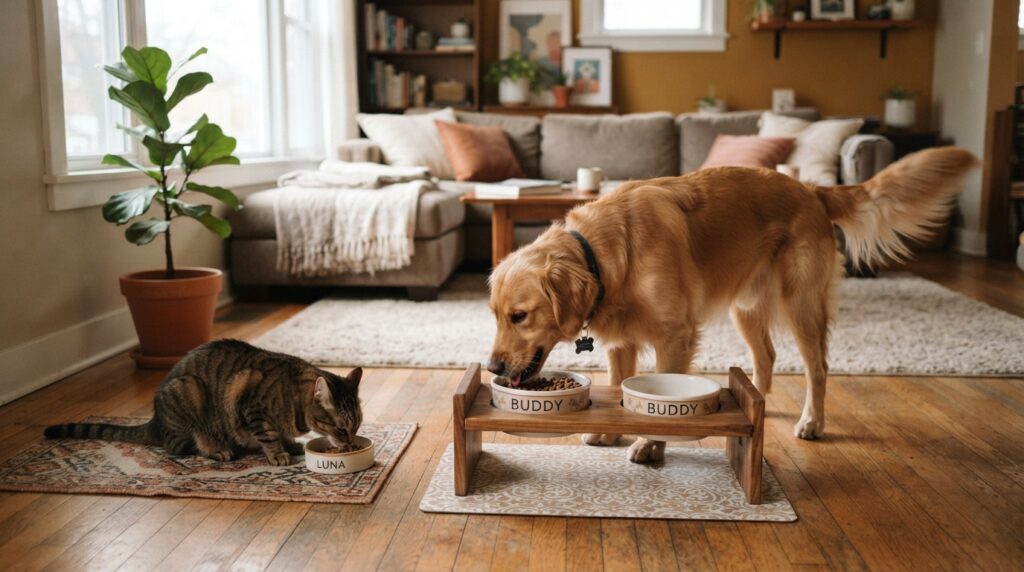
The simplest way to prevent food swapping is to give each pet a clearly identified feeding space. Two separate feeding stations, one for each animal, are a practical starting setup. Keep each pet’s serving distinct, especially when their food or daily targets differ.
Separate spaces help us know which pet ate which food. This matters when pets have different diets, meal amounts, or health needs. A shared bowl makes it harder to track each animal’s intake.
Choose a setup that fits the home and the pets’ behavior:
| Situation | Setup | Check |
|---|---|---|
| Two pets with different foods | Separate stations | Confirm each gets the labeled food |
| One pet finishes early | Supervise or use a closed door | Verify the second pet finishes its own serving |
| Several caregivers share feeding | Use one written meal record | Mark each serving when given |
A closed door can keep a fast eater away from another pet’s bowl. Supervision helps when the animals need to eat in the same room. The aim is to let each pet finish its own serving without pressure.
When several people feed the pets, one shared record can prevent a meal from being served twice. Mark the serving when it is given, rather than relying on memory later. This is especially useful when daily routines change.
If one pet repeatedly reaches another’s food, supervise the meal or separate the animals until both bowls are cleared.
What Can Slow Feeders Change, and What Can’t They Change?
A slow-feeder bowl changes how quickly a pet reaches food, not how many calories are in it. It uses barriers that slow access to the same measured food. Slow feeders do not lower the food’s calorie content or change the daily allowance.
A puzzle feeder works differently: the pet must work to reach the food. Both tools change the pace or access, but neither makes the food itself less energy-rich.
We can put a planned portion in a slow-feeder bowl to make eating take longer. A puzzle feeder can turn access into a task, depending on its design. In both cases, the pet still receives the same food amount unless we change the portion.
Count the full daily allowance before dividing it among meals or feeding tools. Food placed in a puzzle feeder still belongs in the day’s total. Using a feeder does not make an extra serving calorie-free.
These tools are not a good fit for every pet. Avoid them if a pet struggles to reach food or has a veterinary feeding restriction that conflicts with their use. Comfort and the pet’s medical needs come first.
Watch the pet use the bowl or puzzle to see whether access feels manageable. If the pet cannot eat comfortably, use a simpler dish and follow veterinary guidance. Measure the day’s full allowance first, then use a slow feeder only if the pet can eat comfortably from it.
How Should We Transition to a New Food?
A new food can deliver a different number of calories in the same scoop, so its serving should not be copied automatically. When no veterinary or product direction calls for another schedule, a gradual change commonly takes about 7-10 days. Compare the calorie density of both foods before setting the new amount.
Equal volumes of two foods may provide different calories. A cup of one food can have a different calorie amount from a cup of another, even when the scoops look alike.
Use the calorie information on each food label to compare energy per unit of food weight. Then confirm the new target with the veterinary team, especially if the pet needs a therapeutic diet. A food change for a health condition may need a different plan.
A gradual transition gives us time to introduce the new food while reducing the old one. Follow the food directions or veterinary instructions if they set another schedule. The general 7-10-day approach applies only when no specific direction says otherwise.
Do not assume the old scoop amount still fits the new food. Its calorie density may differ, so the same volume can change the pet’s daily intake. Use the new food’s label and the veterinary target to guide the serving.
For a therapeutic diet, check with the veterinary team before making a switch or changing the amount. Follow the veterinarian’s instructions if a health condition requires a food change on a different schedule.
How Can We Prepare Feeding Instructions for a Pet Sitter?
A pet sitter should be able to serve each meal without estimating or asking which bowl belongs to which pet. Prepare one labeled container for each planned meal, with the pet’s name, food amount in grams, and serving time. Divide the full 24-hour food allowance before the caregiver arrives.
Pre-portioned meals reduce guesswork and make it less likely that someone adds an extra scoop. A clear handoff also helps when the usual routine changes while we are away.
Use this four-part handoff checklist:
- Label each container with the pet’s name.
- Portion each meal in grams.
- Mark the serving time.
- Record the meal once served.
Keep containers separate if several pets have different foods or amounts. An unlabeled shared container can make it easy to serve the wrong amount or the wrong food. Each meal should be clear without relying on the caregiver’s memory.
Write down any feeding instructions that affect the pet’s routine. A sitter can use the schedule to check what has already been served, then mark the next meal after giving it. This also helps prevent two caregivers from serving the same meal.
Leave the written daily schedule beside the pre-measured meals, and ask the caregiver to mark each serving when it is given.
Conclusion
A consistent daily routine makes it easier to know what our pet is eating and to notice meaningful changes. Measured meals and counted extras help us follow an individualized target without guessing. They support weight management, but they do not promise a particular health outcome.
Our next step is to discuss the pet’s ideal weight and daily target with the veterinary team. Write down the pet’s current food and usual daily amount, then ask the veterinary team whether that amount supports the pet’s ideal weight.