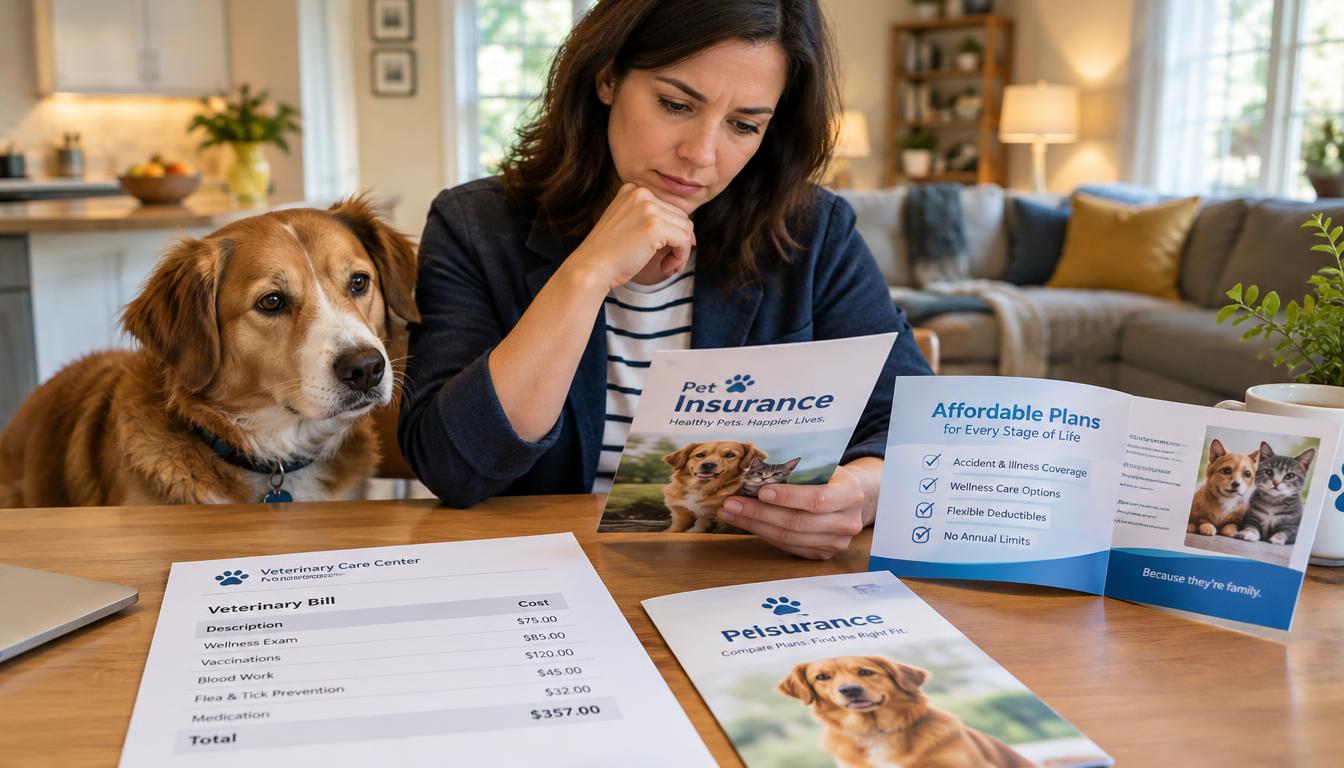
A sudden veterinary bill can strain a household budget even when the monthly premium seemed manageable. Affordable Pet Insurance Plans help us weigh regular costs against unexpected veterinary bills for dog and cat care.
Our comparisons cover different plan types and named options, along with practical ways to review personalized quotes. A low monthly price may look helpful, but it can leave a large share of a covered bill for you to pay.
We’ll focus on insurance cost planning that considers both what coverage costs each month and how it responds when a pet needs care. The useful comparison is the cost of keeping coverage and the share of a covered bill you would still pay.
Key Takeaways
- Compare premiums alongside deductibles, reimbursement rates, and annual limits.
- Use national averages as a starting point, not as your expected quote.
- Match accident-only coverage to the risks you can afford to handle.
- Request at least three quotes with the same coverage settings.
- Read policy terms before relying on a discount or coverage exception.
What makes a plan affordable beyond its monthly premium?
A lower premium can cost more overall if it leaves you paying a larger share of a veterinary bill. True affordability depends on the premium, deductible, and remaining claim costs.
The reimbursement rate is the percentage of eligible veterinary expenses a policy pays back after the deductible, subject to the plan’s limits and terms. A higher deductible or lower reimbursement rate can reduce the premium while increasing what you pay for care.
Choose a deductible you could pay from savings, not just the one that produces the smallest quote.
Your premium is the regular price for keeping the policy. Your deductible is the amount you pay before reimbursement applies, and your share of a covered bill comes after that.
For example, imagine a $1,000 eligible claim with a $250 deductible and 80% reimbursement applied after the deductible. The insurer reimburses $600, leaving you to pay $400.
Monthly premiums also change with location, plan type, pet age, breed, and overall health. Accident-and-illness plans typically cost more than accident-only plans because they cover more types of conditions.
A higher deductible generally lowers a premium, while a lower deductible generally raises it. Plans with lower reimbursement rates also generally cost less, but they return less for eligible expenses.
Compare the premium with the bill you might still owe
Look beyond the monthly price and consider the amount you might need to pay during a costly visit. A plan that costs less each month may leave you with a larger bill when care is needed.
Decide how much financial risk to keep
Choose a deductible you could pay from savings, not just the one that produces the smallest quote.
How much does pet insurance cost by pet and coverage type?
In 2024, average U.S. accident-and-illness coverage cost $62.44 per month for a dog and $32.21 for a cat. Accident-only coverage averaged less for both pets.
These are national averages, not personalized pet insurance quotes. The figures offer a reference point for how much pet insurance may cost per month, not a price you should expect for your dog or cat.
| Species | Coverage type | Average monthly premium |
|---|---|---|
| Dog | Accident-and-illness | $62.44 |
| Cat | Accident-and-illness | $32.21 |
| Dog | Accident-only | $16.10 |
| Cat | Accident-only | $9.17 |
In 2024, accident-only coverage averaged $16.10 per month for dogs and $9.17 for cats. An accident-only policy covers eligible injuries, while accident-and-illness coverage can cover eligible injuries and illnesses.
The averages came from U.S. data for 2024. They describe broad pricing across covered pets, rather than a specific insurer’s offer or a quote for one pet.
A separate comparison of 25 insurers used a $250 annual deductible, a $5,000 annual limit, and 80% reimbursement. It sampled pets aged 2 and 8 in 11 U.S. cities and reported median rates.
Those set details help make the comparison more consistent, but they do not make it a personalized quote. Prices for the same coverage can still differ among pets and locations.
Use the averages to set expectations, then compare quotes based on the same deductible, limit and reimbursement rate.
Which Affordable Pet Insurance Plans Fit Different Budgets?
Among these five sample comparisons, Figo had the lowest monthly figures for both dogs and cats. These sample figures came from plans with the same coverage settings.
Figo’s lower sample rate does not establish the best fit for every pet. The comparison used a $250 deductible, a $5,000 annual limit, and 80% reimbursement for each company.
| Company | Sample dog premium per month | Sample cat premium per month |
|---|---|---|
| Figo | $46 | $22 |
| Spot | $55 | $25 |
| Pumpkin | $71 | $28 |
| AKC | $62 | $35 |
| Lemonade | $53 | $24 |
These are sample monthly rates from a shared comparison setup, not current personalized prices. They do not guarantee the cheapest option for an individual pet.
Figo may belong on a shortlist for shoppers focused on sample price. Spot is an option to examine for coverage breadth, while Pumpkin may interest owners concerned about large bills.
AKC may suit readers researching pre-existing-condition exceptions. Those details depend on policy terms and availability, so none of these descriptions is a universal ranking.
Readers comparing the best affordable pet insurance plans for dogs can use the table to choose companies for closer review. The same sample results may help people looking at Spot pet insurance or other options.
Insurance companies 2026 may offer different products or availability by state. Sample-price results describe one comparison, not every current option or each household’s needs.
Compare the policy terms behind each quote before choosing the lowest number in the table.
How should you compare pet insurance companies?
Three quotes are useful only when they describe comparable coverage. Use matching settings for the deductible, annual limit, and reimbursement rate.
Policy terms decide which expenses qualify and which claim rules apply. A list of advertised features cannot replace the policy for your location.
Start by checking which accidents, illnesses, and other conditions the base pet insurance plan covers. Then review annual coverage limits and exclusions that could narrow that protection.
Check what the base policy covers
Look for rules on reimbursement and whether the policy pays toward exam fees. A condition may be covered while an expense tied to its treatment has a separate limit or exclusion.
Compare whether each policy includes or excludes routine care, dental treatment, or other costs you expect. The exact terms matter more than a short summary of coverage.
Compare limits, service and claim rules
Compare customer support and the options for submitting a claim. Also check the policy’s claim rules, since similar coverage labels can still come with different requirements.
Request at least three personalized quotes from insurance companies using the same deductible, annual limit, and reimbursement rate. That makes their premiums easier to compare fairly.
In 2026, plan options and availability can differ by state. A company’s general feature list is not the policy that applies to your pet.
Save each quote’s coverage selections beside its premium so the apparent bargain can be checked against the policy details.
Which choices and discounts can lower your premium?
Raising the deductible or lowering the reimbursement rate can reduce the premium, but both increase the owner’s share of eligible costs. Each tradeoff changes what you may pay for care.
A discount changes the premium, not the coverage rules. Paying less each month can still leave more of a claim for you to cover.
Adjust the deductible and reimbursement rate
A higher deductible usually lowers the premium, but you must pay more before reimbursement applies. A lower reimbursement rate can lower the monthly cost, while reducing the share returned on eligible expenses.
Check multi-pet and payment discounts
Use these five levers when comparing insurance quotes:
- Choose a higher deductible only if you can cover it from savings.
- Compare a lower reimbursement rate with the added claim costs.
- Check multi-pet savings for every pet in your household.
- Ask whether your employer or household bundle offers a discount.
- Check whether paying annually changes the total bill.
ASPCA Pet Health Insurance offers a 10% multi-pet discount for each additional pet. Spot and Pumpkin each offer a 10% multi-pet discount, while AKC offers 5%.
Lemonade’s multi-pet discount ranges from 5% to 10%, depending on the state. Ask each company which pets count and whether any other terms apply.
A discount can help lower the monthly premium, but it does not change covered conditions, deductibles, or reimbursement rules. Read the quote to see the real cost of each choice.
Confirm the final premium and the conditions attached to every discount in the personalized quote.
What does an accident-only plan cover?
An accident-only plan can help with an injury such as a swallowed object, but it will not pay for cancer treatment. Injury-only coverage can lower the price while leaving illness bills to you.
Accident-only coverage does not cover illnesses such as cancer. Accident-and-illness plans typically cost more because they cover both categories, subject to exclusions and limits.
When injury-only coverage can help
An accident-only policy may cover eligible care for a broken bone, snakebite, or swallowed object. These injuries can lead to sudden vet expenses that may be hard to plan for.
With this coverage, you remain responsible for illnesses that the policy does not cover. That can include costly treatment for conditions such as cancer.
What illness coverage adds
An accident-and-illness plan can address eligible injuries and illnesses, according to the policy’s terms. It may fit owners who want help with both kinds of unexpected care.
Neither plan type pays every bill. Exclusions, limits, and other policy terms still shape what the insurer will reimburse.
- An accident-only plan covers eligible injuries, not illness treatment.
- An accident-and-illness plan can cover eligible injuries and illnesses.
- Either plan can exclude costs or limit reimbursement by its terms.
Choose injury-only coverage only if you can handle the possibility of paying illness bills yourself.
Which Prudent Pet plan matches your coverage needs?
Prudent Pet’s Ultimate plan is the only one of its three plans with an unlimited annual payout. Ultimate differs from the Accident-Only and Essential plans in its annual limit.
Essential has a $10,000 annual-limit headline, while a review also lists a separate $2,500 tier. The two figures are reported as a discrepancy, not a single reconciled limit.
| Plan | Main coverage | Annual payout detail | Customizable reimbursement/deductible |
|---|---|---|---|
| Accident-Only | Injury coverage | $10,000 | 70%, 80%, or 90%; $100, $250, $500, or $1,000 |
| Essential | Accidents and illnesses | $10,000 headline; separate $2,500 tier listed | 70%, 80%, or 90%; $100, $250, $500, or $1,000 |
| Ultimate | Accidents and illnesses | Unlimited annual payout | 70%, 80%, or 90%; $100, $250, $500, or $1,000 |
Prudent Pet policies are underwritten by Markel Insurance Company or Markel American Insurance Company, depending on the state. The policies are administered by Prudent Pet Insurance Agency, LLC.
The listed reimbursement choices are 70%, 80%, and 90%. Listed annual deductibles are $100, $250, $500, and $1,000, with options shown in a live quote.
Exam-fee coverage is not included by default. It is an optional paid add-on at purchase or renewal, so check whether it appears in your selected plan.
Ultimate has a $1,000 annual behavioral sub-limit. An older Ultimate Plus form lists $2,000, a separate form detail that should not be confused with the current plan description.
Check the declarations and state-specific quote carefully, especially for Essential’s differing listed limit tiers.
What does ASPCA Pet Health Insurance cover?
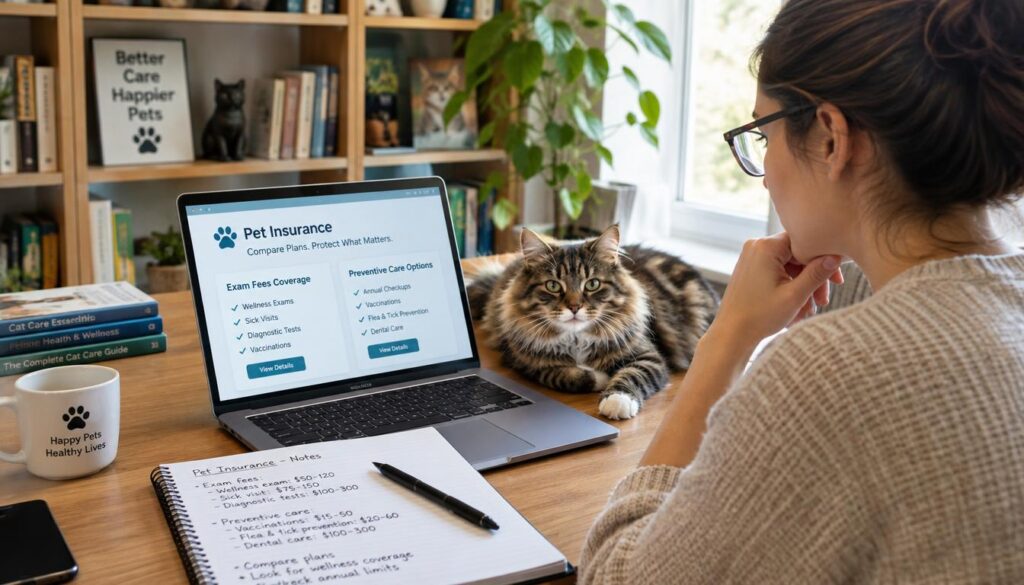
ASPCA Pet Health Insurance offers both accident-and-illness coverage and an accident-only option. Optional preventive care can help with eligible routine expenses, subject to its terms.
Eligible medical expenses may be reimbursed at rates up to 90%, depending on plan options. Coverage is not a promise that every condition or treatment qualifies.
| Coverage choice | Accident and illness treatment | Preventive care | Key detail |
|---|---|---|---|
| Accident-and-illness coverage | Eligible accidents and illnesses | Optional | May include exam fees and diagnostics |
| Accident-only coverage | Eligible accidents | Optional | Illness treatment is not included |
| Optional preventive care | Not accident or illness treatment | Eligible routine expenses | May include vaccines and annual checkups |
Plans can cover eligible exam fees, diagnostics, and treatment for accidents, illnesses, hereditary conditions, and behavioral issues. The selected policy determines which expenses qualify.
Optional preventive-care coverage can reimburse eligible routine expenses such as vaccines, dental cleanings, spaying or neutering, and annual checkups. It is separate from accident-and-illness treatment.
Policyholders can visit any licensed veterinarian in the United States or Canada. That access does not change the policy’s limits or make every expense eligible.
Coverage details can matter when you have one pet or several. Read the terms for the selected plan rather than assuming every service will qualify.
Check the selected plan’s terms to see which routine expenses are eligible for reimbursement.
What plan options can change coverage beyond the premium?
A plan’s annual limit and reimbursement percentage can change the amount available after a covered veterinary bill. Different settings can shape how much support a policy offers.
More options do not guarantee that a particular claim will be approved. The policy and selected terms decide whether an expense qualifies.
Compare annual limits and reimbursement choices
Lemonade lists annual limits of $5,000, $10,000, $20,000, $50,000, and $100,000. Its listed reimbursement choices are 60%, 70%, 80%, and 90%.
Lemonade also lists deductibles of $100, $250, $500, and $750. Those choices let buyers configure a policy, but the selected terms still control eligibility.
Figo offers a 100% reimbursement option, which is unusual. The deductible and eligible-expense rules still apply, so the option does not mean every bill is paid in full.
Check direct payment and support options
Pets Best lets buyers customize the deductible, reimbursement rate, and annual limit. It offers reimbursement up to 90%, direct vet pay with all plans, and a 24/7 Pet Helpline with all plans.
Direct payment differs from reimbursement after the owner pays the clinic. It may change who pays first, but policy terms still decide what qualifies.
Features such as physical therapy coverage also depend on the policy and selected options. Do not treat an advertised feature as approval for a specific claim.
Compare the feature that matters most to your household, not the longest list of optional settings.
Can a pet’s pre-existing condition ever qualify?
Some insurers may cover certain curable pre-existing conditions after a symptom-free period, but exceptions are limited. Most policies exclude conditions that showed signs before coverage began.
Pet insurance generally does not cover pre-existing conditions. Any exception depends on the condition, medical record, policy, and state.
Understand the usual pre-existing-condition exclusion
A prior diagnosis, treatment, or symptom may affect whether a later claim qualifies. The insurer may review records to decide whether a condition began before the policy took effect.
A pet’s breed can shape health risks, but a breed alone does not prove that a condition qualifies for coverage. The policy and the pet’s medical history matter.
Check the curable-condition exceptions
Figo may cover a curable pre-existing condition if the pet has shown no signs or symptoms for 12 months after its last treatment. This rule is conditional, not a promise for chronic conditions.
Spot may cover an eligible curable condition after 180 days without symptoms or treatment. The specific condition must meet the policy’s requirements.
AKC may cover pre-existing conditions after 365 days of enrollment in many states. Availability is not universal, and pets enrolled beyond age 9 are eligible for accident coverage only.
Ask the insurer to assess the specific medical record before relying on an exception.
How do waiting periods and age limits affect eligibility?
Accident coverage can begin within days while illness or orthopedic coverage may require a longer wait. Waiting periods vary by state, insurer, coverage type, and policy.
Check the dates for each kind of coverage, not just the accident start date. Some policies also set an upper age limit for new enrollment.
Know when accident and illness coverage begins
Prudent Pet lists five days for accidents, 14 days for illnesses, and six months for knee and ligament issues. It may waive the last wait after a vet exam within the first 30 days.
Lemonade lists next-day accident coverage, 14 days for illness, and 30 days for orthopedic conditions. These are company examples, not rules for every pet insurer.
Check these details before enrollment:
- Accident waiting period for the selected policy.
- Illness waiting period and start date.
- Special orthopedic or ligament waiting period.
- Any waiver terms, including required vet exams.
- Maximum new-enrollment age for your pet.
Check new-enrollment age rules
Pumpkin allows enrollment from 8 weeks old and has no upper age limit. Prudent Pet also has no upper age limit.
Lemonade may set an upper age limit based on breed. AKC pets enrolled beyond age 9 are eligible for accident coverage only.
These enrollment rules differ by company, state, and policy. They do not set one age limit across the pet insurance market.
Confirm the waiting-period dates and age eligibility in the policy form for your state before enrolling.
What expenses and exclusions should you check before buying?
A policy can cover treatment for an illness yet handle the exam fee for that visit differently. Related costs may have separate terms.
Coverage for a condition does not mean every bill connected to it qualifies. Deductibles, reimbursement rates, annual limits, exclusions, and waiting periods still apply.

Review the base policy and exclusions
Some policies include a cost in the base plan, while others limit it or require an add-on. Use these five checks when reading policy terms:
- Exam fees for visits tied to an injury or illness.
- Dental illness treatment and related procedures.
- Rehabilitation or physical therapy after an injury.
- Behavioral treatment and any stated sub-limits.
- Prescription food or supplements for a covered condition.
Look for expenses that need an add-on
Exam fees may be handled differently from diagnostics or treatment. A plan could cover one expense but not another from the same appointment.
Dental illness, physical therapy, and behavioral treatment may face limits or added conditions. Check whether the policy names the service and how it defines eligible care.
Prescription food or supplements may also have specific rules. Do not assume that a vet’s recommendation alone makes the cost eligible.
Read the exclusions and add-on schedule alongside the headline coverage summary.
How do claims and reimbursement affect what you pay at the vet?
Most pet insurance requires the owner to pay the veterinary bill first and seek reimbursement afterward. Direct payment is available in some cases, but it is not universal.
The policy determines how the deductible and reimbursement rate apply. The order can change the amount returned for the same bill.
Understand the usual reimbursement sequence
In the common process, you visit a veterinarian, pay the bill, submit a claim, and receive reimbursement for eligible expenses. The deductible and policy terms affect the amount returned.
Some insurers may offer direct payment to a veterinarian. This is not the default across the market, and the policy sets the terms for using it.
See how the deductible calculation changes a payout
For a $2,000 surgery bill with a $500 deductible and 80% reimbursement, two calculation orders produce different results:
- Deductible first: $1,200 reimbursed, leaving you to pay $800.
- Reimbursement percentage first: $1,100 reimbursed, leaving you to pay $900.
Both examples use the same bill, deductible, and reimbursement rate. The order of calculation changes the insurer’s payment by $100.
Ask how the deductible is applied, since the same bill and percentages can produce a different payout.
How can you shop for a policy without overspending?
Start with three quotes built around the same pet, location and coverage choices. Matching quotes make it easier to compare the premium with the policy.
A California quote should use your pet’s actual ZIP code and selected coverage. National sample prices cannot show the cost for your location.
Get comparable quotes for your location
Use these five steps to shop for insurance companies 2026 and current pet insurance quotes:
- Gather your pet’s age, breed, and ZIP code.
- Request at least three quotes with matching coverage settings.
- Check the state-specific policy terms for each company.
- Ask about employer or household discounts and eligibility.
- Compare renewal affordability with the first premium.
Affordable options in California depend on your location and chosen coverage. A quote tied to your pet’s ZIP code gives a more useful comparison than a national sample.
Balance price with age and future costs
Seniors can compare available policies, but older pets may cost more to insure. Some insurers also restrict new enrollment based on age or breed.
Discounts and eligibility rules can differ by insurer and state. Check current terms instead of assuming a senior discount or promotion is available.
For the best deals, compare personalized quotes and confirm each discount, deductible, and coverage term. The lowest first premium may not stay affordable at renewal.
Save the policy documents with the quotes so a low first premium does not hide a costly limitation.
What can you do instead of pet insurance?
If a policy premium is not workable, a dedicated veterinary fund or another payment approach may still help prepare for bills. Different options can suit different household budgets.
A veterinary discount plan is not an insurance policy. It does not reimburse claims in the same way as pet insurance.
A discount plan may lower eligible costs, but it does not work like insurance reimbursement.
An emergency savings fund lets you set money aside for unexpected pet care. The amount available depends on what you can save and when a bill arrives.
You can also ask a veterinary clinic whether it offers payment arrangements. The clinic can explain which options it accepts for your bill.
Investigate a veterinary discount plan if participating clinics are available nearby. Pet Assure offers a veterinary discount plan, and Mint Wellness is offered by Pet Assure.
These products belong to the discount-plan category, not insurance. Compare their terms with your expected pet care costs before choosing one.
Check which clinics participate and which expenses qualify before relying on a discount plan.
Conclusion
A budget-friendly policy is one whose premium and likely out-of-pocket costs both fit your household. The best pet insurance plan balances a manageable monthly price with a deductible, reimbursement rate, and coverage limit you can live with.
Request comparable personalized quotes and read the policy exclusions before you buy. Check that the same settings appear across each quote, then weigh the costs against the care your pet may need.
Request three comparable quotes and read the selected policy’s terms before you buy.