A household with two pets can insure both through one company without necessarily putting them on the same policy. That choice matters when a dog and cat have different health needs, or when one pet may use more coverage. The Best Pet Health Insurance for Multiple Pets depends on how you want benefits and policy choices arranged.
We compare providers, policy structures, and monthly cost examples to help you narrow your options. A reimbursement rate is the percentage of eligible covered expenses an insurer reimburses after the deductible is met. Age, breed, location, and selected coverage can all change the cost of a quote.
Pets Best is a price-conscious starting point among providers with comparable two-dog costs. MetLife Pet’s Family Plan suits households that want one shared policy, while individual policies allow different coverage for each animal.
The best fit depends first on whether you prefer shared limits or separate coverage choices.
Key Takeaways
- Pets Best is a budget-focused starting point in the two-dog comparison.
- MetLife Pet offers one Family Plan for up to three dogs and cats.
- Individual policies let you choose different coverage for each animal.
- Compare quotes with matching limits, deductibles, and reimbursement rates.
- Check each pet’s policy terms, including waiting periods and exclusions.
Best Pet Health Insurance for Multiple Pets: Which Plans Fit Your Household?
For a price-conscious household comparing plans for two dogs, Pets Best is the clearest starting point, while MetLife Pet is the standout if one shared policy is the priority. These fit-based recommendations reflect different needs, not a universal ranking. Start with the policy structure that fits your household.
Pets Best is the budget starting point among providers with comparable two-dog costs. MetLife Pet is the choice when one shared policy matters more than separate customization. Spot and Pumpkin stand out for shoppers focused on multipet discounts, while ASPCA offers a direct-vet payment option.
Pets Best suits a budget-first comparison, while MetLife Pet fits households that want one shared policy.
| Provider | Best fit | Concrete differentiator |
|---|---|---|
| Pets Best | Price-conscious households seeking separate policies | Lowest two-dog estimate in this comparison |
| MetLife Pet Family Plan | Households wanting one shared policy | One policy can cover multiple pets |
| Spot | Discount-focused shoppers | Multipet discount |
| Pumpkin | Discount-focused shoppers | Multipet discount |
| ASPCA | Households interested in direct-vet payment | Direct-to-vet payment option |
These pet insurance companies offer different coverage options and policy setups. A lower premium may suit a household that wants separate policies, while shared annual coverage can matter more to another family.
Use the table to narrow which insurer deserves a quote for your pets. Treat the shortlist as a way to narrow quotes, not as a substitute for comparing each pet’s terms.
Can One Policy Cover Multiple Pets?
Yes, a single policy can cover multiple pets through MetLife Pet’s Family Plan, which accommodates up to three dogs and cats. The plan shares a deductible, annual limit, and reimbursement rate across enrolled animals. This setup is different from the individual policies most insurers use.
With most multi-pet arrangements, each animal has an individual policy, even when the policies appear together in one account. A dog and cat can therefore share an insurer but have separate terms. MetLife Pet’s Family Plan for up to three pets is a distinct shared-policy option.
- One shared Family Plan covers up to three dogs and cats.
- Separate individual policies give each pet its own terms.
- Two or more Family Plans can group households with more than three pets.
Households with more than three pets can place them in two or more MetLife Family Plans. That keeps the shared structure within each group, rather than extending one policy beyond its stated limit.
The term pet insurance can describe both shared and individual arrangements, so check the policy itself. Count the animals in your household before comparing quotes, since more than three pets may require multiple Family Plans.
Should You Choose Shared Limits or Separate Policies?
Choose shared limits when you value one pooled benefit amount more than tailoring each animal’s deductible and annual limit. A shared annual limit can shift to whichever enrolled pet needs more eligible care. The tradeoff is one pool of benefits for all covered animals.
Under MetLife Pet’s Family Plan, covered expenses count toward one deductible and annual limit. Eligible expenses are reimbursed at the selected rate until the shared limit runs out. One dog or cat could use more of the annual coverage, leaving less in that pool for another pet.
When Shared Limits Can Help
A shared plan can help when animals have similar coverage needs and you want one set of policy selections. If one pet has a costly year, the shared limit can be used for that animal instead of sitting unused under another pet’s separate limit.
When Separate Policies Offer More Control
Individual policies let you select different coverage levels for each animal. That can suit a young cat and an older dog with different health risks. MetLife’s Family Plan applies the same enrollment selections to all pets enrolled together.
| Setup | Deductible and annual-limit arrangement | Customization |
|---|---|---|
| MetLife Family Plan | One shared deductible and annual limit | Same selections for enrolled animals |
| Individual policies | Separate policy terms | Coverage levels can differ |
| Two or more Family Plans | Shared terms within each group | Useful for more than three pets |
Shared coverage does not mean each animal receives a separate copy of the limit. If one animal needs a higher limit or a different reimbursement rate, compare individual policies before choosing a shared Family Plan.
What Does Multi-Pet Insurance Cost?
For two dogs under the same comparison assumptions, the monthly estimates range from $77 with Pets Best to $94 with ASPCA. Pets Best is the least expensive in this four-provider comparison. These figures are estimates, not a quote for every household.
The comparison uses $5,000 in annual coverage, a $500 deductible, and an 80% reimbursement rate. Matching those settings makes the monthly cost easier to compare across providers. It does not predict the price for a specific dog or address every plan option.
| Provider | Average monthly cost for two dogs | Annual coverage | Deductible and reimbursement assumptions |
|---|---|---|---|
| Pets Best | $77 | $5,000 | $500 and 80% |
| Spot | $84 | $5,000 | $500 and 80% |
| Pumpkin | $81 | $5,000 | $500 and 80% |
| ASPCA | $94 | $5,000 | $500 and 80% |
For broader context, 2024 average monthly premiums for accident-and-illness insurance were $62.44 for dogs and $32.21 for cats. Accident-only averages were lower: $16.10 for dogs and $9.17 for cats.
MetLife Pet lists starting prices of $7 per month for one cat and $16 for one dog. Those starting prices do not describe every plan, pet, or household.
Location, breed, age, and selected coverage change individual premiums. Compare quotes using the same deductible, reimbursement rate, and annual limit so the price difference reflects the provider rather than mismatched coverage.
Which Coverage Options Matter for Multiple Pets?
For most households seeking protection from unexpected treatment costs, accident-and-illness coverage is the more complete starting point than accident-only protection. Accident-and-illness plans generally cover eligible new injuries and illnesses. Accident-only plans focus on accidental injuries, so they offer narrower protection.
Compare each pet’s choices before selecting a plan. A dog that spends time outdoors may have different risks from an indoor cat, and a household may choose different limits through individual policies.
Accident-Only Versus Accident-and-Illness Coverage
An accident-only plan can fit a household seeking a narrower form of protection. Accident-and-illness coverage may help with a wider range of eligible treatment, depending on policy terms. Neither type makes every vet bill eligible.
Annual Limits, Deductibles, and Reimbursement Rates
These five choices shape what a policy covers and what you pay:
- Accident-only or accident-and-illness protection
- Annual limit for eligible covered care
- Deductible paid before reimbursement applies
- Reimbursement rate for covered expenses
- Exclusions and optional add-ons
Prudent Pet lists reimbursement choices of 70%, 80%, and 90%, with deductibles of $100, $250, $500, and $1,000. Its listed annual coverage choices are $10,000 or unlimited.
Lemonade lists annual coverage choices from $5,000 to $100,000. Its reimbursement choices range from 60% to 90%. Plan options may differ by state, so those examples do not mean every choice is available everywhere.
Check the policy’s exclusions as carefully as its limit, because a high annual amount cannot make an excluded treatment eligible.
Which Insurers Offer Useful Multi-Pet Discounts?
A multipet discount is usually 5% or 10%, and it generally reduces the cost of adding pets rather than the first pet’s premium. Discount size alone does not show which plan costs less overall. The starting premium and coverage fit also matter, so compare the final total.
Pets Best offers 5%; Spot, Pumpkin, ASPCA, and Embrace offer 10%. Lemonade’s discount ranges from 5% to 10%, depending on the state. Fetch, Healthy Paws, and Trupanion do not offer a multipet discount.
| Provider | Discount | Application or qualification |
|---|---|---|
| Pets Best | 5% | Multipet discount |
| Spot | 10% | Additional enrolled pets |
| ASPCA | 10% | Additional enrolled pets |
| Lemonade | 5% to 10% | Varies by state |
| Fetch | None | No multipet discount |
MetLife Pet offers a discount for multiple individual policies, but does not state the rate on its page. A discount may reduce a premium, but it cannot fix a policy that does not suit an animal’s needs.
Compare the final quote for every animal, since a larger percentage discount does not guarantee the lowest total bill.
Which Insurers Can Pay Your Vet Directly?
Pets Best and ASPCA are the named options here that can pay a veterinarian directly, while reimbursement after you pay is the typical process. Direct payment can reduce the amount due upfront, but it does not guarantee full payment. The clinic must accept the arrangement, and some costs may remain your responsibility.
Pet insurance typically reimburses a percentage of eligible out-of-pocket costs after the deductible. Coverage can generally be used with any licensed veterinarian, but direct payment is a separate feature. Ask how that feature applies to the treatment you need.
- Check whether the insurer can pay the veterinarian directly.
- Confirm that the clinic accepts that arrangement.
- Keep enough available to cover any unpaid amount.
Pets Best offers Direct Vet Pay with its plans, and ASPCA offers a direct-to-vet payment option. Neither option means every clinic participates or every bill is paid in full.
Ask the clinic and insurer how direct payment works before treatment, rather than assuming the option is available for every claim.
How Do Waiting Periods Affect Multiple Pets?
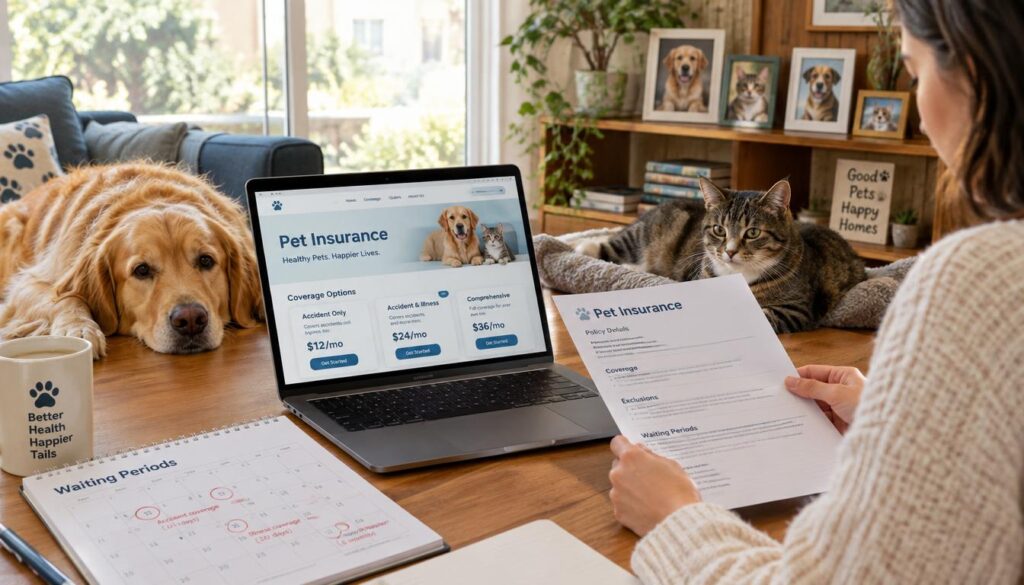
Waiting periods can differ by condition, so an accident start date does not tell you when illness or orthopedic coverage begins. A waiting period is the time between enrollment and when specified coverage can begin. Check each condition’s start date, not just the first day of the insurance plan.
MetLife Pet says its Family Plan has a zero-day waiting period for accidents and preventive care. Lemonade’s accident coverage begins the day after purchase, while its illness waiting period is 14 days.
Accident and Illness Start Dates
Those examples show why two policies can begin covering different needs on different dates. The accident start date does not set the illness start date. State and policy rules can also change the terms.
Orthopedic and Condition-Specific Delays
Lemonade lists a 30-day waiting period for orthopedic conditions. Pets Best waiting periods vary by state and coverage type, and its cruciate-ligament waiting period is six months.
Spot and Pumpkin have no special orthopedic waiting period. A standard accident or illness period may still apply, and specific policy terms govern when coverage starts.
Read the state-specific policy terms for every pet before enrolling, especially if a breed or medical history raises orthopedic concerns.
Is a Wellness Plan Worth Adding?
A wellness plan is worth considering when its listed preventive benefits match care you already expect to pay for. Optional wellness coverage pays toward scheduled care, not unexpected eligible accidents and illnesses. Check the package’s listed services and limits before adding it to each pet’s plan.
Pets Best and ASPCA offer optional routine-care coverage, while Lemonade offers preventive-care packages. These add-ons can include wellness visits, vaccines, dental cleanings, and spay or neuter procedures.
Routine care can look different for a puppy, kitten, adult animal, or older pet. A young pet may need vaccines and spay or neuter care, while another pet may need regular dental cleanings.
List the routine services you expect for each animal, then compare them with the add-on’s eligible services and reimbursement limits. A benefit that does not match your likely visits may add cost without helping much.
Add the cost of the package and its covered services before deciding whether it is a better fit than setting aside money for routine care.
Which Providers Fit Different Multi-Pet Households?
Lemonade and Embrace are worth checking first when a multipet discount is a priority, while the right fit still depends on each animal’s policy needs. Compare their policy terms as well as their discounts. Individual coverage can differ between a dog and cat, so one provider may not be the best match for every pet.
These pet insurance companies have distinct features that may help households decide which quote to request. Their discount rules and policy options can vary by state or animal.
Lemonade and Embrace for Discount-Seeking Households
Lemonade allows individually customized policies, and its multipet discount varies by state. It may also have an upper age limit for new enrollment based on breed. Those rules can affect whether an older pet can enroll.
Embrace offers a 10% multipet discount. Compare its terms with Lemonade’s for each animal rather than assuming a shared discount makes all coverage equal.
Spot and Trupanion for Different Policy Priorities
Spot offers a 10% multipet discount and has no special orthopedic waiting period. That timing detail may matter to households comparing dog insurance for breeds with orthopedic concerns.
Trupanion does not offer a multipet discount. A missing discount is one factor to weigh, not a verdict on the policy. Check the coverage terms and cost for each animal.
Pets Best and Healthy Paws for Individual-Policy Comparisons
Pets Best offers a 5% multipet discount, while Healthy Paws does not offer one. Both deserve an individual-policy comparison when separate coverage choices fit your household better.
Pets Best’s Direct Vet Pay is a distinguishing feature. Compare each policy’s terms rather than assuming the two insurance companies offer the same benefits or limits.
Verify available discounts, age rules, and coverage terms for each pet in the quote before choosing among these providers.
What Should California Pet Owners Compare?
California pet owners should compare the actual state-specific policy terms and quote, not rely only on a national discount or feature summary. Confirm that the insurer is licensed and the policy applies to your ZIP code. State rules can affect available coverage and consumer protections.
California residents should check the quoted policy’s waiting periods, exclusions, and available options. A policy summary may not show every term that applies to a specific address or pet.
Pets Best and ASPCA permit visits to licensed veterinarians in the United States or Canada. That feature does not settle California policy availability or determine the terms in a state-specific quote.
The NAIC Pet Insurance Model Act is a framework states can adopt or change, not a law that applies automatically nationwide. A legal overview of the NAIC model act explains why state rules differ.
Confirm the insurer’s California authorization and read the policy documents before relying on a quoted benefit.
How Do Claims Work When Multiple Pets Need Care?
Claim organization depends on whether the animals share a policy, not simply whether they visited the same veterinary clinic. MetLife allows claims for multiple pets on one policy to be filed together. Pets on separate policies require separate claims, and Lemonade also requires a separate claim for each pet, even on one invoice.
Keep the records clear when one visit covers several animals. A shared clinic bill does not change which policy covers each expense, so identify the animal and service on every record.
- Get an itemized invoice for each animal.
- Check which policy covers each expense.
- Submit each claim through the insurer’s required channel.
- Keep the invoice and supporting records.
- Track each reimbursement against its deductible and limit.
MetLife Pet lets owners file claims for more than one pet on the same policy at the same time. Separate policies require separate claims, even if the animals had care at one clinic.
Keep a separate record for each animal even when the insurer lets you submit claims together.
How Can You Compare Pet Insurance Quotes Fairly?
A fair quote comparison holds the annual limit, deductible, reimbursement rate, and coverage type constant. Matching these settings makes price differences more useful. A $250 deductible and 80% reimbursement rate have appeared in a standard dog-and-cat comparison, but that is an example, not a recommended setting.
Use the same basic settings for each insurer before you compare premiums. The goal is to see how similar policies price, rather than comparing a low-limit plan with a broader one.
Match the Coverage Settings
- Choose the same annual limit.
- Use the same deductible and reimbursement rate.
- Compare accident-and-illness or accident-only coverage consistently.
Compare Each Pet’s Needs Separately
Age, breed, and location can change a pet’s quote, as can the coverage selected. Different health risks may also make one limit suitable for a dog but not a cat.
One household may need different coverage levels for its animals. If individual policies allow those choices, compare each pet separately instead of treating the household as one risk.
Look beyond monthly cost to the deductible and eligible expenses the policy leaves with you. Compare the final out-of-pocket exposure as well as the monthly premium before selecting a policy.
What Mistakes Can Make Multi-Pet Coverage Fall Short?
The biggest avoidable mistake is buying the most attractive discount without checking what each animal’s policy actually covers. A lower premium cannot make an excluded treatment eligible. Review the policy terms for every pet, since their needs may differ.
Check for these risks before choosing:
Choosing a Discount Before Checking the Policy
- Choosing on discount alone, without comparing coverage and total cost.
- Assuming every pet has identical needs and policy choices.
- Overlooking an annual limit shared across enrolled animals.
Overlooking Waiting Periods and Pre-Existing Conditions
Spot and Pumpkin may cover some curable pre-existing conditions after 180 days without treatment or symptoms. That rule does not apply to ligament and knee conditions, so the condition type matters.
Pets Best has a six-month waiting period for cruciate ligament issues. A similar length of time does not mean the policies treat every condition alike.
Policy terms govern whether a condition is eligible and what proof the insurer needs. Ask the insurer to confirm in writing how a known condition, waiting period, and shared limit apply before enrollment.
How Do You Choose the Right Plan for Your Household?
Choose the policy structure that matches how differently your animals need to be covered, not just how many animals you own. A shared Family Plan suits households that value pooled benefits and one policy arrangement. Individual policies fit pets needing different coverage levels.
Compare both structures if one pet is likely to use substantially more coverage than another. A shared limit may offer flexibility, while separate policies give you more control over each animal’s selections.
Choose shared benefits when one pooled limit fits your household. Choose separate policies when your pets need different coverage.
Get a quote for every pet, including each dog and cat that needs coverage. Review the policy documents alongside the estimate, since a quote alone may not show every exclusion or condition.
Consider how you want to manage benefits and policy choices, then compare the terms that apply to each animal. The simplest arrangement is not always the one that offers the right coverage.
Before enrolling, save the quote and policy terms for each pet so you can verify the selections you intended.
Conclusion
A good multipet choice balances each animal’s coverage needs with the way your household wants to manage its policies. Pets Best is a sensible budget-focused starting point among the two-dog comparisons, while MetLife Pet’s Family Plan suits households that prefer shared limits.
Separate policies can work better when a dog and cat need different coverage. Get comparable quotes for every pet using the same coverage settings, then check the policy terms before enrolling.