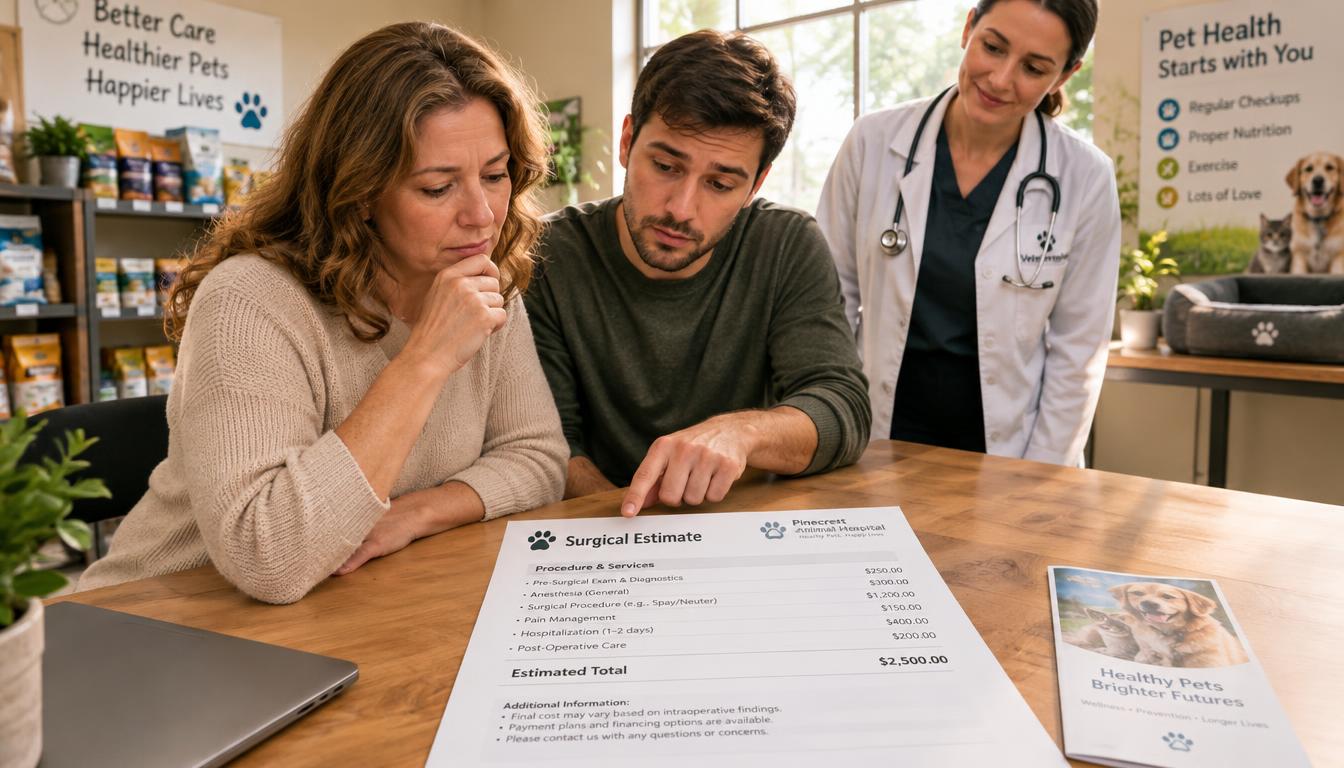
A recommended operation can bring medical decisions and financial questions at the same time. An itemized estimate is a written line-by-line breakdown of expected charges, what is included, and what may be billed separately. Pet owners can use it to understand vet bills and discuss pet care without losing sight of the animal’s needs.
Urgency, the recommended procedure, and our available funds shape the choices ahead. We can ask what the veterinarian recommends, what the clinic expects to charge, and when payment is due. This helps us compare care options while keeping the pet’s health at the center.
Pet Surgery Costs and Financing decisions can feel hard when treatment cannot wait. A clear estimate helps us see what we need to pay now and what options may fit our budget. We can also ask the clinic to explain terms we do not understand.
A written estimate gives us a clear starting point for discussing treatment and payment.
Key Takeaways
- Ask for a written, itemized estimate before agreeing to non-urgent care.
- Separate the procedure fee from tests, medication, and recovery costs.
- Check insurance rules and payment terms before counting on outside funds.
- Contact assistance programs before treatment when the medical timeline allows.
- For urgent cases, ask the veterinary team what must happen first.
What Determines Dog Surgery Prices?
Dog surgery prices reflect the procedure and the resources needed to diagnose, anesthetize, monitor, and support the dog’s recovery. Complexity matters: a longer operation or greater need for monitoring can raise veterinary care costs.
A procedure fee is not the same as a complete estimate. Surgery estimates can include the procedure, anesthesia, bloodwork, medications, and follow-up care. Costs also vary by procedure, species, and region.
A procedure fee covers only the work it names. The full estimate may include testing, medication, and recovery care.
Emergency surgery may treat a blocked urinary tract, swallowed object, fractured bone, or infected uterus. For a swallowed object or broken bone, the veterinarian’s assessment guides the exact treatment plan.
The American Veterinary Medical Association identifies clear communication about costs and treatment options as part of responsible veterinary practice. We can check whether each estimate charge is fixed, likely, or dependent on test results.
- Procedure
- Anesthesia
- Diagnostic testing
- Medication
- Follow-up care
Before agreeing to treatment, ask the clinic to mark each charge as included, separate, or optional.
How Much Do Common Pet Surgery Procedures Cost?
A TPLO example shows why a procedure price and a full treatment budget are not always the same number. TPLO, a common dog orthopedic surgery, repairs a knee ligament. Separate charges can add to the quoted price.
Named clinic prices are examples, not typical U.S. prices or complete bills. The year and city matter when we compare veterinary costs.
Orthopedic Surgery: TPLO Prices and Related Charges
In Chicago, VSx lists a 2026 TPLO procedure at $5,500-$6,800, including the procedure, anesthesia, and post-operative care instructions. In Indianapolis, its 2026 range is $3,950-$4,950, with the same stated inclusions.
VSx lists a 2026 surgeon consultation at $225 in Chicago and $185 in Indianapolis. A CT scan with a radiologist report costs $1,250-$2,500 in Chicago and $1,000-$1,800 in Indianapolis.
VSx bills pre-operative testing, diagnostic imaging, follow-up visits, pain medication, and possible physical therapy separately from its surgical fee. Bloodwork costs depend on the panel ordered. Most dogs need 8 to 12 weeks of restricted activity and physical therapy after major orthopedic surgery.
Foreign-Object Removal and Its Cost Drivers
Dog surgery to remove a foreign object can range from a few hundred to several thousand dollars. The total changes with the retrieval method, diagnostic tests, and hospitalization.
We can ask for an itemized estimate that separates the exam, imaging, operation, and hospital care. A swallowed object may need a different approach than one that has moved through the digestive tract.
Wound Treatment and Skin-Graft Costs
A veterinary practice listed by VSx charges $700-$900 for initial wound management, depending on cause and severity. The practice requires an evaluation before giving a treatment estimate.
Each added wound treatment and bandage change under sedation or anesthesia costs $175-$250 there. Completing skin-graft treatment costs $1,000-$1,900, depending on the wound and graft type.
A wound may take 2-3 months to heal, and a graft may require several procedures over weeks. A graft needs a wound bed with enough blood supply; poor supply can cause failure.
Grafts may work less well over bones, tendons, or ligaments, and on joints or infected wounds. Follow-up checks can confirm that the graft stays in place and does not become infected. A dog may need three weeks of restricted activity after graft surgery.
Ask the surgeon which recovery visits, medications, bandage changes, and therapy charges remain outside the quoted procedure fee.
How Do Pet Surgery Costs and Financing Work Together?
A payment plan can divide a large bill, but the repayment terms determine whether it is affordable. Compare the full cost before choosing credit or a clinic arrangement.
An in-house payment plan is arranged through the clinic; CareCredit and Scratch are outside financing options. Some clinics offer in-house installments, but availability and terms vary.
Clinic Payment Plans and Third-Party Financing
Best Friends lists CareCredit as a veterinary-care financing option and tells applicants to check whether they qualify. CareCredit is a third-party medical credit option. Promotional interest may apply after a promotional period.
Best Friends also lists Scratch as a provider of pet care payment plans. The clinic does not set the terms for either outside option.
| Option | Who sets the terms | Repayment and checks |
|---|---|---|
| In-house clinic plan | Clinic | Installments; ask about fees and due dates |
| CareCredit | CareCredit | Credit account; check APR and promotion end date |
| Scratch | Scratch | Payment plan; review monthly payment and total |
Credit Cards and Personal Loans
An ordinary credit card or personal loan may also help pay vet bills. The lender sets the terms, and the cost depends on the offer we receive.
Before accepting credit, review the APR, promotional-period end date, fees, monthly payment, and total repayment. A promotional offer is not automatically interest-free if the balance remains unpaid when the offer ends.
Compare the full amount repaid, not just the first monthly payment.
What Can Pet Insurance Pay for?
Pet insurance may reimburse part of an eligible surgery bill, but the policy’s exclusions and payment structure matter. Coverage depends on the policy and the pet’s health history.
Accident-and-illness policies may cover eligible surgery for conditions that begin after enrollment. Preventive or elective care may be excluded, so a policy does not promise payment for every procedure.

Many policies reimburse about 70%-90% of eligible costs, based on the chosen policy. A deductible is the amount we pay before coverage applies; a co-payment is our share of eligible costs.
Waiting periods can delay coverage after enrollment. Pre-existing-condition exclusions may rule out symptoms or diagnoses that began earlier, while annual limits cap what the insurer pays.
Many owners pay the veterinary hospital first, then submit a claim for reimbursement. The National Association of Insurance Commissioners’ Pet Insurance Model Act overview explains disclosures about waiting periods, limits, exclusions, and pre-existing conditions. State rules can differ.
Check the policy and call the insurer before counting a reimbursement toward the amount due at the clinic.
Which Financial Assistance Programs May Help?
A grant or assistance program may reduce a bill, but the right fit depends on the treatment and the program’s rules. Apply before care when the veterinary timeline allows.
Several sources may be needed to cover one veterinary bill. Aid providers may be less likely to pay for treatment that has already been provided.
National Funds and Their Focus
The Pet Fund and Pet Lifeline Program focus on non-basic, non-urgent veterinary care. Other programs list support for injuries, emergencies, or chronic conditions.
| Program | Stated focus | Location or eligibility detail |
|---|---|---|
| The Pet Fund | Non-basic, non-urgent veterinary care | Program rules apply |
| Paws 4 A Cure | Illnesses and injuries in dogs and cats | U.S.-wide assistance |
| RedRover | Emergency care, disasters, and domestic violence | Program rules apply |
| Brown Dog Foundation | Veterinary emergencies and chronic conditions | Program rules apply |
| Four-Legged Fund | Veterinary costs; zero-interest, zero-fee loans up to $5,000 | Los Angeles, Ventura, or Santa Barbara County residents |
RedRover also helps pets affected by natural disasters and other emergencies, including pets of domestic-violence survivors. Four-Legged Fund support is a loan, not a grant.
Applying Before Treatment
We can prepare a short application packet and contact more than one suitable source. A clear diagnosis and estimate can help programs assess the request.
- Confirm the program’s focus.
- Check eligibility and geographic limits.
- Gather the veterinary estimate and diagnosis.
- Contact more than one suitable source.
Contact eligible programs before treatment whenever the veterinary timeline allows.
Where Can We Find Lower-Cost Veterinary Surgery?
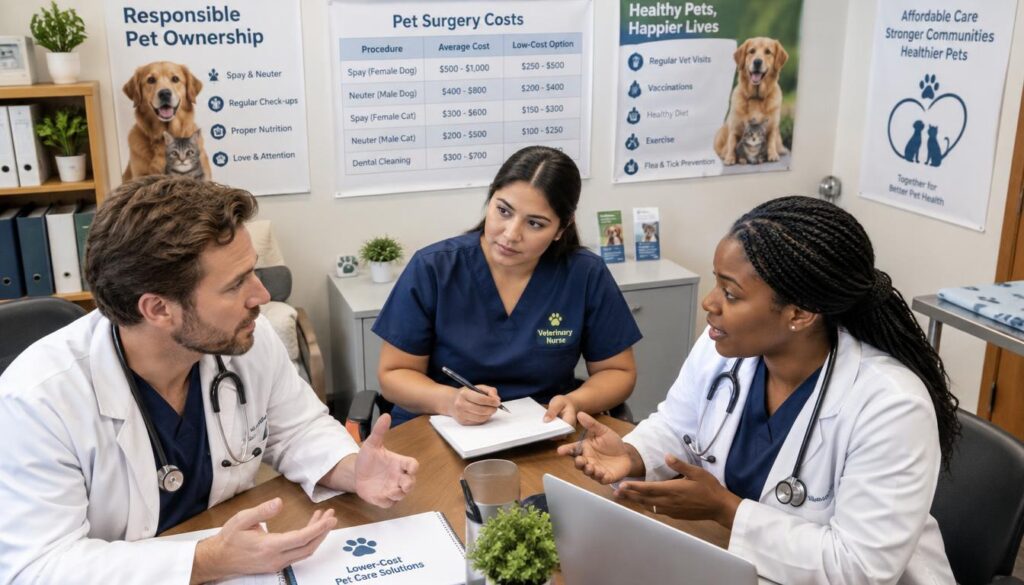
Accredited veterinary schools and community animal-welfare organizations are useful places to ask about reduced-cost care. Availability is local, and a lower price does not mean every procedure is offered.
Confirm that a provider can safely perform the specific surgery and provide follow-up. Programs, wait times, and eligibility vary by location and case.
Veterinary Schools and Teaching Hospitals
Accredited veterinary schools may offer reduced-cost treatment for pets. Best Friends identifies them as one possible source, but each school sets its own services and access rules.
We can ask whether a teaching hospital treats the condition, how soon it can see the pet, and whether the case suits its service. A long wait may not fit an urgent medical need.
Community Clinics and Routine Procedures
Low-income pet owners can check humane societies, shelters, rescue groups, and community clinics for free or reduced-cost veterinary care. Some areas offer spay neuter services at lower cost, though local programs differ.
Spay-neuter services are common low-cost options, while complex or urgent surgery may need another provider. The USDA Animal Welfare Information Center offers background on animal-welfare standards and regulated veterinary and rescue organizations.
We can compare written estimates for medically appropriate care, including what each provider offers after surgery. Ask whether follow-up visits, wound checks, or medication are available at that clinic.
Confirm that the clinic can provide the specific procedure and follow-up your veterinarian recommends.
What Should We Do When Surgery Is Urgent?
In an emergency, first confirm with the veterinary team how quickly the pet needs to be seen. Do not delay urgent care while waiting for a grant, loan, or crowdfunding response.
Ask what treatment must happen now and what the hospital expects it to cost. We can take these steps while the team explains the pet’s condition.
Funding can help, but it should not delay care the veterinary team says is urgent.
- Call the emergency hospital and describe the symptoms.
- Ask whether the pet needs immediate transport.
- Request the stabilization cost separately from the full procedure.
- Ask about the hospital’s payment policies.
We can contact family and friends or start a transparent crowdfunding campaign. Post the written estimate, state a specific goal, and share recovery updates; launching within the first 24 hours can help the campaign get seen.
Some larger hospitals have veterinary social workers who can help owners find grants, counseling, and community resources. Ask the hospital whether one is available.
Keep the treatment estimate and any funding requests aligned with the veterinarian’s current plan.
Conclusion
A clear estimate helps us weigh the recommended care against the resources available now. Knowing what the quoted amount includes helps pet owners make a sound choice without confusing a procedure fee with the full bill.
Our next step is to call the clinic with the estimate in hand and confirm the immediate payment requirement. Ask the veterinary team what amount is due first and which payment or assistance options can be pursued today.