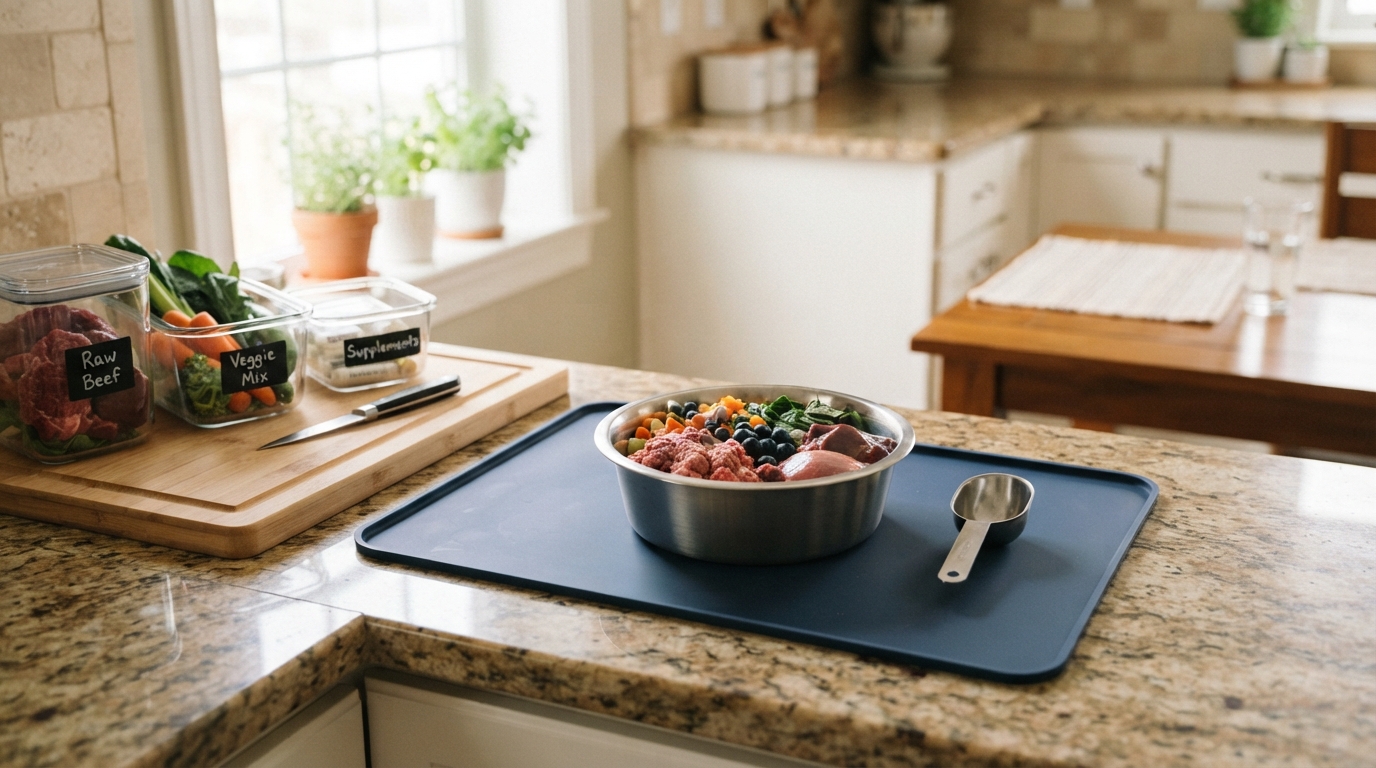
Raw feeding can expose dogs and people to harmful bacteria, and safety depends on both careful handling and nutritional balance. A bowl that looks fresh can still bring bacteria into a home. That risk matters for pets and everyone who shares their space.
We can lower exposure with a steady food safety routine, but no routine removes every risk. A dog also needs a diet that meets its health and life-stage needs. The right choice depends on the food, the dog, and the people at home.
We’ll cover safe handling, nutritional adequacy, recalls, and household fit. These points can help us weigh risks without treating careful habits as a guarantee. Treat raw feeding as a choice that calls for an informed plan, not as a risk-free routine.
Key Takeaways
- Raw food can carry harmful bacteria.
- Dogs may spread bacteria without looking sick.
- Separate preparation and careful cleanup lower exposure.
- Check that the main diet meets the dog’s needs.
- Review recalls and discuss diet changes with a veterinarian.
Raw Feeding Safety for Dogs: What Are the Main Risks?
Fifteen of 196 raw pet food samples in an FDA CVM study tested positive for Salmonella. Those results show that raw food can carry harmful bacteria, though they do not measure every product today.
Cross-contamination is the transfer of bacteria from raw food, hands, utensils, or surfaces to other food or people. It can also spread bacteria to pets, bowls, and kitchen surfaces. Raw food may contain germs even when it looks and smells normal.
From October 2010 through July 2012, FDA CVM screened over 1,000 pet-food samples. The review included 196 commercially available raw dog and cat foods; 32 tested positive for Listeria monocytogenes.
The FDA raw-food sampling assignment reports these historical findings. A 2017-2018 U.S. survey found that 3% of dog owners bought raw pet food.
Pathogens can affect pets and people
A raw meat-based diet uses uncooked ingredients from domesticated or wild animals. It may include meat, organs, bones, eggs, unpasteurized milk, produce, or supplements.
Salmonella and Listeria monocytogenes can affect pets and people. Pregnant people, newborns, adults ages 65 and older, and people with weakened immune systems face greater risk of serious illness from Listeria.
Scientific research on a raw food diet for dogs documents pathogen exposure, but reported health benefits are not the same as proven outcomes. Infected pets may spread Salmonella or Listeria monocytogenes before anyone knows they are carrying germs.
A healthy-looking dog can still carry bacteria
A dog can carry and spread harmful bacteria without showing signs of illness.
Some dogs do become sick, while others appear well. That makes a healthy-looking pet an unreliable sign that raw food has not brought bacteria into the home.
A dog’s healthy appearance does not rule out carrying bacteria that can spread to people or other animals.
How Can We Handle and Store Raw Pet Food Safely?
Set up raw-food preparation so it stays separate from the food and surfaces used for people’s meals. Keep each step distinct, from frozen storage through feeding and cleanup.
Wash hands with soap and water for at least 20 seconds after handling raw pet food or touching anything it contacted. Use separate tools and keep raw pet food apart from other food. Do not rinse raw meat, poultry, fish, or seafood, since splashes can spread bacteria.
Keep preparation and storage separate
Freeze raw meat and poultry until you need them. Thaw them in a refrigerator or microwave, not on a countertop or in a sink.
Keep raw pet food in a closed container, away from other food. Use a dedicated cutting board and utensils when possible, then keep them apart until cleanup.
Plan portions before serving to limit leftover food. Do not let raw juices drip onto shelves, counters, or other items in the refrigerator.
Clean up after feeding
After feeding, cover and refrigerate uneaten food promptly, or discard it safely. Keep the bowl away from food-preparation areas until it has been cleaned.
First clean surfaces and objects that touched raw food with hot, soapy water. Cleaning removes food and grime; it is not the same as disinfecting.
Then disinfect the clean surface with an effective bleach solution: 1 tablespoon bleach to 1 quart (4 cups) water. Follow the product directions for safe use, and keep pets away while the solution is in use.
Wash hands with soap and water after touching raw food, bowls, utensils, or contacted surfaces. Thoroughly wash feeding tools before using them for other food.
Do not kiss a pet around its mouth or let it lick your face, especially just after a raw meal. Raw ingredients in homemade pet food should be thoroughly cooked instead.
Use a food thermometer to confirm that homemade pet food made with raw ingredients reaches a proper internal temperature.
How Do We Check Whether a Raw Diet Is Nutritionally Complete?
The nutritional adequacy statement is the first label check for whether a pet food is intended to meet a dog’s nutrient needs. Look for the life-stage claim, not just a list of appealing ingredients.
“Complete” means all required nutrients are present, while “balanced” means they are present in the right ratios. The Association of American Feed Control Officials (AAFCO) names this statement as key label information.
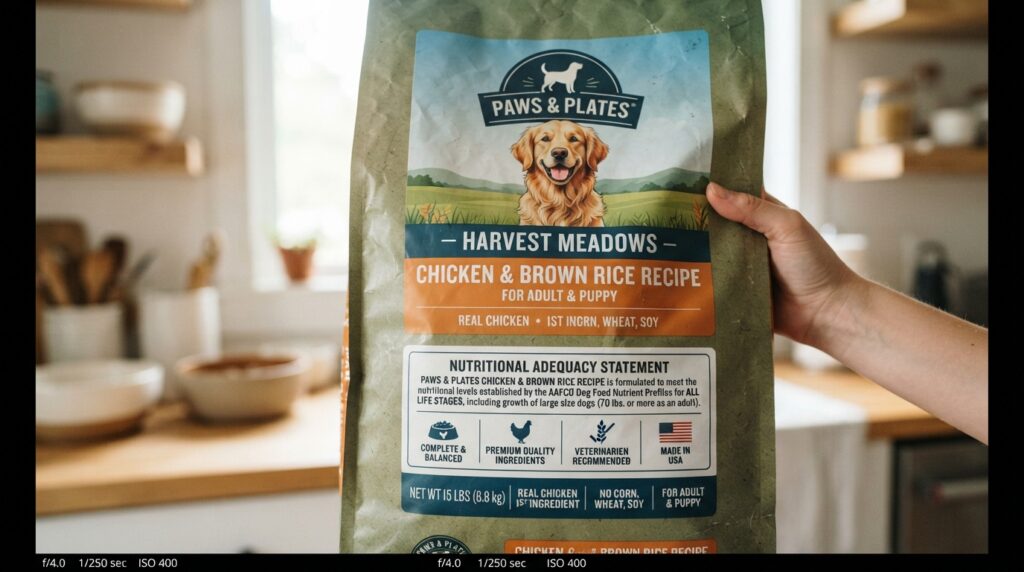
Read the nutritional adequacy statement
Labels may say a food is formulated to meet AAFCO nutrient profiles, tested through feeding trials, or comparable to a product substantiated by feeding tests. These claims describe different ways a food’s adequacy is supported.
| Statement type | What the label says | What it establishes | Reader check |
|---|---|---|---|
| Formulated to meet nutrient profiles | Meets AAFCO nutrient profiles | Formulation targets listed nutrient levels | Check the life stage |
| Feeding-test substantiation | Animal feeding tests support adequacy | Tests support use for the stated life stage | Read the exact claim |
| Comparison with a feeding-tested product | Comparable to a tested product | Comparison supports the stated claim | Check the named life stage |
Recognized life stages are gestation/lactation, growth, maintenance, and all life stages. Feeding directions are required for most foods that claim complete and balanced nutrition.
Most states have adopted versions of AAFCO model regulations, which are not themselves official regulations. FDA animal-food labeling rules apply to products that cross state lines.
Use a recipe formulated for the dog
An online raw food diet recipe is not automatically complete and balanced. A veterinary nutrition professional can formulate one for a dog’s life stage and health needs.
Common raw diet ingredients include:
- Uncooked meat, including beef or chicken
- Organs and bones
- Eggs and unpasteurized milk
- Fruits or vegetables
- Supplements
Freezing, freeze-drying, and dehydration can lower bacterial counts without removing every living pathogen. High-pressure processing can kill most bacteria, including Salmonella and Listeria, but processing claims do not show whether a diet meets nutrient needs.
For choosing animal protein sources, we still need to consider the whole diet, not one ingredient alone. Match the statement’s life-stage claim to the dog’s actual life stage before making a food the main diet.
What Should We Do About Raw Pet Food Recalls or Illness?
A familiar product name is not enough to identify a recalled food; check the lot code and package details. Match the full package, since one brand may sell several recipes and lots.
Compare the lot, package size, UPC, and best-by date with the recall notice. The table lists four recalled lots and the reported distribution and illness status.
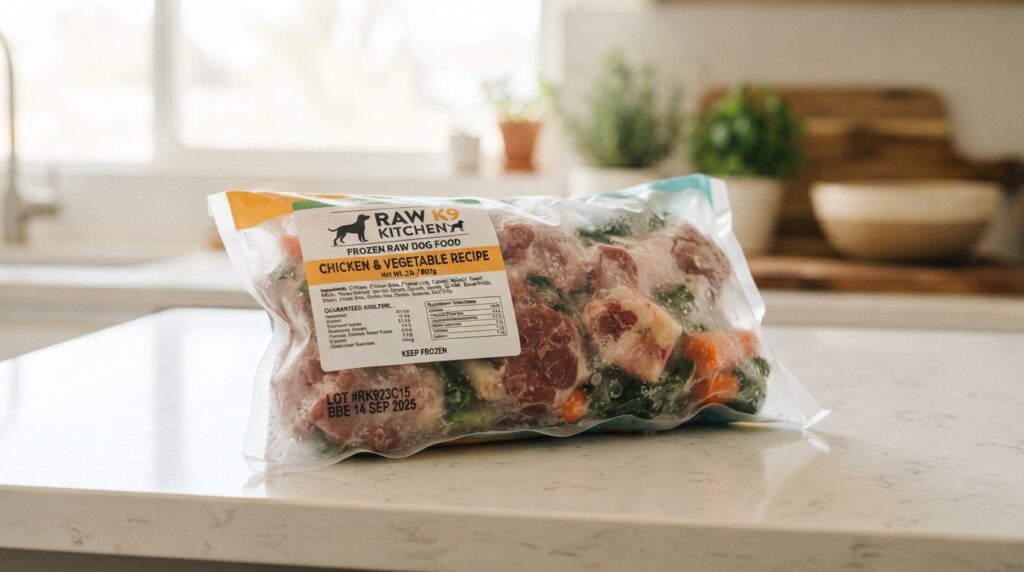
Match the product, lot, and date
| Product and lot | Package and identifying details | Contamination | Distribution and reported illness status |
|---|---|---|---|
| Northwest Naturals, lot B-19 | 6 lb Frozen Raw Diet for Dogs Chicken Recipe; UPC 087316380392; best by January 25, 2028 | Salmonella and Listeria monocytogenes | Retail stores nationwide; no associated illnesses reported as of August 28, 2026 |
| Northwest Naturals, lot B-5 | 2 lbs Frozen Chicken Recipe; UPC 087316384956; best by January 26, 2028 | Salmonella | Retail stores nationwide; no associated illnesses reported as of August 28, 2026 |
| Oma’s Pride Woof Complete Canine Chicken Recipe, lot BB012729 | 6 lb bag; twelve 8 oz vacuum-sealed portions; UPC 8 7938400145 9; best by January 27, 2029 | Salmonella | Distributed February 12-May 15, 2026, to retail and wholesale accounts and directly to consumers in AZ, CA, IN, KY, LA, MD, NJ, NV, NY, PA, and VA; three dog illnesses and no human illnesses reported as of August 17, 2026 |
| Albright’s Raw Chicken Recipe for Dogs Complete and Balanced, lot C001730 | 1 lb pouch; UPC 20855404008367; best by April 28, 2027 | Salmonella; composite sample tested positive | Direct to consumers nationwide, selected retailers in MA, CA, SC, NC, WI, and NY, and direct online sales; no associated illnesses reported as of May 6, 2026 |
Northwest Naturals announced its recall on August 28, 2026. Oma’s Pride announced its recall on August 17, 2026, while Albright’s Raw recalled its lot on May 7, 2026.
The FDA recall archive listed Northwest Naturals chicken recipe, Oma’s Pride canine food, and other pet-food recalls on October 21, 2026. A brand name alone cannot confirm whether a package matches a recalled lot.
Watch for symptoms in pets
Pets with Salmonella or Listeria monocytogenes may show lethargy, diarrhea or bloody diarrhea, fever, and vomiting. Some may instead have decreased appetite, fever, and abdominal pain.
Contact a veterinarian if these signs appear after a possible exposure. A pet can also carry an infection without obvious signs, so appearance alone cannot rule it out.
Keep the package or a clear photo of its lot code available when contacting a veterinarian about a possible exposure.
Does Raw Feeding Fit Our Dog and Household?
A raw-feeding decision should weigh documented safety and nutrition concerns against a household’s ability to follow a consistent plan. Reported benefits are not proof of better health.
Available studies have limits, and most claimed health benefits lack strong scientific support. A 2025 review says most nutrition specialists and public-health stakeholders question raw meat diets because of contamination and nutrition risks.
Before changing foods, discuss your dog’s health, medications, and diet with a veterinarian. Consider four practical questions:
- Can our household maintain safe handling every time?
- Does the dog have health needs that affect food choice?
- Can we manage the time and cost of the plan?
- Can we get advice from a veterinary nutrition professional?
Owners may stop feeding raw because of pathogen exposure, nutrition concerns, or the demands of daily handling. A dog can become seriously ill, but a specific illness or death needs veterinary assessment rather than assumptions about its cause.
Do not treat a reported health benefit as a reason to overlook a real safety or nutrition concern.
Our guide to dog insurance coverage options explains how deductibles, limits, and exclusions can affect eligible veterinary costs. Ask the veterinarian to review the dog’s full diet and health history before starting or stopping a feeding plan.
Conclusion
A safer feeding choice starts with an honest look at both the food’s nutritional adequacy and the risks it brings into the home. Careful handling can reduce exposure, but raw food is never risk-free. Every main diet needs to meet the dog’s nutrition needs and fit its life stage.
We can make a better choice by weighing the dog’s health alongside what our household can manage each day. Before changing your dog’s diet, arrange a conversation with your veterinarian about a complete plan that fits your dog and household.