
Domestic dogs and cats can digest more than 95% of starches. A grain-free recipe is a formulation choice, not a complete nutrition strategy by itself.
For brands, the choice matters when customers ask for grain-free diets or a product team wants a distinct recipe. The label alone cannot show whether food meets an animal’s needs. We need to consider the intended pet, the finished nutrition profile, and how we describe the product.
This guide offers a practical way to assess that choice. It focuses on product purpose, nutritional adequacy, and clear communication, not on treating grain exclusion as a health claim. We can build a strong product with grains or without them, provided its formula supports its stated use.
Key Takeaways
- Grain-free describes ingredient exclusions, not nutrition quality.
- Set species, life stage, and feeding purpose before choosing ingredients.
- Assess each ingredient for nutrient contribution and processing fit.
- Use a recognized route to support complete-and-balanced claims.
- Communicate dietary risks and benefits without making disease claims.
Begin product development with a defined animal, life stage and feeding purpose.
What Does Grain-Free Mean on a Pet Food Label?
A grain-free label means the recipe excludes grains, not that it excludes every plant ingredient or all starch. The claim describes the ingredients used, not the food’s nutritional quality.
In cat food, grains include barley, corn, oats, rice, rye, and wheat. Grain-free means those grains and their listed by-products are absent. The label does not establish that the pet food is complete and balanced or lower in carbohydrates.
Grain-free describes what a recipe leaves out. It does not tell us whether the food is complete, balanced, or low in starch.
Recipes can use non-grain ingredients in place of grains. Some may still contain gluten-free grains such as rice, millet, maize, quinoa, or buckwheat, so label terms need careful reading.
The grain-free definition for cat food also treats the term as gluten-free by definition. Neither label alone means a food is healthier. Grain by-products, including bran, gluten, hull, flour, and starch, can indicate grain is present in cat food.
Ingredient lists give more detail than a front-panel claim. Read the full ingredient list rather than inferring a recipe’s nutrition from its front-panel claim.
Which Ingredients Replace Grains, and What Do They Contribute?
Grain-free recipes most often replace cereal grains with pulses, tubers or a combination of both. Each group brings a different mix of starch, protein, and fiber.
Cereal grains include rice, corn, wheat, barley, sorghum, and oats. They mainly supply starch, with varying amounts of protein, fiber, lipids, vitamins, and minerals. Replacing cereals does not remove carbohydrates or starch from a recipe.
Cereal grains bring starch and other nutrients
Grains can serve as energy sources and add nutrients to the finished formula. Their contribution depends on the ingredient and its use. A grain-free formula can still contain starch from other plant ingredients.
Pulses contribute protein and fiber as well as starch
Pulses are dried edible seeds of legume plants, including peas, beans, chickpeas, and lentils. They typically contain less starch and more protein than cereals. Their protein and fiber also affect the overall nutrient profile.
| Ingredient group | Examples | Typical nutrient contribution | Formulation role |
|---|---|---|---|
| Cereals | Rice, corn, oats | Mainly starch; variable protein and fiber | Carbohydrate and nutrient source |
| Pulses | Peas, beans, lentils | Protein, fiber, and starch | Non-grain carbohydrate and protein source |
| Tubers | Potatoes, sweet potatoes | Carbohydrate and starch | Non-grain carbohydrate source |
Potatoes and sweet potatoes replace grains without removing starch
Potatoes and sweet potatoes are non-grain carbohydrate sources. They can replace cereals in a recipe, but they do not make a food starch-free. The finished product’s carbohydrate and nutrient levels depend on all ingredients together.
Compare the nutrient contribution of each ingredient group, not just whether its name contains “grain.”
What Nutrients Must a Formula Deliver?
A sound formula delivers the nutrients the animal needs, whether its carbohydrate comes from grains or other ingredients. The target applies to the finished food, not one ingredient category.
Dogs and cats need suitable amounts of protein, fat, carbohydrates, vitamins, minerals, and water. Nutrition targets concern the finished diet, not the grain status of a single ingredient. Ingredient names alone cannot prove a food meets those targets.
Protein supplies amino acids, while fat provides energy and essential fatty acids. Carbohydrates include starch and fiber. Starch can provide energy, and fiber can support digestive health.
Domestic dogs and cats can digest more than 95% of starches. Starch is not automatically unsuitable simply because a food is for a dog or cat. The formula must still fit the animal and its feeding purpose.
For cats, grain ingredients do not inherently make food lower quality, and cats can digest starch. PetMD’s veterinary explainer on grain-free cat food also describes why the label does not establish health benefits.
Vitamins and minerals must be present in suitable amounts and ratios. Water matters too, whether it comes from the recipe or the pet’s drinking supply.
Judge the finished nutrient profile instead of assuming an ingredient category determines quality.
How Do Species and Life Stage Change the Formula?
A recipe for a growing animal needs a different target from one intended only for adult maintenance. Species and life stage set the nutrient profile before ingredient selection.
AAFCO recognizes growth, maintenance, gestation and lactation, and all life stages. Dog and cat profiles differ, as do growth and adult-maintenance targets. A product brief should name the intended profile rather than leaving it to guesswork.
Match nutrient targets to species and life stage
Growth and reproduction profiles address animals with changing needs. Adult maintenance profiles apply to adult animals. These groups use different nutrient quantities and ratios, so a single target cannot cover every feeding purpose.
| Species | Profile | Intended life stage |
|---|---|---|
| Dog | Growth and reproduction | Growth, gestation, or lactation |
| Dog | Adult maintenance | Adult maintenance |
| Cat | Growth and reproduction | Growth, gestation, or lactation |
| Cat | Adult maintenance | Adult maintenance |
Treat dog and cat recipes as separate formulations
A dog recipe cannot simply be relabeled for cats, or the reverse. Each species has its own nutrient profile. Even within one species, a growing animal and an adult may need distinct formulas.
“All life stages” is not a shortcut for a product brief. It covers a broad feeding purpose and may set targets that do not match a product intended for adult maintenance alone.
AAFCO identifies separate nutrient profiles for growth and adult maintenance in dogs and cats. Write the species and life-stage target into the product brief before evaluating ingredients.
How Should Formulators Choose Protein Ingredients?
Choose a protein source for the nutrients it contributes, not just for the name that stands out on a bag. A strong choice meets the recipe’s amino-acid needs and works in the intended formula.
Protein ingredients can come from animal tissues or plant sources. Beef and chicken are common examples, but the front-panel name cannot show the full nutrient value. Crude protein percentage alone does not establish protein quality or adequacy.
Assess protein ingredients through four practical checks:
- Amino-acid profile: confirm the essential amino acids the ingredient contributes.
- Digestibility: assess how well the animal can use its protein.
- Processing stability: check how processing affects the ingredient.
- Recipe fit: consider its role in the species- and life-stage target.
Two ingredients with similar crude protein may supply different amino acids or digest differently. The formula may need more than one protein source to meet its target.
Our guide to animal protein sources explains why amino-acid supply matters more than a high crude-protein figure or a prominent ingredient name.
Check ingredient performance in the full recipe, not in isolation. Dog and cat formulas also need their own species-specific nutrient targets.
Confirm the amino-acid contribution in the finished formula rather than relying on a front-panel protein claim.
Which Carbohydrate Sources Can Replace Grains?
A grain-free recipe still needs a deliberate plan for its carbohydrate and fiber sources. Pulses, potatoes, and sweet potatoes are common non-grain choices.
Grain-free does not mean carbohydrate-free or low-starch. Pulses usually contain less starch than cereals but more protein. Each carbohydrate source changes more than the recipe’s grain status.
Carbohydrates include starches and fibers. Starch can contribute energy, while fiber has a digestive role. Formulators should assess both in the context of the finished diet.
Texture can help guide ingredient choice. Potatoes and sweet potatoes can support a different recipe structure than pulses. The choice also affects the formula’s energy contribution and fiber balance.
Pulses may bring protein along with carbohydrate, while tubers serve as non-grain carbohydrate sources. These ingredients should not be treated as interchangeable without recalculating their nutrient contributions.
Processing needs matter too. A recipe’s starch and fiber sources must suit the desired food format, including the texture and shape of dry kibble.
Set the ingredient inclusion level from the formula’s nutrient and manufacturing targets, not from the grain-free claim.
How Do Fats, Fiber, Vitamins, and Minerals Fit?
A recipe needs more than a protein source and a starch source to deliver complete nutrition. Fat, fiber, vitamins, and minerals each have a specific role.
Dietary fat supplies energy and essential fatty acids. Fiber is a carbohydrate component with a digestive role. Vitamins and minerals must fit the animal’s life stage in both amount and ratio.
Ingredients contribute nutrients before any supplements are added. A recipe may also use vitamin and mineral supplements to meet its target. Formulators must count both sources together.
Adding a supplement without accounting for ingredient contributions can create excesses as well as gaps. The same issue applies when a supplier changes an ingredient’s specification or nutrient content.
Fat level affects the food’s energy contribution. Fiber affects more than the ingredient list, since its level and type can influence digestive effects and recipe design.
Supplement choices should follow the formula’s calculated needs. They are not a substitute for checking the contribution of the whole recipe.
Check the finished nutrient contribution of the whole recipe before adding a supplement to correct one ingredient.
How Does Processing Shape a Grain-Free Dry Food?
For extruded kibble, the recipe must work as a food and as a material that can be cooked and shaped. Starch helps create structure in dry pet food.
Extrusion commonly uses heat and pressure to cook and shape ingredients into dry food. Changing an ingredient can change how the recipe cooks, forms, and holds its texture.
Build the recipe for extrusion and kibble structure
Ingredient choices affect the dough-like mix as it moves through the equipment. Starch helps bind ingredients and support kibble structure. A grain-free recipe may use other starch sources for that role.
Different ingredients can affect cooking, shaping, texture, and consistency. A formula that looks suitable on paper may behave differently on a production line.
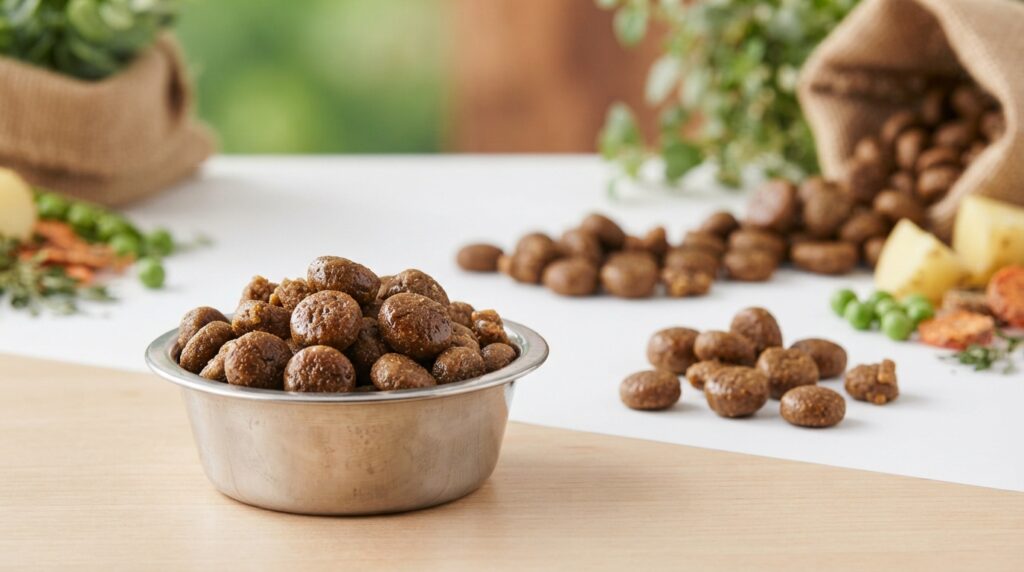
A review of extruded dry pet food processing explains how heat and pressure can affect food properties, including flavor and texture.
Validate processing conditions and finished food
Not every grain-free food uses the same process. Recipe design must fit the actual equipment and intended product format, rather than a generic idea of extrusion.
Production checks should look at finished-food consistency as well as whether the recipe runs. Texture and shape are visible results, while the formula must also retain its intended nutrient profile.
Validate the actual formula under its intended process instead of assuming a successful ingredient list will run consistently.
How Do We Confirm a Formula Is Complete and Balanced?
Confirming a formula means demonstrating that it meets the intended nutritional target, not simply reviewing its ingredients. Complete and balanced means required nutrients are present in correct ratios for the intended life stage.
A food making this claim is intended as the sole diet and must meet an AAFCO Dog or Cat Food Nutrient Profile or pass an AAFCO-procedure feeding trial. Every nutrient listed in the chosen profile must meet its recommended level.
Choose the AAFCO adequacy pathway
Use four checks to review nutritional adequacy:
- Confirm the intended species and life stage.
- Choose a nutrient-profile or feeding-trial route.
- Check every required nutrient against its target.
- Compare nutrient values on a dry-matter basis.
AAFCO defines “complete” as containing required nutrients and “balanced” as having them in correct ratios. The AAFCO feeding-trial route is one recognized way to support a nutritional adequacy statement.
Convert guaranteed analysis to dry matter
Dry matter basis means the nutrient composition of food after its moisture is removed. AAFCO profiles use dry-matter values, while guaranteed analysis uses as-fed values.
Canned food typically contains 75-78% moisture, while dry food typically contains 10-12%. Comparing their listed nutrient percentages without adjusting for moisture can mislead.
Dry matter percentage equals 100 minus the moisture guarantee. To convert an as-fed nutrient guarantee, divide it by the dry matter percentage, then multiply by 100.
For example, a food with 10% moisture has 90% dry matter. A 27% protein guarantee converts to 30% on a dry-matter basis: 27 divided by 90, multiplied by 100.
Convert nutrient guarantees to a dry-matter basis before comparing foods with different moisture levels.
What Must a U.S. Pet Food Label Show?
The label is useful when we read each statement for the specific information it provides. Each claim has a limit, and none replaces the full product assessment.
Ingredients appear in descending order of predominance by weight. That order does not show whether the food meets its nutrient targets. Most complete-and-balanced foods include feeding directions, while treats, snacks, and supplements do not need a nutritional adequacy statement.
| Label item | Rule or threshold | What it does not establish |
|---|---|---|
| Grain-free claim | Excludes grains under the claim’s meaning | Complete nutrition or low carbohydrate |
| Ingredient list | Descending order by weight | Nutrient adequacy or ingredient quality |
| Complete-and-balanced statement | Profile or feeding-trial route | Health benefits for every pet |
| Named-ingredient claim | Generally 95% by weight, excluding processing water | Whether the food is grain-free |
The 95% rule applies to named-ingredient product claims, not grain-free claims. It generally requires 95% of the product by weight, excluding water used for processing.
Many states have adopted versions of AAFCO model regulations, though those models are not official regulations themselves. Ingredient names also need context: neither a grain ingredient nor a non-grain ingredient proves quality by itself.
There is no single list of ingredients to avoid in grain-free dog food. Judge each ingredient against the product’s purpose and its nutrient contribution, rather than in isolation.
When changing a pet’s food, a gradual transition over 7-10 days is a common approach unless a veterinarian advises otherwise. This can help avoid an abrupt change in feeding routine.
Check the adequacy statement and intended life stage before treating a marketing phrase as a nutrition guarantee.
What Does the DCM Evidence Mean for Grain-Free Dog Food?
The current evidence supports caution about some high-pulse dietary patterns, not a conclusion that every grain-free food causes DCM. Diet-associated DCM means dilated cardiomyopathy associated with dietary factors.
Diet-associated cases differ from taurine-deficiency DCM. The specific cause of diet-associated DCM had not been identified as of June 2026. Reported risk concerns some dietary patterns, not every grain-free recipe.
Separate taurine-deficiency DCM from diet-associated cases
A 2025 review describes taurine-deficiency-related DCM and cases linked with unidentified dietary factors. Golden Retrievers appear more susceptible to the taurine-deficiency form.
Dogs with diet-associated DCM have included breeds with a known genetic risk and breeds without one. Cats also appear susceptible, though less sensitive than dogs.
What studies know, and do not know
Studies have found larger left ventricular diameters and reduced systolic function in dogs eating non-traditional, grain-free, legume-rich diets. They also found more premature ventricular complexes than in dogs eating traditional, low-legume diets.
These findings describe observed cardiac changes, not a proven cause. Nutritional deficiencies did not appear to play a major role, and the condition does not appear to result from lack of grains or taurine deficiency.
Phospholipidosis is under study as a possible mechanism after researchers found higher levels of a urine biomarker in affected dogs. It is not an established cause. Gut microbes and fiber-related bile-acid metabolism are other possible contributors, but the mechanisms remain unclear.
Many affected dogs improved after diet changes and treatment, suggesting some nutritional DCM may be reversible. Recovery can be slow, and the disease can remain deadly even with care.
What brands should communicate about risk
The FDA opened an investigation into reported canine non-hereditary DCM cases in 2018. Reported diets included high proportions of pulses and/or potatoes, in both grain-free and grain-inclusive products.
The FDA reported no product recalls and said in December 2022 it would wait for meaningful new scientific information before further public updates. Its investigation information is not an approved or ranked food list.
Veterinarians do not recommend grain-free food as a general health choice. They may advise against some diets based on a dog’s needs and the pulse-associated concern; brands should not present all grain-free foods as unsafe.
Brands should avoid disease-prevention promises and advise consumers to discuss an individual dog’s diet with its veterinarian.
When Is Grain-Free or Limited-Ingredient Food Useful?
A grain-free recipe and a limited-ingredient recipe solve different formulation problems. One excludes grains; the other aims to simplify the ingredient list for a defined need.
Food reactions are uncommon in pets seen by veterinarians. Cutaneous adverse food reactions, including allergy and intolerance, have been reported in 1-2% of dogs and 0.2% of cats presented to veterinary clinics.
Protein sources such as beef, chicken, fish, and dairy are common proven allergens. An allergic response can also involve protein in cereals or pulses, so grain-free does not automatically avoid a trigger.
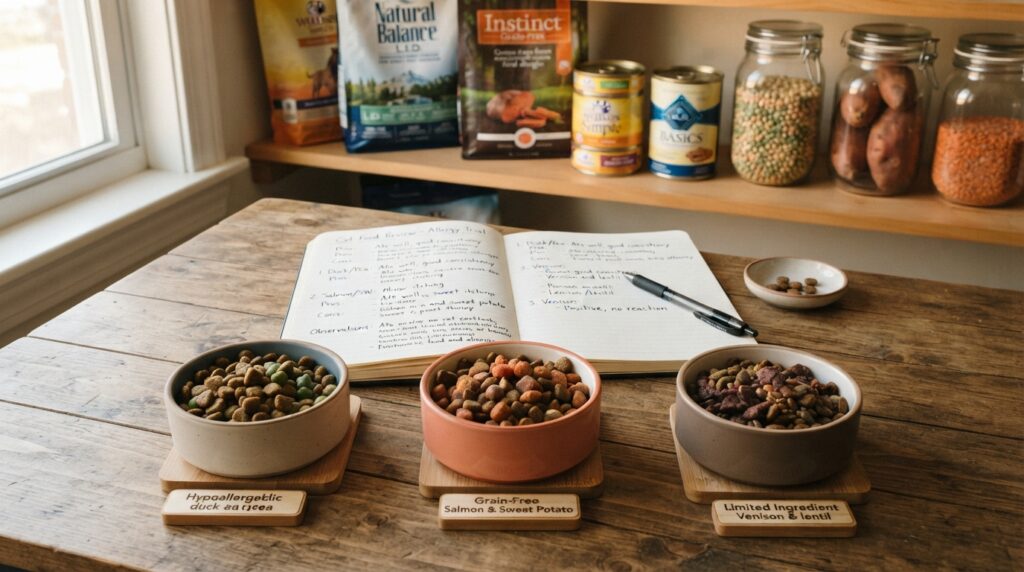
For cats, grain-free cat food may have a role when a veterinarian identifies a food allergy, inflammatory bowel disease, or another inflammatory condition. The recipe still needs to match the cat’s specific needs.
Grain-free diets are not a proven allergy treatment for every dog or cat. Any protein, including one from a grain or pulse, can trigger a reaction in an individual pet.
Veterinary guidance helps identify the suspected cause and select a suitable diet. A limited-ingredient approach may be more relevant than grain exclusion when the goal is to control exposure to specific ingredients.
Use a named ingredient restriction only when it addresses a defined need and the whole recipe remains nutritionally suitable.
How to Approach Grain Free Pet Food Formulation for Dogs and Cats
Begin with a written product brief that says who the food is for and how it will be made. That brief should guide every formulation choice.
Grain Free Pet Food Formulation joins ingredient selection, nutrient targets, and processing conditions. Assess those parts together during commercial development.
Translate the product brief into nutrient targets
Use this five-step development sequence:
- Define the species and life stage.
- Set nutrient targets and product-format goals.
- Select ingredients and calculate their contributions.
- Test the recipe under intended processing conditions.
- Review the finished food and label with qualified nutrition and regulatory experts.
Validate ingredients, process and finished formula
Ingredient suppliers, manufacturing teams, and nutrition experts each hold part of the development picture. A change to one ingredient may affect the nutrient calculation and how the recipe runs.
Homemade recipes need the same care. Swapping ingredients in a recipe does not ensure the finished food remains nutritionally complete. A qualified veterinary nutrition specialist should develop and validate the full recipe.
The American College of Veterinary Nutrition provides a specialist pathway for veterinary nutrition expertise. Brands can involve a qualified specialist before finalizing a product brief or recipe.
Bring a veterinary nutrition specialist into the process before a recipe is treated as a finished commercial formula.
How Can We Assess the Best Grain-Free Formulation?
The best formulation is the one that meets its stated nutritional purpose, not simply the one labeled grain-free. A useful review weighs evidence instead of marketing language.
For most brands, the best default is a validated, complete-and-balanced recipe for a clear species and life stage. A label alone cannot rank grain-free formulas because their ingredient designs differ.
| Formula type | Carbohydrate architecture | What a label can establish | Main formulation check |
|---|---|---|---|
| Pulse-led grain-free | Pulses supply carbohydrate, protein, and fiber | Listed ingredients and stated claims | Check total nutrient contribution and process fit |
| Tuber-led grain-free | Potatoes or sweet potatoes supply carbohydrate | Listed ingredients and stated claims | Check starch role and finished nutrient profile |
| Grain-inclusive, low-pulse | Cereals supply starch with fewer pulses | Grain ingredients and stated claims | Check life-stage fit and full formula balance |
Reviewers should assess formulation evidence, not treat a high protein content or grain-free claim as a quality score. For a documented medical or dietary need, a veterinarian-guided tailored diet may fit better.
Use four review criteria:
- Life-stage fit: does the product target the named animal?
- Nutritional adequacy evidence: does it support its feeding purpose?
- Ingredient contribution: do the ingredients serve the formula?
- Process suitability: does the recipe work under intended manufacturing conditions?
Compare the evidence behind a formula’s claims before treating a review or ingredient list as proof of quality.
What Should a U.S. Brand Document Before Launch?
A launch-ready formula needs an organized record of what it contains, how it is made and how its claims are supported. Good records help teams keep product decisions clear.
FDA animal-food current good manufacturing practice and preventive-control requirements appear in 21 CFR Part 507. Facility duties depend on the activity and any applicable exemption.
Organize five key records before launch:
- Approved product brief and formula version.
- Ingredient and supplier specifications.
- Process and finished-product controls.
- Support for nutrition and label claims.
- Facility food-safety and registration documents.
Keep the approved recipe tied to its version, ingredient specifications, and production records. That link helps teams trace what changed if a supplier or process is updated.
Substantiation should match the claims on the label. Keep records that support the product’s nutritional purpose and the wording used to describe it.
Many facilities that manufacture, process, pack, or hold animal food must register with the FDA, subject to exemptions. Brands should confirm the rules that apply to their own facilities and products.
Document the formula, process, claim support, and facility duties before production. A record set should match the product that will actually be sold.
Confirm the applicable FDA requirements for the facility and product before commercial production begins.
Conclusion
A trustworthy grain-free product begins with a defined nutritional purpose and evidence that the finished formula meets it. Grain-free is an ingredient choice; it does not replace a nutrition target.
Our two key points are simple: name the animal and feeding purpose, then support the finished food with suitable evidence. That approach helps brands make clear choices for dogs, cats, and the wider pet food market.
Before launch, have a qualified veterinary nutrition specialist review the product brief and nutrient targets. Make the next step a qualified review of the product brief, nutrient targets and validation plan.