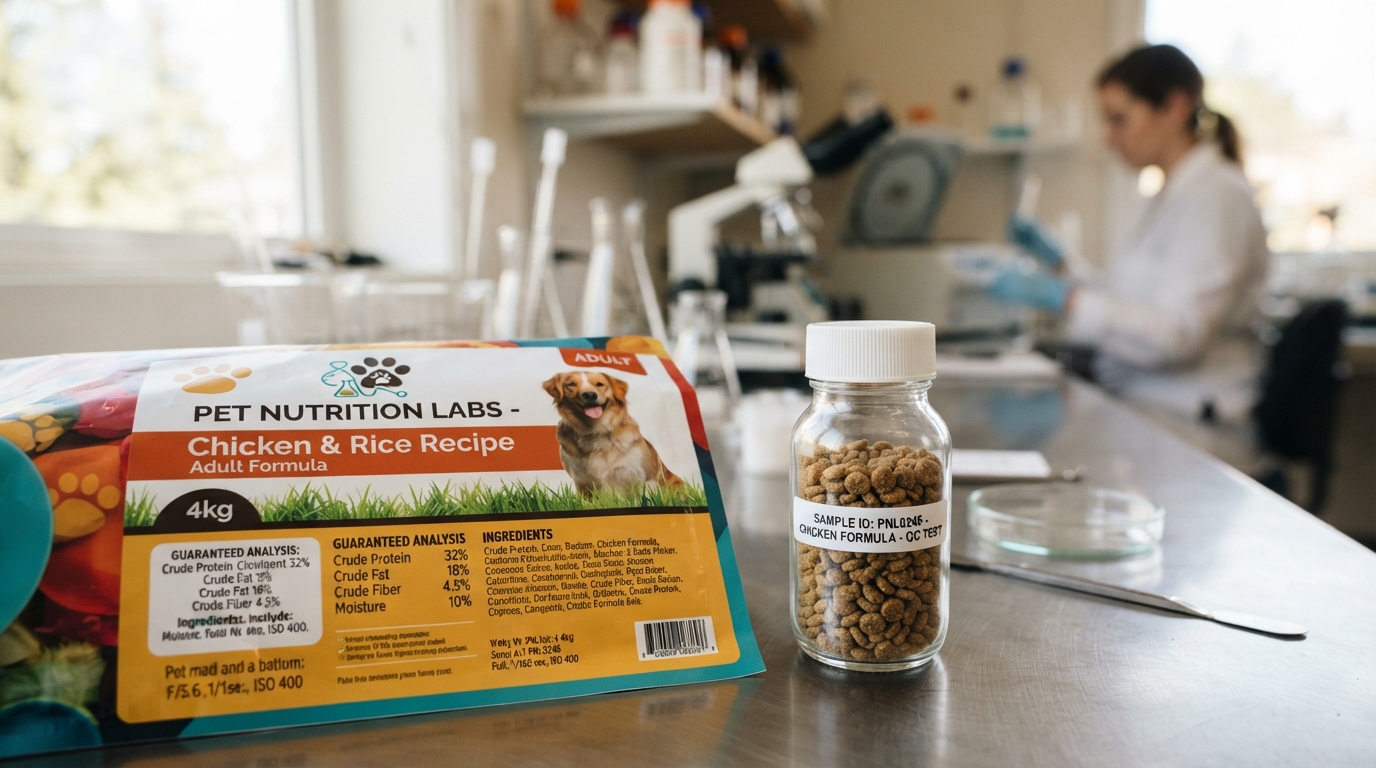
One study found 13% of 90 canned cat foods labeled complete and balanced fell below AAFCO’s thiamine minimum. A label offers a starting point, while our Pet Food Nutritional Analysis can answer specific questions about composition and quality.
Labels help us make an initial review, but they do not show every actual nutrient result. Testing can check nutrient composition, contaminants or ingredient authenticity, depending on the product and your concern.
Our analysis of ingredients and nutrient levels can help assess food quality and support diet recommendations. The right test depends on the question, so we first learn what you want to understand. The most useful starting details are the species, life stage, product type and question the analysis needs to answer.
Key Takeaways
- A label is useful for an initial review, not a full nutrient profile.
- Test selection depends on the product and the question.
- Laboratory analysis can measure selected nutrients or screen for concerns.
- Species, life stage and product type help shape the request.
- A sample result does not prove a diet meets every need.
What Does Pet Food Nutritional Analysis Measure?
A Guaranteed Analysis gives required nutrient minimums and maximums, while a dry-matter comparison helps account for water in the food. Dry matter basis (DMB) means nutrient percentage calculated after removing moisture, allowing comparison between foods with different water content.
GA values are guarantees, not exact nutrient test results. AAFCO offers nutrient profiles used in state rules, but does not approve, test or certify individual foods.
GA values set minimums for protein and fat, and maximums for fiber and moisture. They do not report exact nutrient levels.
What a Guaranteed Analysis Shows
A guaranteed analysis for pet food must list minimum protein and fat, plus maximum fiber and moisture. Moisture appears in all cases, and a nutrient claim may require that nutrient’s guarantee. “Crude” describes the measurement method, not nutrient quality.
Four batches can help set reliable guarantees; testing at least two batches per variety is recommended. One protein example measured 25%, 26%, 25.2% and 23% as-fed, averaging 24.8% with a 1.28 standard deviation.
Assuming a normal distribution, average plus or minus two standard deviations covers about 95% of a batch population. Suggested guarantees for that example were 22% minimum protein, 12% minimum fat, 5% maximum fiber and 10% maximum moisture.
How to Compare Nutrients Fairly
A pet food nutritional analysis chart can compare adult maintenance with growth and reproduction profiles. These AAFCO profiles were last updated in 2016, and adult and growth nutrient standards are listed on a dry matter basis.
| Nutrient | Adult maintenance | Growth and reproduction | Basis |
|---|---|---|---|
| Crude protein | 18.0% minimum | 22.5% minimum | DMB |
| Crude fat | 5.5% minimum | 8.5% minimum | DMB |
| Calcium | 0.5%-2.5% | 1.2% minimum; maximum 1.8% for large-breed puppies, 2.5% for others | DMB |
| Phosphorus | 0.4%-1.6% | 1.0%-1.6% | DMB |
| Calcium-to-phosphorus ratio | 1:1-2:1 | 1:1-2:1 | Ratio |
Both profiles cap the omega-6-to-omega-3 ratio at 30:1. Growth minimums include linoleic acid 1.3%, alpha-linolenic acid 0.08%, and EPA plus DHA 0.05%; adult linoleic acid minimum is 1.1%, with no set minimums for the others.
Adult and growth minimums are potassium 0.6% each, sodium 0.08% and 0.3%, chloride 0.12% and 0.45%, and magnesium 0.06% each. Iron, copper and zinc minimums are 40, 7.3 and 80 mg/kg for adults, and 88, 12.4 and 100 mg/kg for growth.
Both profiles set iodine at 1.0-11 mg/kg and selenium at 0.35-2 mg/kg. They also set minimums for arginine, histidine, isoleucine, leucine, lysine, methionine, phenylalanine, threonine, tryptophan and valine.
For example, food with 70% moisture has 30% dry matter. If its as-fed protein is 10%, its DMB protein is 33%: divide 10 by 30, then multiply by 100.
GA figures may come from laboratory analysis or ingredient-nutrient software. Complete-and-balanced claims can rely on meeting nutrient standards through laboratory analysis or feeding trials, not AAFCO certification. A guide to AAFCO pet food labeling explains these label roles.
Compare foods on a dry matter basis for moisture differences, then use grams per 1,000 kilocalories when energy density also differs.
Which Laboratory Tests Answer Your Quality Questions?
A finished-product proximate analysis usually measures protein, fat, fiber, moisture and ash, while targeted tests address specific safety or authenticity concerns. Routine nutrient testing describes basic composition; other methods look for a named hazard or ingredient.
Choose tests to match the product and concern; no single test proves overall safety. A sample request can focus on one or more objectives:
- Nutrient composition
- Microbial contamination
- Residues or contaminants
- Ingredient authenticity or adulteration
Proximate results usually report percentages as-fed. Other food testing can include microbiological checks, heavy metals and other residues, meat or ingredient authenticity, and GMO screening.
A semi-quantitative metal screen can assess 70 elements with high-resolution ICP-SFMS. Matrix interference may prevent some results, while quantitative elemental analysis is a separate method that calibrates all elements except halogens and osmium.
A pet food nutritional analysis template can help organize a request. Include sample identity, species and life stage, product type, requested analytes, method, reporting basis and decision limits.
A pet food nutritional analysis calculator can standardize dry-matter or calorie-based comparisons, but it cannot replace laboratory analysis of a submitted product.
USDA FoodData Central Foundation Foods covers analytical data and metadata for commodity and minimally processed foods, with updates each April and October. USDA Branded Foods uses a public-private partnership and updates monthly.
The Global Branded Food Products Database has received no new or updated food-component information from Label Insight since November 16, 2023, though earlier records remain. USDA FoodData Central data are public domain under CC0 1.0 Universal; USDA requests citation when data are used. USDA FoodData Central records help distinguish analytical commodity data from branded entries.
Before submitting a sample, confirm the requested method, reporting basis and whether the laboratory needs a particular sample amount or handling condition.
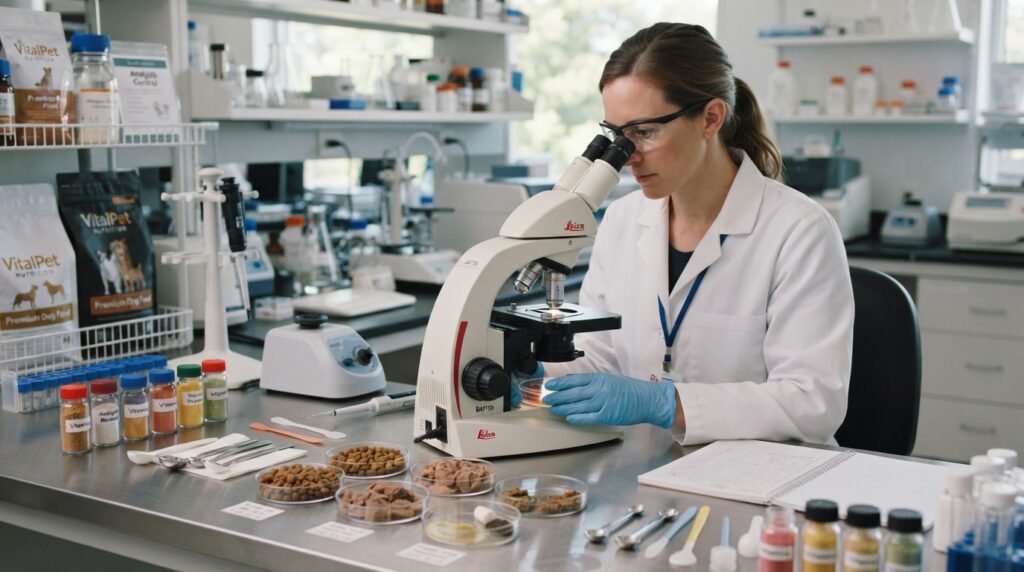
How Should Homemade Diets Be Analyzed?
A laboratory result can describe a homemade batch, but it cannot by itself establish that the recipe is balanced for the animal’s needs. The best review starts with the decision you need to make.
For a homemade recipe, seek careful formulation and review by a nutrition expert, not a lab panel alone. Testing a finished sample measures selected nutrients in that batch; recipe review considers whether the food meets a dog’s or cat’s needs.
A sample test describes the batch, not the recipe’s full nutritional adequacy. Expert review helps assess whether the recipe fits the animal.
For routine food comparison, compare nutrient amounts on a dry matter and calorie basis. A complete food is intended as the sole ration, while treats, supplements and mixers are not substitutes.
A 2025 review said home-prepared dog diets need careful planning, since diets made without nutrition-expert input may have harmful gaps or imbalances. In a survey cited by that review, 38% of 426 dog owners fed unconventional diets, including BARF or homemade meals. See our pet nutrition and homemade diet guidance for label and feeding context.
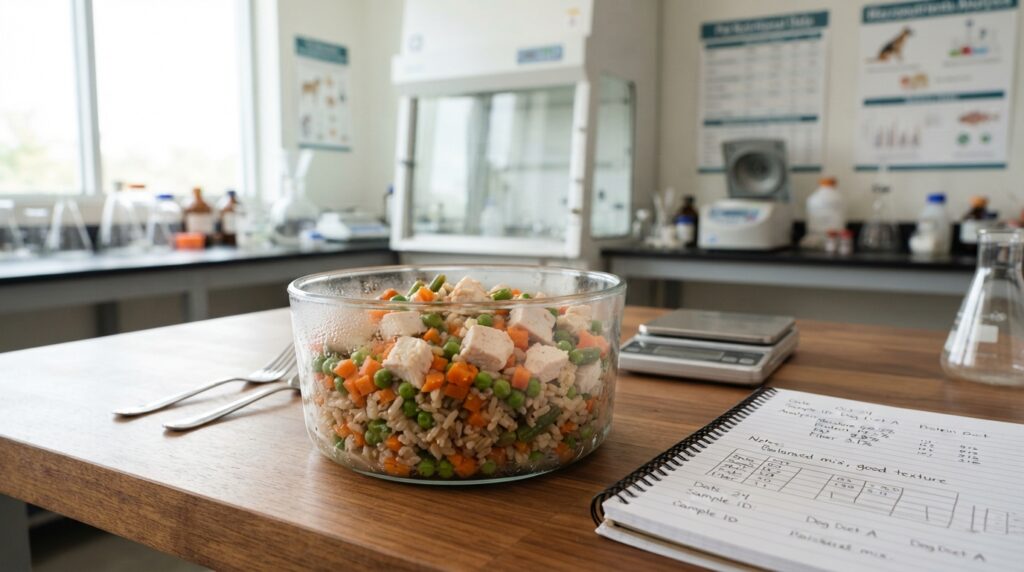
For a home-prepared diet, have the recipe reviewed by a qualified veterinary nutrition professional before using sample results to guide feeding.
Conclusion
A clear testing question makes it easier to choose useful measurements and interpret the results. We can help identify which analysis fits your product, whether you need nutrient data, a quality check or testing for a specific concern.
Share the species, life stage and product type, along with the decision you need the results to support. Those details help us discuss suitable testing services and reporting needs without treating one test as a full measure of safety or diet quality.
Contact us with the species, life stage, product type and concern you want the analysis to address.