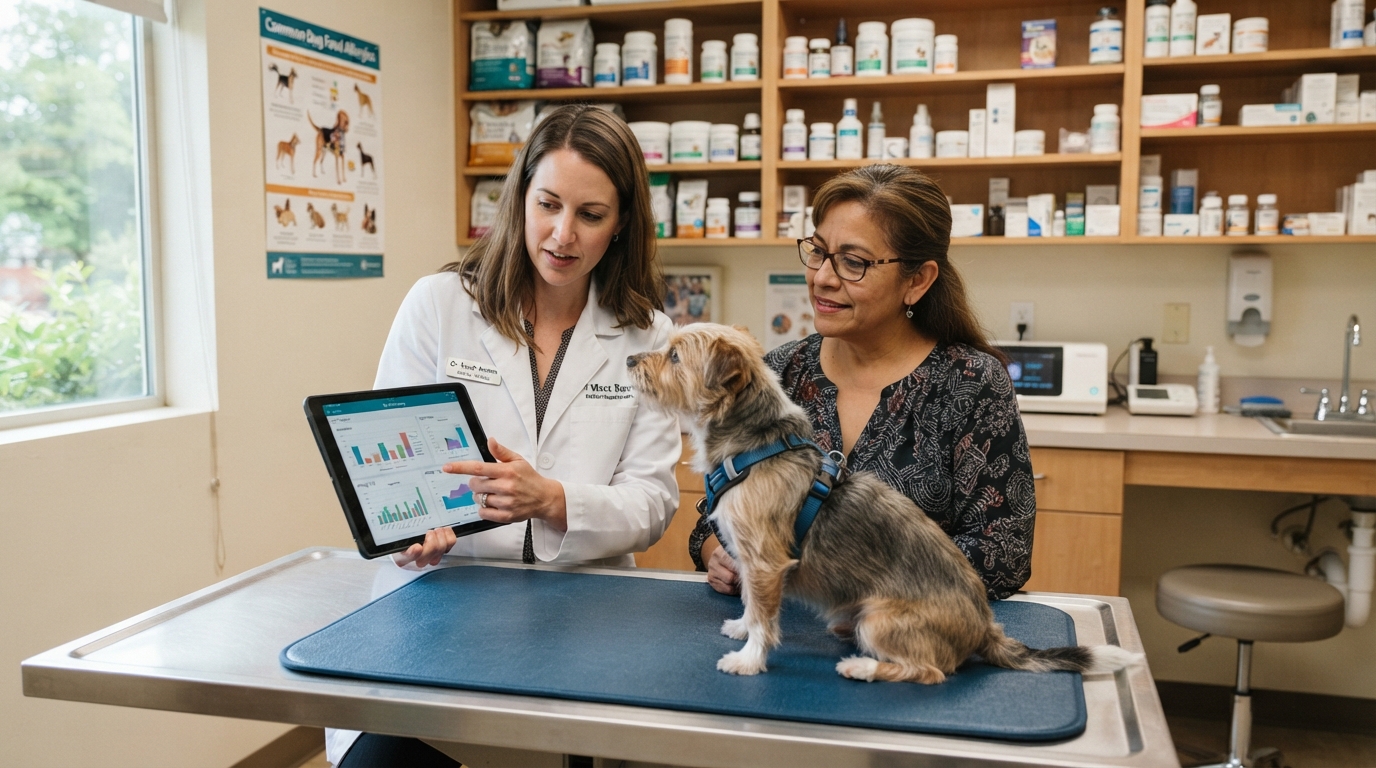
A food switch alone cannot confirm an allergy, even when your dog’s itching seems to improve. Similar signs can have several causes, so a new bag may change symptoms without showing why they started.
A structured diagnosis can help us identify a trigger and avoid it over time. We can work with your veterinarian to assess the problem before making lasting diet changes.
Pet Food Allergy Management is a practical, veterinary-guided process, not a series of guesses. It gives us a clear way to investigate possible food reactions while protecting a dog’s health and nutrition.
Dogs cats and other pets can develop problems that look alike, even when the cause differs. A careful review of food, symptoms, and health helps us decide what to do next.
Ask your veterinarian to help assess the symptoms before restricting your dog’s diet.
Key Takeaways
- Several conditions can cause signs that resemble food allergy.
- A food change by itself does not confirm a trigger.
- A veterinarian can guide a controlled elimination diet trial.
- Long-term control depends on avoiding a confirmed trigger.
- Itching relief and food diagnosis are separate goals.
How Common Is Food Allergy in Dogs?
Food allergy is a meaningful but not dominant explanation for itching in dogs seen for pruritus. Pruritus means itching, and many causes can lead to it.
An adverse food reaction is an umbrella term for immune-mediated food allergy and nonimmune food intolerance. The two terms describe different responses, even when both follow eating a food.
An immune food allergy involves the body’s immune system reacting to a food protein. Food intolerance does not use that same immune process, and may simply cause digestive trouble.
Among dogs presenting with pruritus, food allergy accounts for about 18% of cases. The reported range is 9% to 40%, reflecting differences among the groups studied.
Food allergy accounts for 20% of dogs presenting with allergic skin disease. It accounts for 29% of dogs presenting with atopic dermatitis, an allergic skin condition.
Use these rates to guide a veterinary investigation, not to diagnose an individual dog.
These percentages apply to different groups of dogs, not to every pet with itching. They also do not mean that the remaining dogs have one shared cause.
Dogs cats may have food reactions, but a dog’s signs alone cannot tell us whether the cause is food. Fleas, environmental allergens, and other health problems can also matter.
For dogs, allergies may overlap, and a food reaction can exist alongside another skin condition. A veterinary exam helps sort out those possibilities before we change the diet.
Treat these figures as a reason to investigate, not as a reason to switch foods without testing.
Which Signs Point to a Food Allergy?
Persistent itching is the most common skin clue, and repeated ear or skin infections can accompany it. Ongoing problems deserve a veterinary review.
Food allergy can affect skin alone, so digestive signs are not required. The pattern can raise suspicion, but it cannot confirm the cause.
Itching, Inflamed Skin, and Recurrent Ear Problems
Dogs with food allergy often scratch, lick, or chew at itchy areas. The pruritus may persist over time rather than appearing only after one meal.
Hair loss can develop where a dog repeatedly scratches or licks. The skin may also look red, sore, or inflamed from the irritation.
Recurring skin infections or ear infections can occur in affected dogs. These problems may return even after treatment, which is one reason to discuss the full history with a veterinarian.
In dogs, itching can affect different parts of the body. Dogs cats do not always show the same pattern, so the location of irritation is only one clue.
Vomiting and Diarrhea Are Not Required
Vomiting and diarrhea are common gastrointestinal signs linked with food allergy. A dog may have these signs along with skin or ear trouble.
But a dog can have food allergy without gastrointestinal signs. Normal digestion does not rule out a food reaction, and diarrhea alone does not prove one.
Dogs cats with allergy may show different signs, and cats commonly itch around the face, ears, and neck. That pattern can help a veterinarian assess cats, though this guide focuses on dogs.
Changes in appetite, stool, or skin can also have causes unrelated to diet. We should note when problems began and whether they recur, then share that history during an exam.
An allergy dogs cats may have is not confirmed by a symptom pattern alone. A veterinary assessment can consider other causes and decide whether food testing makes sense.
Arrange a veterinary exam for recurring ear or skin infections even when your dog’s digestion seems normal.
Which Foods Commonly Trigger Reactions in Dogs?
Beef, dairy, and chicken are common triggers, while wheat, lamb, and soy are less common. Common does not mean certain for an individual dog.
Any food protein can trigger a reaction, and no ingredient should be blamed without a controlled test. Animal proteins are frequent food allergens in dogs.
Beef and chicken appear in many dog foods, which can make a dog’s food history important. But past exposure does not prove that either ingredient caused an allergy.
| Ingredient | Reported trigger frequency | Can allergy develop after long exposure? |
|---|---|---|
| Beef | Common | Yes |
| Dairy | Common | Yes |
| Chicken | Common | Yes |
| Wheat | Less common | Yes |
| Lamb | Less common | Yes |
A dog can develop an allergy to a protein eaten for a long time. Dogs of any age can develop a food allergy, so long exposure does not rule one out.
Food reactions dogs experience may relate to one ingredient or more than one. The ingredient list can include animal proteins, grains, and other components, so names matter.
Our [guide to animal protein sources for pets](https://visuora.com/animal-protein-sources-for-pets-a-pet-nutrition-guide/) explains how a dog’s food history can help shape diet choices. A careful record can include past foods, treats, chews, and flavored products.
There is no blanket “good” or “bad” protein label for every dog. A food’s reputation as a common allergen does not prove it is your dog’s trigger.
How Pet Food Allergy Management Confirms a Trigger
A food allergy is confirmed by improvement on a controlled elimination diet, a flare after the original diet returns, and renewed improvement when the elimination diet resumes. All three steps matter.
Improvement alone is not proof of a food allergy. A veterinary team uses a planned sequence to test the suspected link between food and signs.
- A veterinarian assesses the dog and checks for other possible causes.
- The dog eats a controlled elimination diet during the diagnostic trial.
- The veterinarian plans a challenge by reintroducing the original food.
- The dog returns to the elimination diet to see whether signs resolve again.
A positive result depends on the full pattern: signs improve on the trial diet, return after the challenge, and improve again when the trial diet resumes.
An 8-week elimination diet trial raises diagnostic sensitivity for food allergy in dogs and cats to more than 90%. The veterinarian can set a suitable plan for the pet.
Serum, saliva, and hair tests are not reliable ways to diagnose food allergy in dogs. These panels cannot replace the controlled diet process.
Environmental atopy, an allergic response to things in the environment, can exist with food allergy. Flea allergy can also occur at the same time.
Those overlapping conditions may affect how a dog responds during diagnosis. A veterinarian can assess them instead of assuming that every sign comes from food.
Do not call improvement alone a confirmed allergy if the original diet has not been challenged.
Which Diets Can We Use for an Elimination Trial?
The main trial options are a prescription novel-ingredient diet, a prescription hydrolyzed diet, or a nutritionist-formulated home-cooked diet. Each option needs veterinary guidance.
A home-cooked trial diet must be balanced for the dog, not just made from unfamiliar foods. A veterinary nutritionist should formulate it with vitamins and minerals.
| Diet type | How it works | Key guardrail |
|---|---|---|
| Novel-ingredient prescription | Previously uneaten protein and carbohydrate | Check every ingredient against food history |
| Hydrolyzed prescription | Protein broken into small fragments | Choose with veterinary direction |
| Home-cooked novel-ingredient | Selected new protein and carbohydrate | Veterinary nutritionist formulation required |
A novel-ingredient diet uses protein and carbohydrate sources the dog has not eaten before. The full food history helps us decide whether an ingredient is truly novel.
That history may include dry and canned foods, treats, table scraps, chews, and supplements. An ingredient name on a bag does not show every past exposure.
For homemade food for dogs with skin allergies, choose one new protein and one new carbohydrate based on that history. Ask a veterinary nutritionist to create a complete recipe for the dog.
A home recipe should include the right vitamins and minerals for that dog. A simple mix of meat and starch is not automatically balanced, even if the ingredients are new.
Hydrolyzed protein has been broken into small fragments that are less likely to trigger an immune response. The process changes the protein’s size; the diet still needs professional selection.
Prescription hydrolyzed and novel-protein diets are made under strict controls to limit cross-contamination with other protein sources. That control can make them useful for diagnosis.
Choosing a novel protein depends on what the dog has eaten. Lamb may cross-react after earlier beef or milk exposure, though the clinical importance of that possibility is unclear.
Our guide to protein sources can help us think through ingredient history and food choices. It does not replace a veterinary diet plan.
Check the dog’s full food history before choosing a candidate protein, rather than relying only on the ingredient named on a bag.
How Long Should a Dog Stay on an Elimination Diet?
Most skin-related trials need 8 to 12 weeks, and a flare after the original food returns may take up to 7 to 14 days to show. Patience matters during both stages.
For suspected skin allergy, keep to the veterinarian’s planned trial length. A short test may miss a response that takes longer to appear.
Gastrointestinal signs may respond to a shorter trial than skin signs. The veterinarian can set the schedule based on the signs under investigation.
An elimination trial may be shortened to 4 to 6 weeks when oral prednisolone is used in the initial phase. This exception belongs in a veterinary plan.
A challenge can take time to produce a flare. Reintroducing several foods quickly can make it hard to tell which one caused a change.
Keep the trial controlled with these rules:
- Feed only the prescribed diet.
- Block access to table scraps and other pets’ food.
- Leave out treats, edible chews, supplements, and flavored medications.
- Ask the veterinarian about an approved alternative if the dog refuses the diet.
Even a small extra snack can make the result harder to interpret. Household members should know which food the dog can have.
Food reactions dogs show can also vary in how quickly they return after a challenge. Keep a dated record of the food and any changes you notice.
If signs flare during a challenge, stop it and contact the veterinarian before returning to the elimination diet.
Can Food Allergies Contribute to Recurrent Yeast Infections?
Recurrent yeast infections can justify checking for a food-allergy contribution, but changing food alone will not clear the infection. Both issues need attention.
A food trial may help identify a dietary trigger, but it is not a yeast treatment. The veterinarian can assess the infection and the dog’s wider skin health.

When food allergy is suspected, a veterinarian-guided novel or hydrolyzed protein trial may help identify a trigger. The best food for allergies and yeast infections is not a low-carbohydrate shortcut.
Dietary carbohydrates do not directly feed Malassezia on a dog’s skin. This yeast primarily uses fatty acids in skin oil.
A food change alone does not clear canine yeast infections. Recurrent cases may need veterinary evaluation and antifungal treatment as part of a broader care plan.
Itching and infection can each affect a dog’s comfort. The veterinarian can decide whether the infection needs treatment while the food question is investigated.
That approach avoids treating a suspected food allergy as the only cause of repeated skin trouble. It also avoids changing food without a reason tied to the dog’s history.
Do not cut carbohydrates as a stand-alone strategy for yeast on a dog’s skin.
What Can Help Control Itching During Diagnosis?
Veterinary treatment can reduce discomfort during a food trial, but it cannot tell us which ingredient caused the reaction. Relief and diagnosis have separate jobs.
Medication can control clinical signs while the veterinarian investigates the cause. It does not replace a controlled diet test.
Vet-Directed Relief for Itch and Infection
A veterinarian may treat itching while the diagnostic diet continues. The plan can also include care for secondary skin or ear infections.
That treatment can make daily life easier for the dog, but a better response does not identify a food trigger. Food diagnosis still depends on the controlled trial and challenge.
Tell the veterinarian about all medicines and supplements the dog receives. Some products may affect the trial or carry flavors that need review.
Dogs with atopic dermatitis or other allergies may need a broader plan. A food allergy can occur with those conditions, so one treatment may not address every cause.
Where NUMELVI Fits
The FDA approved NUMELVI (atinvicitinib tablets) on February 25, 2026, to control pruritus associated with allergic dermatitis in dogs 6 months of age and older.
NUMELVI is a once-daily prescription JAK inhibitor for dogs with pruritus associated with allergic dermatitis. It is approved for dogs weighing at least 4.4 lb. (2 kg).
Atinvicitinib is at least 10 times more selective for JAK1 than for JAK2, JAK3, and TYK2 in in vitro assays. This lab finding does not predict a better result for every dog.
NUMELVI controls itching linked with allergic dermatitis, not the underlying dietary trigger. A veterinarian must prescribe it and decide whether it suits the dog.
Pet allergy treatment may ease symptoms, while Pet Food Allergy Management seeks to confirm and avoid a food trigger. These goals can work side by side under veterinary care.
Contact the veterinarian promptly if itching remains uncontrolled or a medication causes a concerning reaction.
How Do We Choose Food for Long-Term Control?
Long-term food choice should exclude the confirmed trigger and meet the dog’s nutritional needs for its life stage. Both points matter.
During diagnosis, prescription hydrolyzed or carefully selected novel-protein dry food is generally more reliable. After diagnosis, choose a complete and balanced food without the known trigger.

Retail limited-ingredient foods may contain trace chicken protein from cross-contamination. They are less reliable for diagnostic elimination trials, though a veterinarian can help assess long-term choices.
The best dry dog food for skin allergies is a type, not a single product: a suitable prescription diet during diagnosis, then a balanced food that avoids the confirmed trigger.
- Confirm the full ingredient list.
- Check the AAFCO nutritional adequacy statement and life stage.
- Verify that the confirmed trigger is excluded.
- Ask whether the food suits the dog’s other health needs.
In the United States, the FDA oversees pet-food safety and labeling. An AAFCO statement tells us whether a food is complete and balanced for a stated life stage.
A grain-free or “limited ingredient” label alone does not prove that a food suits a dog with allergy. The confirmed trigger and nutrition statement matter more than marketing terms.
Choose food based on the confirmed trigger and the dog’s nutritional needs, not a label that promises allergy relief.
Before buying a new dry food, ask the veterinarian to compare its full ingredient list with the confirmed trigger list.
Conclusion
A reliable answer starts with a veterinary-guided elimination diet and a controlled challenge, not guesswork. Symptoms and unreliable test panels alone cannot confirm a food allergy.
A veterinarian can help us build a balanced plan that fits the dog’s needs and daily life. Avoiding a confirmed trigger can guide long-term food choices.
Bring the food history, symptom timeline, and a list of treats or supplements to the appointment. Book a veterinary appointment with your dog’s food and symptom history in hand.