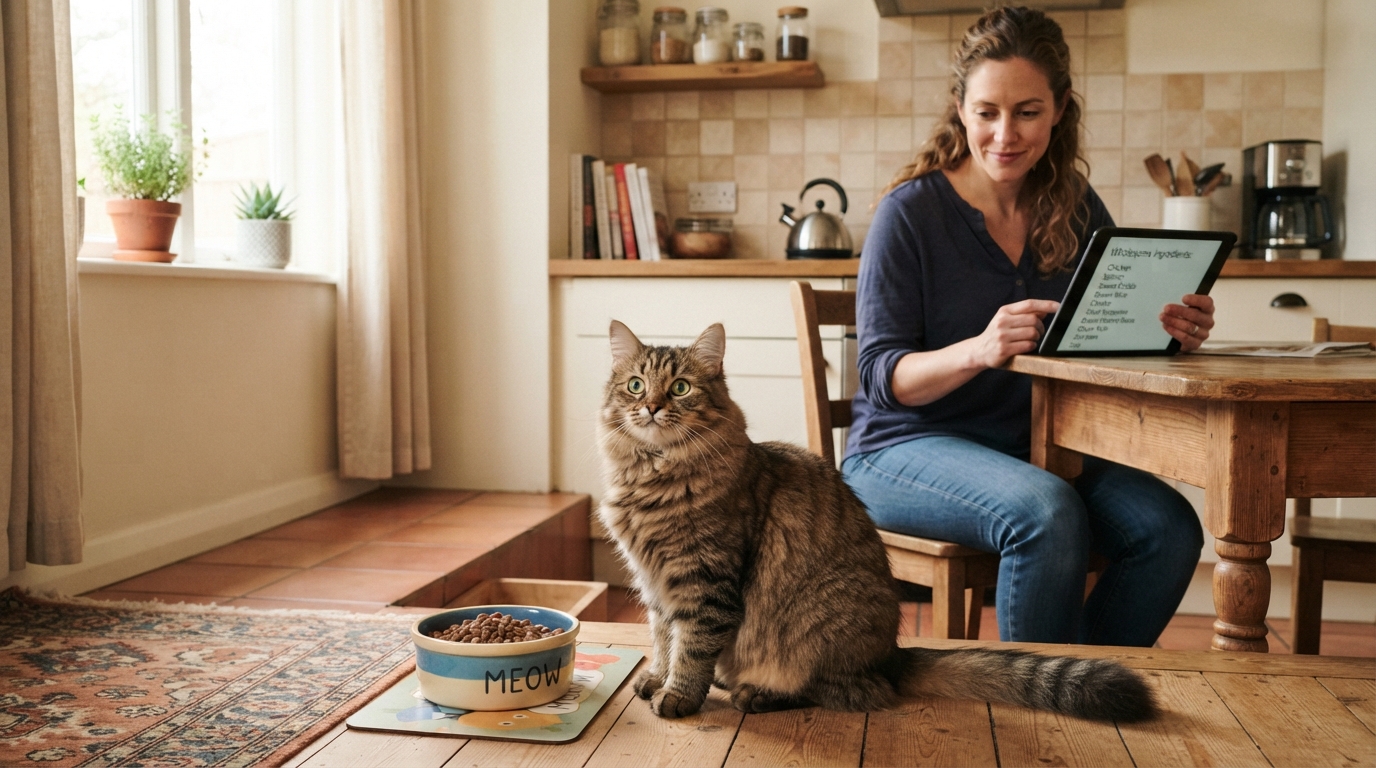
A food’s ingredient list alone cannot tell us how much of its nutrition a cat will absorb. Apparent digestibility is the estimated share of a consumed nutrient absorbed rather than excreted in feces. It helps us think beyond what goes into a bowl.
Nutrient absorption depends on the food and the individual cat. A cat’s health, the recipe, and the way the food is made can all affect how the body uses nutrients. One cat may respond well to a food that does not suit another.
We can use digestibility results as one part of a wider feeding picture, not as a stand-alone score. Ingredient choices, processing, label claims, and daily feeding practices all deserve attention. We can also watch for changes in stool, appetite, or comfort.
A useful food choice starts with both a sound nutritional label and attention to how the individual cat responds.
Key Takeaways
- Apparent digestibility estimates how much of a nutrient a cat absorbs.
- Recipe, processing, and individual health can affect nutrient use.
- A label’s nutritional adequacy statement should match the cat’s life stage.
- Stool and appetite changes can offer useful clues about a cat’s response.
- A veterinarian can help assess ongoing digestive changes or special diet needs.
What Does Cat Food Digestibility Measure in a Feeding Test?
Two cats can eat the same measured ration yet leave different amounts of a nutrient in their stool. A feeding test estimates apparent digestibility by comparing the nutrient entering in food with the nutrient leaving in feces.
A nutrient-specific result estimates one nutrient’s apparent digestibility, while total dry-matter digestibility covers the food’s moisture-free portion. Neither number tells us every detail of a cat’s health or nutrition.
Intake, feces, and nutrient estimates
In a test, researchers record how much food each cat eats and analyze the food’s nutrient content. They also collect feces and measure what remains. The difference estimates the share absorbed rather than excreted.
Researchers may use a marker to help estimate how much food material passed through the cat. The result is an analysis of a specific nutrient, such as protein, or of total dry matter. These measures answer different questions.
A protein result does not describe the digestibility of fat or fiber. Total dry-matter digestibility, in turn, combines many parts of the food rather than tracking one nutrient alone. A 2023 in-home cat study examined how test length and cat numbers affect estimates.
Adaptation days and collection periods
Cats need time to adjust to a test food before researchers collect samples. A 2023 study of privately owned cats found fecal marker concentrations stabilized from day 2 on the less-digestible food and day 3 on the more-digestible food.
The study recommended at least two adaptation days and three fecal collection days for future in-home tests. Researchers also found that extending collection from one to six days did not improve estimate precision.
Adding cats improved precision more than collecting feces for extra days. A sound test needs an adequate group, not just a longer collection period.
Increasing the number of cats from five to 25 did improve precision. Larger groups help account for differences between animals, including variation in how each cat uses the same food.
A test result is most useful when the feeding period allows the cat to adapt and the sample includes enough animals.
Which Cat Food Digestibility Factors Affect Nutrient Absorption?
The best-supported answer is that both recipe formulation and food format affect digestibility, not moisture alone. Dry, semimoist, and canned products differ in water content, protein level, caloric density, palatability, and digestibility.
Moisture levels vary widely by format, but a food’s recipe and the cat’s health also shape nutrient use. These Cat Food Digestibility Factors work together rather than acting as guarantees on their own.
Moisture and food format
Dry cat food typically contains 10-12% moisture. Semimoist cat food contains approximately 35%, while canned pet food typically contains 75-78% moisture.
| Format | Typical moisture | Practical distinction |
|---|---|---|
| Dry | 10-12% | May be less palatable; digestibility depends on formulation |
| Semimoist | Approximately 35% | Can dry out after opening |
| Canned | 75-78% | Highly palatable for many cats; refrigerate opened portions |
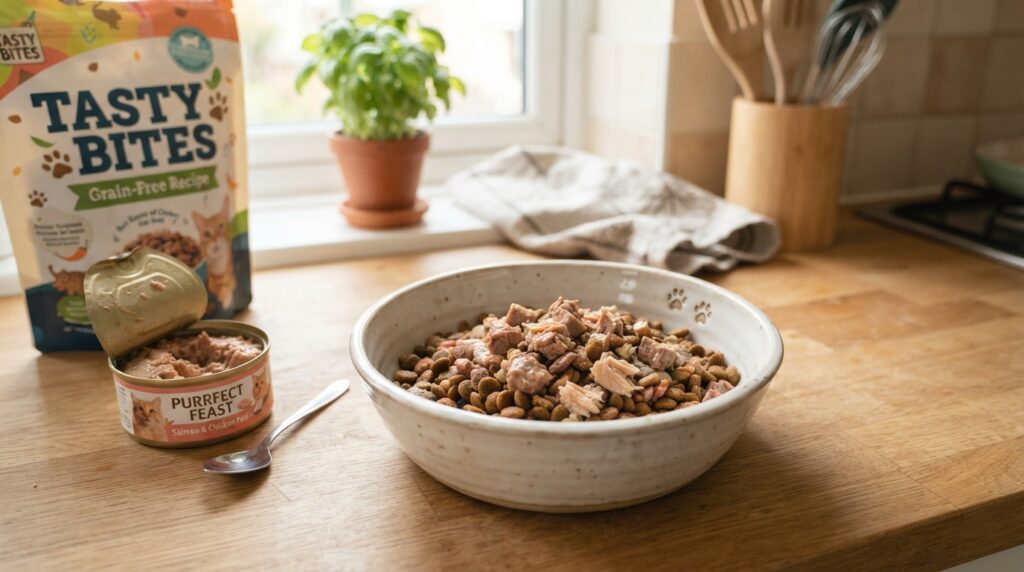
Dry food may be less palatable than moist food, and its digestibility depends partly on formulation and ingredients. A product’s texture and water content do not tell us the whole nutritional story.
Ingredients, fiber, fat, and processing
Ingredient source and quality affect how well a cat can use protein and other nutrients. Protein and fat composition, fiber, ash, processing, and the cat’s health also matter. A recipe can be highly digestible for one cat and less suitable for another.
Fiber can change stool amount and consistency, while fat contributes energy and can affect how a food is digested. Processing can also change how nutrients are available. We should judge these factors as parts of a complete recipe.
A “grain-free” claim alone does not prove higher digestibility. For a closer look at protein choices, we can review animal protein sources for pets, while keeping in mind that cats have needs different from dogs.
Compare the whole recipe and your cat’s response rather than treating one ingredient or format as a guarantee.
How Do We Compare Cat Food Nutrients on a Label?
The most reliable label comparison is to put nutrient percentages on the same dry-matter basis. Dry matter means the moisture-free portion of food, so this method lets us compare products with different water levels.
Adult-maintenance cat food has a minimum crude-protein level of 26% on a dry-matter basis, not on the as-fed label. We should first check whether the food’s life-stage claim fits the cat.
Check the nutritional adequacy statement
The Association of American Feed Control Officials, or AAFCO, sets nutrient profiles for different life stages. A food can carry a complete-and-balanced statement if it meets an AAFCO nutrient profile or passes an AAFCO-procedure feeding trial.
The complete-and-balanced statement tells us whether a food is meant to meet a cat’s nutritional needs for a stated life stage. The ingredient list orders ingredients by decreasing proportional weight, but ingredient order alone does not establish quality or digestibility.
We can learn more about label standards and nutrition in this guide to pet nutrition requirements. Crude protein is useful for comparing foods, but it does not show protein digestibility or amino acid balance.
Compare nutrient percentages on a dry-matter basis
To convert a nutrient percentage, divide it by the food’s dry-matter percentage and multiply by 100. Find dry matter by subtracting the moisture percentage from 100.
For example, a label showing 10% protein and 78% moisture has 22% dry matter. Divide 10 by 22, then multiply by 100, for about 45% protein on a dry-matter basis.
We can use five checks when reading a label:
- Life stage named on the package
- Complete-and-balanced statement
- Moisture percentage
- Nutrient comparison on a dry-matter basis
- Ingredient order by proportional weight
Homemade recipes may need a veterinarian’s formulation when a cat has medical needs. A homemade mix can miss key nutrients even when its ingredients seem wholesome.
Match the adequacy statement to your cat’s life stage before comparing the finer details of a recipe.
What Feeding Choices Support Digestion and Safety?
For most adult cats, plan at least two meals a day, with three or four meals useful for some cats. More frequent meals may help cats that beg between meals or eat only small amounts.
Treats should make up no more than 10-15% of daily calories. Fresh, clean water should always be available, and supplements need veterinary approval before use.
Meal timing, treats, water, and supplements
An empty stomach can begin sending hunger signals after 8-10 hours. We can divide a cat’s daily food into meals that suit its appetite and routine, rather than letting treats replace balanced meals.
Most cats eating a complete-and-balanced diet do not need supplements. Extra vitamins or minerals can cause problems, so we should not add them without a veterinarian’s approval.
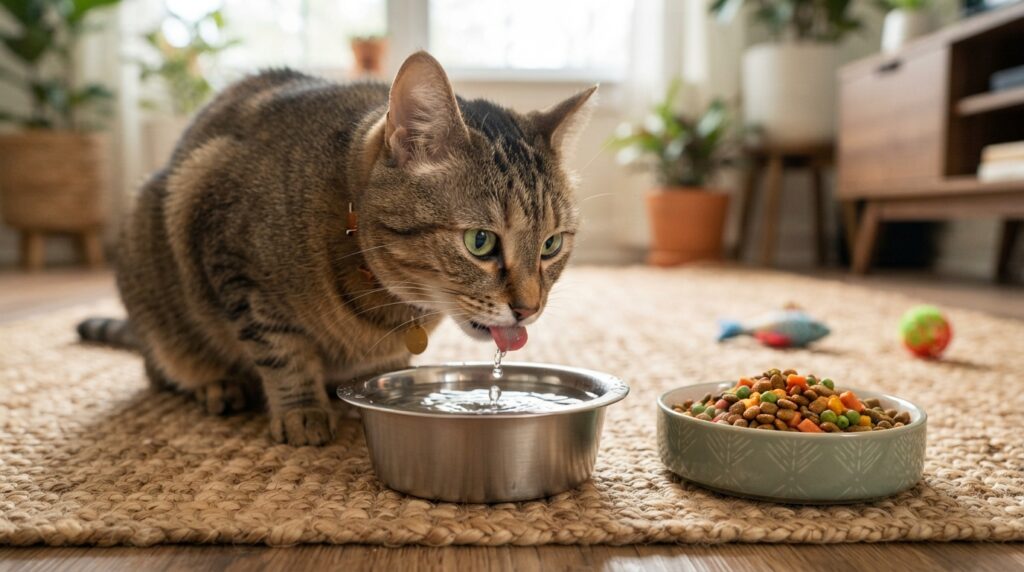
Fresh water supports normal body function, and cats need access to it throughout the day. Ongoing digestive signs may call for veterinary advice instead of a new supplement or sudden diet change.
Food hazards and safe storage
Some foods can harm cats even in small amounts. Keep these six groups away from the food bowl and kitchen scraps:
- Onions, garlic, and chives can upset the digestive tract and damage red blood cells.
- Milk and dairy can cause digestive upset.
- Raw meat and eggs can carry Salmonella and E. coli, which can infect cats and people.
- Raw bones can injure or block the digestive tract.
- Yeast dough can cause painful gas and potentially life-threatening bloat.
- Fatty nuts can cause vomiting, diarrhea, or pancreatitis; high-salt foods can cause illness or salt toxicity.
Salt toxicity can bring vomiting, diarrhea, depression, tremors, seizures, or death. Raw or gently cooked diets are not recommended because proven health benefits are lacking and pathogens may infect cats and people.
Store dry food in an airtight container in a cool, dry place, check expiration dates, and refrigerate opened canned food. Keep packages sealed between servings to protect the food from moisture and dirt.
Keep dry food in an airtight container in a cool, dry place and discard it after its expiration date.
What Can Stool and Transit Patterns Tell Us?
Transit measurements can differ substantially between cats, so a single timing estimate is not a personal digestion clock. Stool amount and consistency can offer useful clues, but they cannot show how much of each nutrient entered the body.
A stool check cannot replace a nutrient-specific digestibility test. A 2021 study of six healthy cats found wide variation in stomach, intestinal, and overall gastrointestinal transit times.
What stool can and cannot indicate
Changes in stool can help us notice that a cat’s routine or health has shifted. Stool size and firmness are observations, not direct measures of nutrient absorption or the quality of a food’s results.
A cat may pass more stool for several reasons, and stool alone cannot identify which nutrient the body absorbed. We should consider appetite and other changes alongside stool patterns, rather than treating one sign as a diagnosis.
Why transit time varies
The study tracked gastric transit, intestinal transit, and overall gastrointestinal transit before and after feeding. Its six healthy cats showed wide differences within and between individual animals.
| Transit measure | Median before feeding | Median after feeding | Range before feeding | Range after feeding |
|---|---|---|---|---|
| Gastric transit | 94 minutes | 1,068 minutes | 1-4,101 minutes | 484-5,521 minutes |
| Intestinal transit | 1,350 minutes | 1,534 minutes | 929-2,961 minutes | 442-2,538 minutes |
| Overall gastrointestinal transit | 1,732 minutes | 2,795 minutes | 1,105-5,451 minutes | 926-6,563 minutes |
The spread matters: even healthy cats did not follow one fixed schedule. These results describe a small group, not a clock we can apply to every cat or use to judge a meal by itself.
Transit time varies widely within and between cats. A single timing result cannot tell us how quickly every cat digests food.
Record a persistent change in stool or appetite and discuss it with your veterinarian.
Conclusion
A sound feeding choice combines a complete-and-balanced food with attention to the cat eating it. Digestibility results can add context, but a label and a cat’s response both matter for health and nutrition.
We can make the next veterinary visit more useful by bringing the current food label and a short record of stool or appetite changes. Those details help the veterinarian judge whether a change is needed and how to make it safely.
Bring the food label and your observations to your veterinarian before making a major diet change.