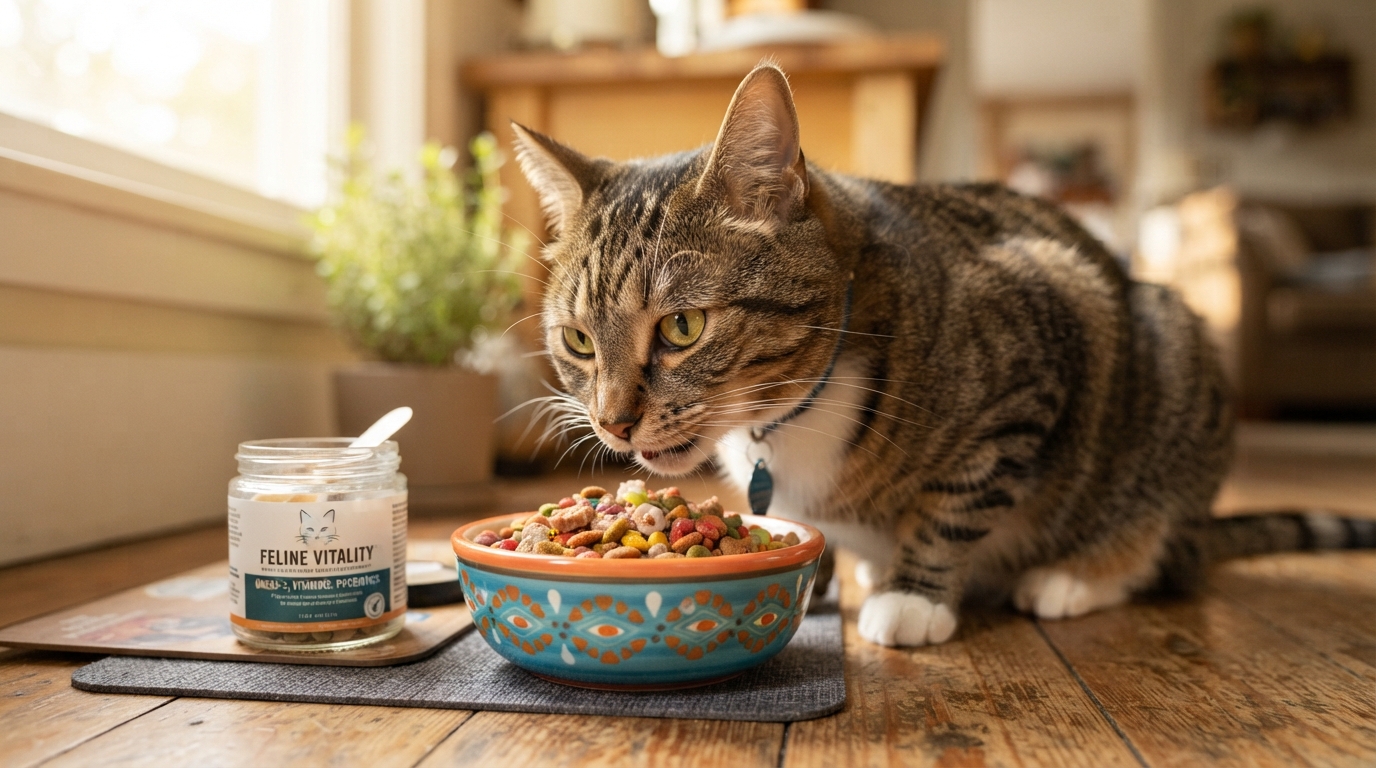
A cat can eat every day and still miss important nutrients if its food is incomplete, poorly matched to its needs, or affected by illness. Feline nutritional deficiency prevention starts with food choice, attention to changing needs, and veterinary care when health shifts. A nutritional adequacy statement is label wording that identifies the type of pet and life stage a food suits, and explains how its complete nutrition is substantiated.
That matters because nutrition problems can build quietly, even when a cat seems eager to eat. We can lower risk by checking the food’s purpose and watching for changes in appetite, weight, or energy. A veterinarian can help when illness or a new life stage may change what a cat needs.
Key Takeaways
- Choose cat food suited to the cat’s species and life stage.
- Review food choices when health or life needs change.
- Ask a veterinarian before adding supplements or changing a diet for illness.
- Keep the package and lot code if a food is recalled.
- A useful first step is to judge a food by its nutritional adequacy statement rather than its marketing language.
How Can Feline Nutritional Deficiency Prevention Start With a Balanced Diet?
A food earns a place as a daily staple only when its label identifies feline suitability and explains its nutritional adequacy. For feline nutritional deficiency prevention, choose complete and balanced food made for the cat’s species and life stage.
A diet for feline nutritional deficiency prevention should be complete and balanced for the cat’s species and life stage. Food for this purpose should carry a nutritional adequacy statement that fits the cat.
Choose a cat-suitable food whose nutritional adequacy statement matches the cat’s needs.
Read the nutritional adequacy statement
Cats and dogs need six major nutrient classes. The National Research Council’s 2006 nutrient guide lists about 50 essential nutrients for dogs and cats.
AAFCO statements may say a food is formulated to meet AAFCO Cat Food Nutrient Profiles. They may also say feeding tests using AAFCO procedures substantiate complete and balanced nutrition for a stated life stage.
The two ways AAFCO substantiates adequacy help explain what the statement means. The FDA also explains complete and balanced pet food claims and how they are supported.
FDA animal-food labels must name the product, give its net quantity, and identify the manufacturer or distributor and business address. Ingredients appear from most to least by weight.
On October 13, 2026, AAFCO issued a final position on enforcement discretion tied to updated feline calcium and phosphorus profiles. This concerns profile updates, not a reason to ignore the food’s intended use.
Match the food to the cat’s species and life stage
Recognized life stages include gestation and lactation, growth, maintenance, and all life stages. A food labeled for all life stages is formulated for reproduction and growth.
Kittens need food suitable for growth, while adult cats need food suited to maintenance. A pregnant or nursing cat has different demands from a cat eating for maintenance.
Cats need animal tissues for taurine, arginine, arachidonic acid, and vitamins A and D. Dog food does not meet a cat’s distinct needs, so dogs’ food is not a substitute for cat-suitable nutrition.
Our pet nutrition requirements guide covers how food labels and diet choices support pets. Check the manufacturer or distributor details and ingredient order as well as the adequacy statement.
What Signs Can Point to a Nutritional Deficiency in Cats?
Thiamine deficiency can begin with reduced appetite or vomiting and progress to serious neurologic signs. These changes need attention, but signs alone cannot confirm a nutritional deficiency.
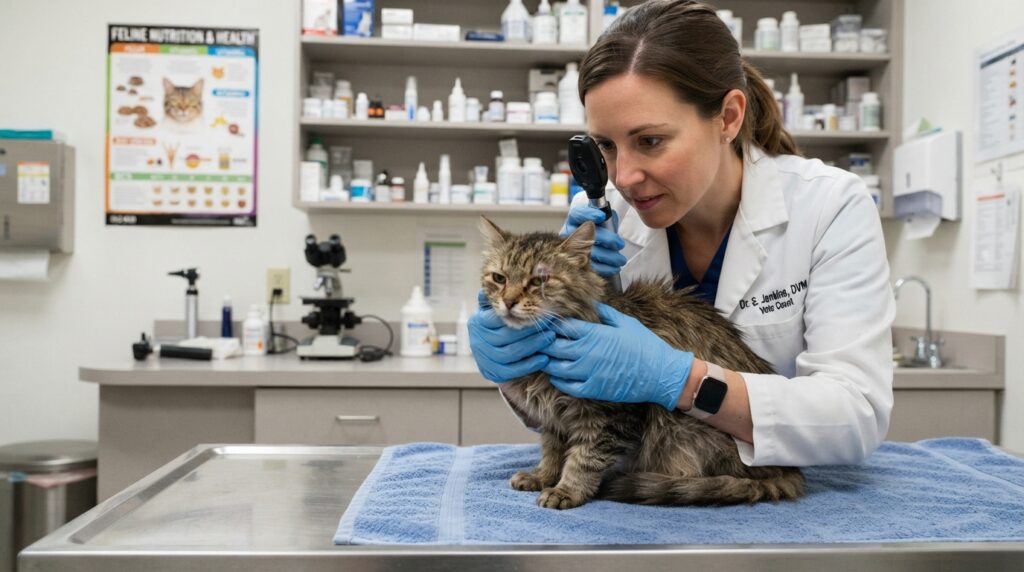
A veterinarian should assess a cat when we suspect a deficiency. Taurine deficiency can affect the heart, while thiamine deficiency can cause neurologic disease.
Early appetite and digestive changes
Decreased appetite or vomiting may appear early in thiamine deficiency. A cat may eat less before more severe signs become clear.
Those symptoms can also have causes unrelated to nutrition. Illness, pain, and other problems can change appetite or upset digestion, so we should not treat a symptom as a diagnosis.
Watch for groups of changes, not just one isolated moment. A simple record of meals, vomiting, and behavior can help us explain what has changed during a veterinary visit.
Neurologic signs and symptom timing
Advanced thiamine deficiency can affect movement and awareness. Signs may appear after as little as one week on an affected diet, while other cats may take months to show symptoms.
Possible signs include:
- Decreased appetite or vomiting
- The neck bending downward
- Muscle weakness
- A wobbly gait or falling
- Seizures or circling
The neck may bend downward as the disease advances, and weakness can affect how a cat stands or walks. Seizures and circling call for prompt care, even if the cat’s food seems suitable.
Timing varies between cats, so a recent diet change does not rule out a food-related problem. A longer gap between a food change and symptoms does not prove the diet caused them either.
A veterinarian can review the cat’s diet, exam findings, and health history together. Seek prompt veterinary care for a cat that develops weakness, an unsteady gait, seizures, or other sudden neurologic changes.
Which Everyday Feeding Choices Lower Deficiency Risk?
The safest everyday routine gets most calories from a complete cat food and treats extras as a small part of the diet. We should review food and portions as a cat’s needs change through kittenhood, adulthood, pregnancy, and lactation.
Supplements for feline nutritional deficiency prevention should be used only with veterinary approval, because excess nutrients can harm cats. A diet review can also help us spot changes in appetite, weight, or coat before they become harder to explain.

Adjust food as needs change
Complete and balanced commercial foods are made for a specific life stage. The food and portion that suit a kitten may not fit an adult cat, a pregnant cat, or a nursing mother.
Growth brings changing needs for energy and nutrients. Pregnancy and lactation also change the demands on a cat’s body, so a food that once worked may no longer fit.
We can record the food name, serving size, and the cat’s weight during routine care. A steady pattern makes changes easier to notice, while a sudden change may call for a veterinary review.
Get professional help with homemade and raw diets
Homemade recipes can miss key nutrients or contain the wrong proportions. A veterinary nutritionist can formulate a home-prepared diet for a cat’s medical needs.
Recipes found online may not give enough of every nutrient, even when they use fresh ingredients. Cats need specific nutrients, including certain amino acids and fatty acids, in the right balance.
Raw or gently cooked diets can expose cats to live bacteria, viruses, and parasites. Evidence of health benefits from these diets is lacking, so their risks need careful thought.
Our guide to pet nutrition requirements also explains why home-prepared recipes need expert input. A veterinary nutritionist can shape the recipe around a health issue without leaving basic needs out.
Keep treats and supplements in proportion
Treats generally should account for no more than 10 to 15 percent of a cat’s daily calories. That calorie guideline is different from the rule for foods labeled short-term, intermittent, or complementary.
Those foods should make up 10% or less of the diet unless a therapeutic diet is fed under veterinary supervision. The label’s feeding purpose matters, even when the food looks like a normal meal.
For feline nutritional deficiency prevention with supplements, use them only after veterinary approval. Too much of a vitamin or mineral can harm a cat, and combining products can add up to an unsafe amount.
A diet heavy in liver or liver oil can cause chronic vitamin A toxicity. Possible signs include neck pain, a rigid neck, and forelimb lameness.
Vitamin D3 poisoning can cause weakness, appetite loss, vomiting, increased thirst and urination, and dehydration. Signs and lab changes often develop within 12 to 48 hours.
In animals, cholecalciferol doses as low as 0.1 mg/kg can cause clinical signs. Doses above 0.5 mg/kg can cause marked calcium and phosphorus rises and mineral deposits in soft tissues.
Those dose figures show why we should not add supplements based on coat appearance or a guess. A veterinarian can assess whether a supplement is needed and set a safe amount.
Store food to protect its quality
Long storage can lower vitamin activity in dry food and raise the chance that its fats turn rancid. Buy amounts we can use while the food remains fresh, and keep the package closed between meals.
Opened canned food belongs in the refrigerator. Use the product’s storage directions, and do not leave opened wet food sitting out for long periods.
A diet-review log can help us share clear details with a veterinarian:
- Food name and lot code
- Measured meals and leftovers
- Treats and toppers
- Supplements and doses
- Appetite, weight, or coat changes
Keep opened canned food refrigerated, and avoid storing dry food so long that its vitamins lose potency or its fats turn rancid.
What Should We Do If a Cat Food Is Recalled?
A recalled lot needs immediate action even if the food looks normal and the cat has no symptoms. Stop feeding the affected lot, keep its package, and contact a veterinarian if the cat ate it or seems unwell.
The lot code matters because a recall may cover only certain packages. FDA testing found extremely low or no thiamine in all eight tested Quest lots; continued feeding could cause deficiency, serious illness, or death.
| Product and form | Lot | FDA thiamine result in mg/kg | Date type and date |
|---|---|---|---|
| Prey Model Chicken Recipe Freeze Dried Nuggets | C25288 | 0.22 | Best by 10/15/27 |
| Prey Model Chicken Diet Bite Size Nuggets, frozen | MCD25350 | None detected | Use by 06/16/27 |
| Prey Model Pork Recipe Freeze Dried Nuggets | C25358 | Less than 0.1 | Best by 12/24/27 |
| Prey Model Beef Recipe Freeze Dried Nuggets | C25318 | Less than 0.1 | Best by 11/14/27 |
| Prey Model White Fish Freeze Dried Nuggets | C25337 | 0.85 | Best by 12/03/27 |
The AAFCO Cat Food Nutrient Profile minimum for thiamine is 5.6 mg/kg on a dry-matter basis. FDA’s results above are reported in mg/kg, not as dry-matter values.
The other tested lots had these results: Chicken Diet Bite Size Nuggets, frozen, lot MCC25321, had no thiamine. Chicken Recipe Freeze Dried Nuggets, lot C25336, had 0.21 mg/kg, and Pork Recipe Freeze Dried Nuggets, lot C25321, had 0.32 mg/kg.
The February 17, 2026, FDA recall covered 10-ounce bags of Quest Cat Food Chicken Recipe Freeze Dried Nuggets. The package had UPC 6-91730-18103-1, lot C25288, and a best-by date of 10/15/2027.
One illness was confirmed for that recalled lot, and the cat recovered after veterinary treatment. A single reported recovery does not show that every exposed cat is safe.
Do not feed a recalled lot, even when a cat still seems well.
FDA requires pet food to be safe, made under sanitary conditions, free of harmful substances, and truthfully labeled. Keep the package or a clear photo of its lot code available when contacting the veterinarian or reporting the food.
Conclusion
We can make prevention practical by treating food choices and changing health needs as part of routine care. A cat’s food should remain suited to its life stage, health, and growth.
Illness may change which diet works best, while a home-prepared plan needs professional formulation. Veterinary guidance can help us make that change without overlooking the cat’s nutrient needs or energy needs.
At the next wellness visit, ask the veterinarian to review the cat’s current diet against its life stage and medical history.