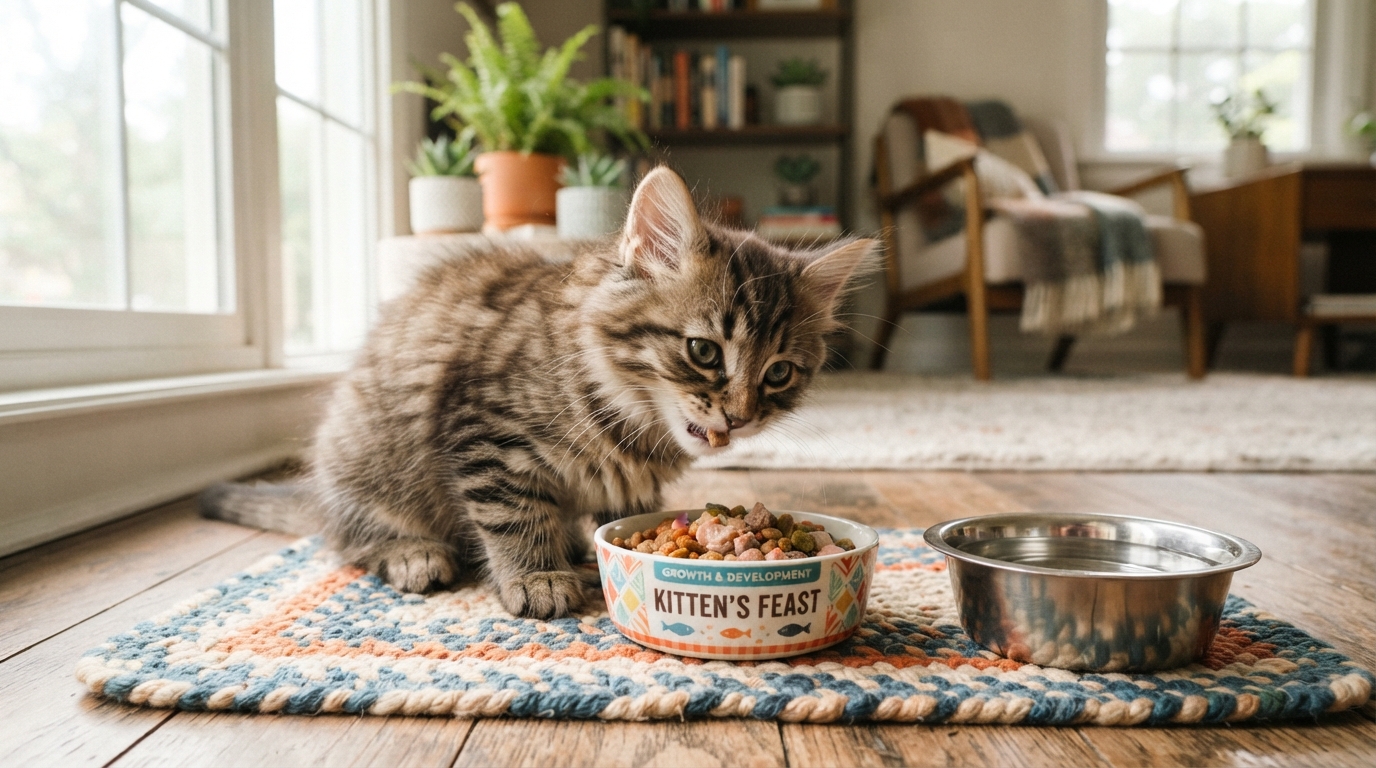
A complete, balanced growth diet, offered in portions that change with age, supports a kitten’s healthy first year. Kittens grow quickly, and their feeding needs shift as their bodies change. Age-appropriate food helps support healthy development at each life stage.
We may be caring for a nursing kitten, a newly weaned kitten, or one nearing adulthood. Each stage brings different food choices and feeding routines. We’ll explain how to adjust those choices as growth, weight, and health change.
Key Takeaways
- Choose a complete food made for kitten growth.
- Use the package directions as a starting point for daily portions.
- Offer meals suited to the kitten’s age and routine.
- Keep fresh water available, including for kittens eating wet food.
- Ask a veterinarian about feeding changes for an orphaned or unwell kitten.
Growth is not a single milestone, so feeding decisions should keep pace with a kitten’s age, weight, and health.
What Does Kitten Nutritional Development Require?
Growing kittens need a complete nutrient profile, not just a high-protein food. A growth-formulated diet supplies nutrients in the right balance for developing bodies. Protein, fat, minerals, vitamins, and other nutrients must work together.
Protein supports growing tissues and supplies amino acids, the small units the body uses to build proteins. Cats need certain amino acids from food, including taurine and arginine. A single ingredient or front-label claim cannot show whether a diet meets every need.
Protein, Fat, and Amino Acids
Protein provides essential amino acids for muscles, organs, skin, and other growing tissues. Kittens cannot make enough of some amino acids on their own. Their diet must supply them in suitable amounts each day.
Fat provides concentrated energy, which supports the demands of rapid growth. Essential fatty acids also help support normal skin and other body functions. A food’s full nutrient profile matters more than choosing a diet based on protein alone.
Calcium, Phosphorus, and Bone Growth
Calcium and phosphorus help build strong bones and teeth. Their amounts and proportions both matter as a kitten grows. A food with extra calcium is not automatically better, since too much or an imbalance can be harmful.
Vitamins and minerals help the body carry out many normal tasks. A complete diet formulated for growth accounts for these nutrients along with protein and fat. This is safer than trying to balance a kitten’s diet one nutrient at a time.
Taurine, DHA, and Development of Vision
Taurine supports normal vision and heart function, while DHA contributes to brain and vision development. These nutrients have specific roles, but they do not replace the rest of a balanced diet. A food must provide the full set in suitable amounts.
Adding a nutrient without veterinary guidance can upset a complete diet’s balance.
We should avoid supplements unless a veterinarian recommends them for that kitten. A supplement may add nutrients the food already supplies, and the extra amount may not fit the kitten’s needs. Choose a growth-formulated diet rather than adding isolated nutrients to an otherwise complete meal.
How Do Kittens Move From Milk to Solid Food?
Most kittens begin weaning at about 3 to 4 weeks, while orphaned kittens need kitten milk replacer and close feeding guidance. Weaning is the gradual transition from a mother’s milk to solid food. Kittens without access to their mother’s milk need veterinary advice about formula and feeding times.
As kittens become ready, we can offer wet food or dry kibble softened with water. Start with a small amount in a shallow dish, and let each kitten explore at its own pace. The change happens over time, not in one meal.
Nursing and Formula for Orphaned Kittens
Kittens who cannot nurse usually need kitten milk replacer every few hours, around the clock. Their formula and schedule depend on their needs, so a veterinarian should guide both. Cow’s milk and goat’s milk can be hard to digest and may cause diarrhea.
For an orphaned kitten, we should take these steps:
- Use kitten milk replacer, not cow’s or goat’s milk.
- Follow a veterinarian-guided feeding schedule.
- Monitor that the kitten is feeding.
A kitten that is not nursing needs prompt veterinary guidance, since young kittens depend on frequent feeds. We should ask the veterinary team how to prepare and offer the formula safely.
Starting Soft Foods During Weaning
Offer wet food or moistened dry kibble when kittens show interest in solid food. By 6 to 8 weeks, kittens can begin eating wet or dry kitten food. A shallow dish can make the first tries easier to manage.
Some food may land on a kitten’s face or paws at first. Keep offering suitable food as the kitten learns to eat from a dish. We can leave the mother’s presence and nursing pattern to guide the pace when she is available.
When Milk Stops and Water Starts
Once fully weaned, kittens do not need milk in other forms. A 2-month-old kitten that has completed weaning should drink fresh water, not cow’s or goat’s milk. Water belongs within easy reach as solid food becomes the kitten’s main diet.
We should keep a clean bowl available through the transition and after it. Once weaning is complete, keep fresh water available and do not offer milk as a substitute for food.
How Much Should a Kitten Eat at Each Age?
A feeding chart gives a useful daily starting point only when its age, weight, and formula match the kitten. The daily amount changes as kittens grow and gain weight. These figures are for Purina Pro Plan Development formulas, not every kitten food.
Use the age and weight ranges together when reading the chart. The listed amount is for the full day, not for each meal. Divide it across the kitten’s meals, and use the package chart for the exact formula you feed.
| Age | Body weight | Dry food per day | Wet food per day |
|---|---|---|---|
| 4 to 12 weeks | 1 to 3 lb | 1/4 to 1/2 cup | 1/2 to 1-1/2 3 oz cans |
| 12 to 24 weeks | 3 to 5-1/2 lb | 1/3 to 2/3 cup | 1-1/2 to 2 cans |
| 24 to 36 weeks | 5 to 7 lb | 1/3 to 2/3 cup | 2 to 3 cans |
The Purina Pro Plan Development feeding amounts apply to those formulas and can differ from another product’s directions. Food calorie content affects how much food a kitten needs, so cup and can amounts are not interchangeable across brands.
The first row covers kittens from 4 to 12 weeks old weighing 1 to 3 pounds. The next rows show larger age and weight ranges, but a kitten may not match both neatly. Ask a veterinarian to help assess the portion when the kitten’s age or body weight falls outside the chart.
Keep the food package nearby when you measure a serving. A chart tied to one formula may not fit another formula from the same brand. Recheck portions against the food’s own chart whenever you change formulas.
How Often Should Kittens Eat, and How Can You Estimate Calories?
A kitten’s daily calorie estimate starts with body weight, then changes according to age and growth stage. Meal frequency also shifts as kittens get older. Use the calorie math as an estimate, not an individual prescription.
RER means resting energy requirement, an estimate of the calories a body needs for basic functions at rest. To calculate it, convert body weight to kilograms, then use this formula: RER = 70 × body weight in kilograms raised to the 0.75 power.
Estimate Calories From Body Weight
For kittens under 4 months, the estimated daily need is RER × 2.5. For kittens from 4 to 12 months, the estimate is RER × 2.0. A 2-pound kitten has an RER of about 65 calories per day.
That 2-pound kitten’s estimated daily need is about 163 calories under 4 months, or about 130 calories from 4 to 12 months. These are calorie estimates, not cups of food or cans. The food’s calorie content determines how much volume provides that energy.
Growth, activity, health, and the specific food can change an individual kitten’s needs. A kitten eating an energy-dense food may need less volume than one eating a food with fewer calories per cup. The calculation gives us a starting point for a feeding discussion.
Set Meal Frequency by Age
Meal frequency usually decreases as kittens mature. This age guide pairs a daily meal count with the calorie multiplier used for the estimate:
| Age | Meals per day | Daily calorie multiplier |
|---|---|---|
| Under 4 months | 3 to 4 | RER × 2.5 |
| 4 to 6 months | 3 | RER × 2.0 |
| 6 to 12 months | 2 to 3 | RER × 2.0 |
At 6 weeks, kittens can have 3 to 4 meals daily; from 4 to 6 months, they can have 3. From 6 to 12 months, 2 to 3 meals daily is a suggested range. We can space meals around the kitten’s household routine while keeping portions measured.
A veterinarian can consider growth and health alongside the number on a scale. Use the calculation as a conversation starter with a veterinarian, not as a substitute for monitoring the kitten’s growth.
Should Kittens Eat Wet Food, Dry Food, or Both?
Wet food, dry food, and a measured combination can all fit a kitten’s routine when the food is formulated for growth. Food format does not decide whether a diet is complete. Choose a growth-formulated diet in whichever format suits the kitten and household.
Wet food adds moisture through the diet, while dry food can be convenient to portion and serve. Either can be part of a complete growth diet. We can also combine them, as long as we measure the total daily amount.
What Wet Food Adds
Wet food supplies moisture along with the meal. That can be useful for kittens who eat little water-rich food, but it does not replace a water bowl. A 2-month-old kitten should still have fresh water available, even when eating wet food.
For more on how food format and moisture fit into a cat’s diet, Cornell’s cat feeding guidance covers wet and dry options. We should also consider what the kitten will eat reliably and what fits the feeding routine.
When Dry Food or Mixed Feeding Fits
Dry food can suit households that need a food that is easy to measure and serve. A suitable puzzle feeder can make dry food a foraging activity. The feeder should fit the kitten’s size and ability to use it.
Mixed feeding is another practical option. We can serve wet food at one meal and dry food at another, or combine measured amounts. The key is to account for both foods within the kitten’s daily portion rather than adding one on top of the other.
Different formats may have different calorie levels, so measure each one using its own directions. That helps keep the full day’s serving in view, including when meals happen in different places. Keep clean, fresh water accessible no matter which format fills the food bowl.
How Do You Choose a Complete Kitten Food?
For a 2-month-old kitten, choose a complete food whose label confirms it is formulated for growth. Life-stage wording helps show whether the diet fits the kitten’s age. Adult-maintenance-only food does not meet the stated growth stage.
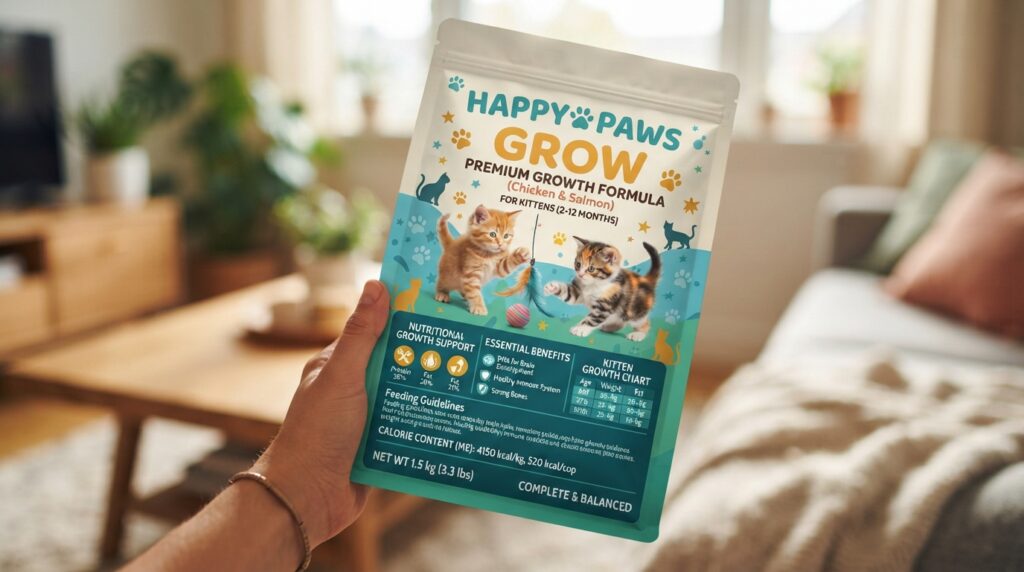
The AAFCO nutritional adequacy statement identifies the life stage a food is formulated to support. A statement for growth, or a qualifying statement for all life stages, can fit a growing kitten. The Association of American Feed Control Officials (AAFCO) recognizes nutrient profiles and feeding protocols as ways to support adequacy claims.
Read the Nutritional Adequacy Statement
We should look for a statement that confirms the food is complete for growth, rather than relying on the product name or a large claim on the front. A food labeled only for adult maintenance is meant for adult cats’ needs, not a 2-month-old kitten’s growth.
AAFCO’s nutritional adequacy methods describe nutrient profiles and feeding protocols used to support complete-and-balanced claims. The package statement is useful because it names the life stage the food is designed to support.
Match the Formula to the Kitten’s Age
Before choosing a product, check these four details on the package:
- The life-stage adequacy statement.
- Feeding directions for the kitten’s age and weight.
- Calorie information for the food.
- Whether the product is a complete diet or a supplement.
Royal Canin Kitten dry food is an example of a formula intended for kittens from 4 months to 1 year. It is not an age match for a 2-month-old kitten. The food provides 3,823 kcal/kg or 367 kcal/cup on an as-fed basis, calculated.
Royal Canin Kitten dry food is formulated to meet the AAFCO Cat Food Nutrient Profiles for growth. That status does not change its stated age range. Match the stated life stage to the kitten’s actual age before using the package’s feeding directions.
When Should a Kitten Switch to Adult Food?
Many kittens move to adult food around their first birthday, but the right timing follows their growth as well as the calendar. Most cats reach adulthood between 12 and 15 months. Breed and individual growth can affect when a kitten is ready.
The first birthday is a practical point to review the food, not a fixed deadline for every cat. Body condition, activity, health, and veterinary advice can help guide the timing. Spaying or neutering alone does not mean a kitten is ready for adult food.
Follow Growth, Not the Calendar Alone
Growth pace varies by breed, and cats do not all mature on the same schedule. We can discuss a kitten’s body condition and health with a veterinarian when deciding whether to keep feeding a growth diet. The food change should fit the cat’s stage, not just a birthday.
Activity also matters when assessing the overall feeding plan. A highly active cat and a less active cat may have different needs. The veterinarian can use the kitten’s health and growth pattern to help decide when adult food fits.
Make the Food Change Gradually
Once the timing is right, mix increasing amounts of adult food with the current food over 7 to 10 days. Start with a small share of the new food, then raise it in steps while reducing the old food. A slower change can help avoid digestive upset.
Keep an eye on how the cat responds during the switch. A sudden refusal or digestive problem can make it hard to complete the change as planned. If the transition brings persistent vomiting or diarrhea, contact a veterinarian rather than continuing to change foods on your own.
Which Feeding Mistakes Can Harm a Kitten?
A kitten’s diet can be disrupted by unsafe human foods, unbalanced additions, or changes in eating that signal a health problem. Some foods are unsafe even in small amounts. Keep onions, garlic, chocolate, grapes, and raisins away from kittens.
Raw diets can expose kittens and household members to harmful pathogens. Treats should remain a small share of daily calories, and table food should not replace a balanced diet. We should avoid adding supplements or large amounts of human food without veterinary guidance.
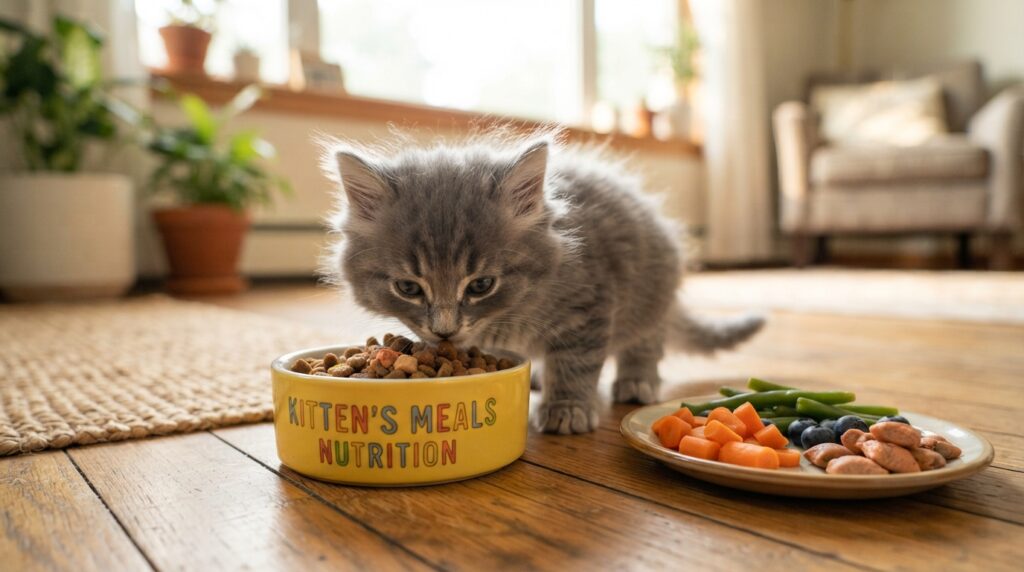
Keep these foods out of a kitten’s reach:
- Onions
- Garlic
- Chocolate
- Grapes
- Raisins
We should seek veterinary advice for sudden appetite changes, repeated vomiting, ongoing diarrhea, difficulty chewing, or increased thirst. These signs can affect a kitten’s health and may need prompt attention. A record of eating changes can help the veterinary team assess the problem.
Measured portions and counted treats can help us keep track of the full diet; see these indoor cat weight management tips for related feeding habits. Contact a veterinary team when appetite or digestion changes suddenly or does not return to normal.
Raw food can carry germs that put kittens and people in the household at risk.
Conclusion
The most useful feeding plan is one that keeps pace with an individual kitten’s growth and health. We can review portions and routines as the kitten changes, rather than treating one feeding plan as permanent.
A simple record helps make that review concrete. Note the food, daily portions, and any changes in eating or body condition. At the next wellness visit, bring the food label and a record of daily portions so your veterinarian can review the plan.