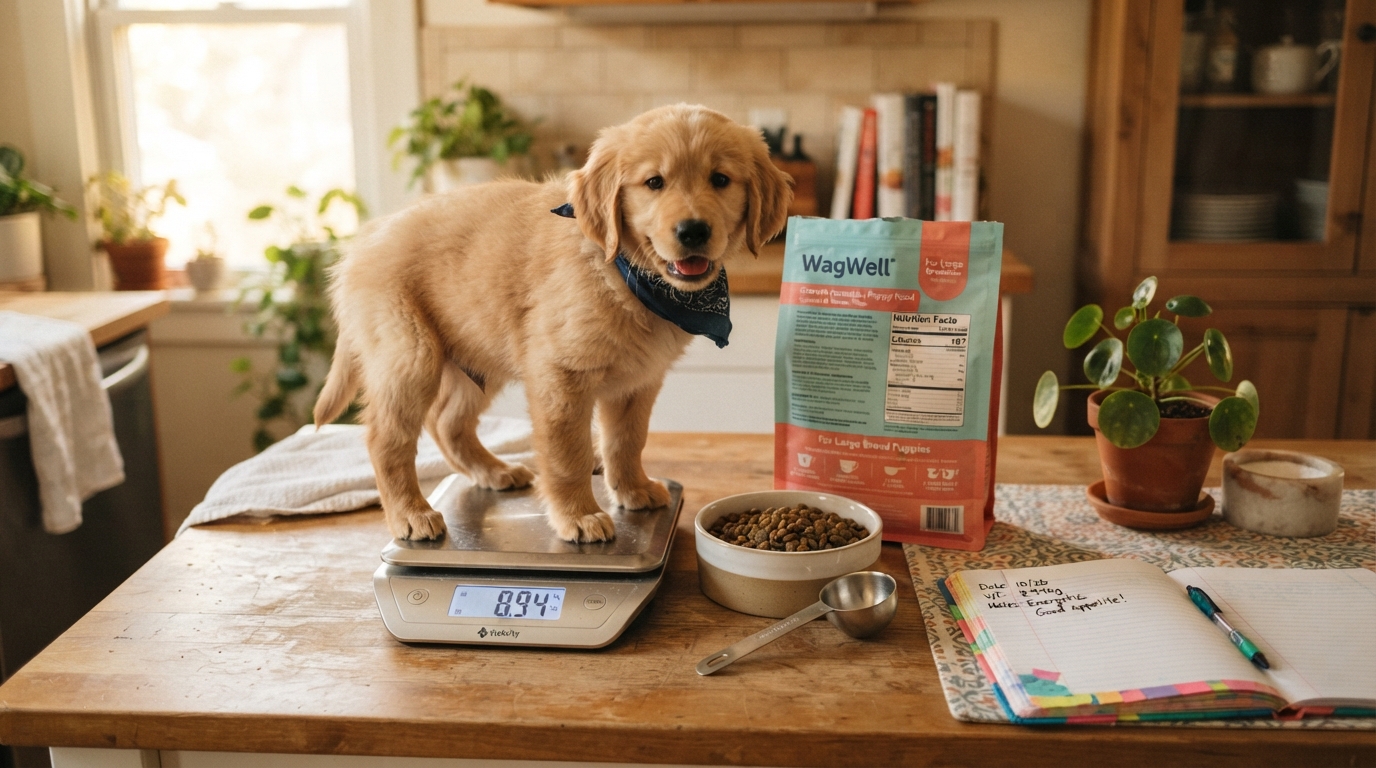
Healthy puppy growth starts with food labeled for growth, with portions and meal timing adjusted as a puppy matures. One food amount will not suit every puppy for long. Age, adult size, and individual growth all shape feeding needs, and a growth-formulated food gives us a sound starting point. A veterinarian can help us adjust portions when a puppy’s needs change. This matters because early feeding choices support development, health, and a steady routine. We can use the food label and regular weight records to make those choices with care, rather than guessing at each meal. Keep the food label and your puppy’s current weight handy when setting a feeding routine.
Key Takeaways
- Choose food labeled for puppy growth.
- Adjust portions as age and size change.
- Use meal timing suited to your puppy’s stage.
- Track weight and body condition over time.
- Ask a veterinarian about feeding changes.
When Do Puppies Start Weaning, and How Often Should They Eat?
A newborn puppy needs a meal every 2 to 3 hours, while feeding intervals change as puppies grow and begin weaning. Puppies usually start weaning at 3 to 4 weeks and finish around 6 to 8 weeks. A 1-month-old puppy can begin softened puppy food while nursing continues, but its solid-food servings should stay small.
For puppy food for a 1-month-old puppy, mix moist food with warm water at 1:1, or dry kibble with warm water at 1:3. Reduce the added water over 7 days; puppies should eat puppy food by 5 weeks and can usually manage dry kibble by 6 weeks.
Moving from milk to softened food
Offer the soft mixture in a shallow dish so puppies can lap and chew. Some puppies need time to learn this new way of eating, so we can let them explore at their own pace. Nursing may continue during the change, and the amount of solid food can rise as they handle drier textures.
Reduce added water over 7 days, and aim for puppy food by 5 weeks and dry kibble by about 6 weeks.
Matching meal timing to age
Bottle-feeding intervals differ from meal schedules for puppies who still nurse. Newborns need frequent feeds, while bottle-fed puppies aged 2 to 4 weeks commonly eat less often. By 4 to 12 weeks, puppies commonly eat 3 to 4 meals across the day.
| Age or stage | Feeding rhythm |
|---|---|
| Newborn | Every 2 to 3 hours |
| Bottle-fed, 2 to 4 weeks | Every 6 to 8 hours |
| 4 to 12 weeks | 3 to 4 meals daily |
The bottle-feeding interval is not the same as the solid-food schedule for a nursing puppy. Toy- and small-breed puppies may need extra snacks because they face a higher risk of low blood sugar. Cornell’s guidance on staying with the litter also highlights the value of time with the mother and littermates.
Keep nursing puppies’ solid-food portions small while they learn to lap and chew.
What Does Puppy Growth Nutrition Require?
A growth diet needs more than calories: its protein, fat, calcium, and phosphorus must also fall within appropriate ranges. AAFCO sets nutrient standards for growth and reproduction, with amounts stated on a dry-matter basis. Dry matter means the food’s nutrients after removing its water content.
These percentages are standards for complete diets, not targets for owners to use when making food at home. Dog nutrition 101 starts with knowing that puppy nutritional requirements by percentage refer to dry matter, not the food as served.
Protein supports tissue growth, while fat supplies energy and essential fatty acids. Calcium and phosphorus need the right balance for skeletal development. DHA, an omega-3 fatty acid, is associated with brain and vision development.
| Nutrient | AAFCO amount | Condition |
|---|---|---|
| Crude protein | Minimum 22.5% | Dry matter |
| Crude fat | Minimum 8.5% | Dry matter |
| Calcium | Minimum 1.2% | Dry matter; maximum 1.8% for large-breed puppies |
| Phosphorus | 1.0% to 1.6% | Dry matter |
The AAFCO growth and reproduction profile sets these nutrient amounts. It also sets a calcium-to-phosphorus ratio between 1:1 and 2:1. Large-breed puppies need close attention to calcium because excess can harm skeletal development.
Food labels use different moisture levels, so an “as fed” percentage may not match the dry-matter figure. We should compare foods on the same basis instead of judging one number alone. That helps us check whether puppy food fits the stated growth standards.
Do not add calcium to a complete growth diet unless your veterinarian directs it.
How Much Food Does a Puppy Need Each Day?
We can estimate a puppy’s daily portion by calculating a calorie target, then dividing it by the food’s calories per cup or ounce. Resting energy requirement (RER) is an estimate of the calories a body uses at rest, calculated from body weight. RER gives us a starting point, not a precise meal plan.
A puppy’s daily amount depends on age, weight, and body condition. We can use this short calculation, then adjust the estimate with veterinary guidance as the puppy grows.
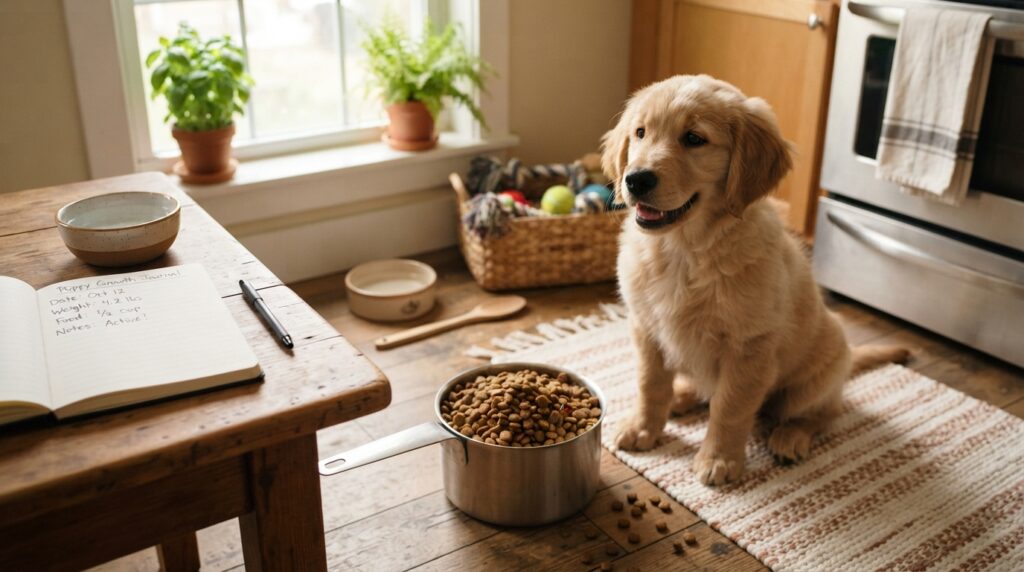
Estimate daily calories and portions
- Weigh the puppy in kilograms.
- Calculate RER as 70 × body weight in kilograms raised to the 0.75 power.
- Multiply RER by 2.2 from birth to half of mature weight, or by 1.5 from half of mature weight to full maturity.
- Divide the calorie target by the food’s labeled kilocalories per cup or ounce.
The RER formula and growth factors estimate calorie needs in kilocalories. For example, the food’s label helps convert that daily target into cups or ounces. We should not treat the result as exact, since age, weight, and body condition can call for changes.
A puppy with a lean outline may need a different portion from one gaining too quickly. Our veterinarian can help us judge the puppy’s body condition and make safe changes. For more consistent serving sizes, we can use portion control strategies and measure the amount rather than pouring by eye.
Treat feeding charts as a starting point
Feeding charts estimate daily food amounts, but each brand’s directions and each puppy’s needs can differ. The chart’s amount usually covers the whole day, not each meal, so we divide it across the puppy’s meals. Treats also count toward daily intake and can take the place of some regular food.
Keep treats ideally below 5% of daily calories. A few small rewards can add up, especially for a small puppy. We can include them in the daily total instead of adding them on top.
Measure the daily total before dividing it among meals so treats do not silently increase the portion.
How Can We Choose a Complete Puppy Food?
For most puppies, choose a complete-and-balanced food labeled for growth; large-breed puppies need a formula designed for large-size growth. The best puppy food is one that meets growth needs and suits the puppy’s size and energy level. Life-stage wording on the package helps us tell whether the food fits.
Look for an AAFCO nutritional adequacy statement that names growth or all life stages. That statement identifies the life stage the food is meant to support, while a complete-and-balanced claim can rely on laboratory analysis or feeding trials.
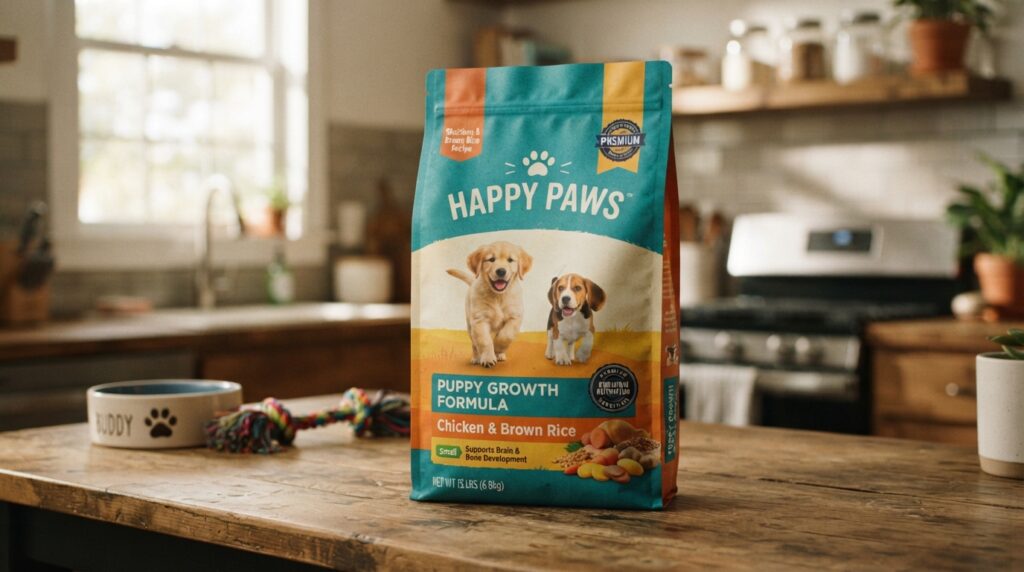
What makes a puppy food suitable?
Puppies need food formulated for growth and development, with portions suited to breed, size, and energy level. A food labeled for adult maintenance alone is not the right choice for a growing puppy. Large-breed puppy food should be made for large-size growth, rather than chosen only because the puppy looks big.
One example is Hill’s Science Diet Large Breed Puppy Chicken & Brown Rice Recipe. The manufacturer describes it as complete and balanced for growing puppies based on animal feeding tests using AAFCO procedures. It is intended for puppies expected to weigh over 55 pounds as adults and is described as suitable from weaning through 18 months.
What the adequacy statement tells us
The AAFCO nutritional adequacy statement may name growth, maintenance, or all life stages. A product labeled for all life stages can support growth, but its portions still need to fit the puppy. We can also check whether the claim rests on feeding trials or laboratory analysis.
The example formula lists chicken and chicken meal as its primary protein sources, plus fish-oil DHA. Those details show how an ingredient list and adequacy statement answer different questions. The statement covers nutritional adequacy, while the list names ingredients.
Do growing puppies need supplements?
A complete growth food usually does not need extra calcium or vitamins. Adding them without veterinary advice can upset the nutrient balance, especially for large-breed puppies. We should discuss a supplement if a veterinarian finds a specific need.
Homemade diets need careful formulation to supply the right nutrients in the right amounts. Raw diets also carry risks from bacterial contamination and nutritional imbalance. A food plan for a growing dog should meet needs across development, not just include foods that sound healthy.
Ask your veterinarian to review a homemade or raw diet before making it the puppy’s main food.
How Can We Monitor Healthy Growth and Adjust Feeding?
A puppy is on a healthier growth track when weight gain stays steady and body condition remains lean. A puppy growth chart follows age and weight over time, and the best chart depends on expected adult size and sex. Body condition means how lean the puppy looks and feels.
A chart tracks an individual pattern; it is not a reason to force a puppy to catch up with littermates. We can use a consistent routine to see changes early and share clear records with a veterinarian.
Track weight and body condition
- Weigh the puppy consistently.
- Record the puppy’s age and weight.
- Feel the ribs and look for a lean outline.
- Contact a veterinarian about weight loss, stalled gain, or a concerning change.
Puppies should be weighed daily, and steady gain is expected after the first day. Average daily weight gain is 8% at 1 week, 6% at 2 weeks, 4% at 3 weeks, and 3.5% at 4 weeks. These are reference points, not targets for every puppy.
A growth chart helps us follow a puppy’s own pattern, not push the puppy to match littermates.
Our veterinarian should assess an individual puppy when weight gain raises concern. The ribs should be easy to feel without standing out sharply. If we cannot judge body condition, a veterinary check can help us decide whether feeding needs to change.
Change food as growth slows
Adult-food timing follows skeletal maturity, which varies by breed size. Small breeds commonly reach it at 8-12 months, medium breeds at 12-18 months, and large and giant breeds at 18-24 months. A puppy may need growth food until the skeleton is mature, even if its body looks nearly full-sized.
When we change foods, we should make the shift gradually over 7-10 days. That gives the puppy time to adjust to the new diet and lets us watch for changes in appetite or stool. We can keep recording weight during the transition.
Contact your veterinarian promptly if a puppy loses weight or stops gaining.
Conclusion
A steady feeding routine supports healthy development when it keeps pace with a puppy’s changing needs. We can start with a complete growth diet, measure the daily amount, and adjust it as the puppy grows. A puppy’s needs can shift with age, breed size, and activity, so a fixed portion may not fit for long.
Weight records and body condition give us useful details to discuss with a veterinarian. Those checks can help us avoid both too little food and too much. If we are unsure about a diet or a change in appetite, we can bring the label and our notes to the next visit.
Bring your puppy’s current food label and recent weight records to the next veterinary visit.